Free, no account needed
AI Visibility Checker
Check whether ChatGPT, Claude, Gemini and Perplexity can discover, interpret and safely cite your website. The reference implementation of the AI Discovery Files specification validates all ten files in under a minute, against the published processing model and validator-output.schema.json.
Why this check matters
AI assistants are already answering questions about your business. Are they getting it right?
File Analysis checks your AI Discovery Files are properly configured, giving AI systems the right information to work with.
Live Snapshot proves it's working, showing exactly what ChatGPT says when someone asks about your services.
About the AI Visibility Checker
The AI Visibility Checker is a free technical tool built by 365i, the publisher of the AI Discovery Files specification. It validates your website against the exact standard, not an approximation of it.
Unlike prompt-based tools that test what AI systems say about your business, this checker validates the inputs AI systems rely on: your machine-readable files, crawler access settings, identity signals, and structural configuration. Results are deterministic: the same domain produces the same score every time.
Enter your domain above to get a free, scored report with a file-by-file breakdown and specific recommendations. No email or account needed to see results.
- Validates all 10 AI Discovery File types against the published specification
- Checks GPTBot, ClaudeBot, and PerplexityBot crawler access
- Detects identity contradictions across AI-facing files
- Deterministic scoring against the published ADF specification
- Downloadable AI Discovery File templates included in results
- Optional AI Snapshot: live queries to ChatGPT
What the AI Visibility Checker Validates
AI Discovery Files
Checks for the presence, validity, and consistency of files like llms.txt, ai.txt, identity.json, and brand.txt that help AI systems understand your website.
Identity Consistency
Verifies your business presents a single, unambiguous identity across all AI-facing files, with clear services, location, and exclusions.
Crawler Access
Validates whether AI crawlers (GPTBot, ClaudeBot, PerplexityBot, etc.) are allowed, blocked, or contradicted by your robots.txt and AI-specific directives.
Structural Readiness
Assesses whether your site structure supports deterministic interpretation and safe citation by AI systems.
How the score is calculated
Your score runs from 0 to 100 across four signal groups. Each is checked against the published specification, not a subjective judgement.
| Signal group | What we check |
|---|---|
| AI Discovery Files | Whether each of the 10 files exists, is accessible, valid, and internally consistent |
| Crawler access | Whether known AI crawlers are allowed, blocked, or contradicted in robots.txt and AI-specific directives |
| Identity consistency | Whether your business name, services, location, contact details, and exclusions match across AI-facing files |
| Structural readiness | Whether your site gives AI systems a clear, machine-readable basis for interpretation and citation |
The same domain receives the same score on repeat checks unless the site itself changes. No hidden weighting. No subjective manual judgement. The checker emits output conforming to the published validator-output schema and follows the documented processing model.
How it works, an example report, and the crawler evidence Three sections
How the AI Visibility Checker Works
- Enter your domain Type your domain name (e.g. example.com) and click Check.
- Automated AI visibility analysis The AI Visibility Checker scans your publicly accessible AI-facing infrastructure in real time.
- AI visibility score and recommendations You get a detailed AI visibility score, a file-by-file breakdown, and actionable recommendations to improve it.
- AI Snapshot (optional) Run live AI queries to see how ChatGPT actually perceives your business.
Example AI Visibility Checker report
Here is what a report looks like for a site that has not yet added its AI Discovery Files. It is an illustrative example for a fictional example.com, not a live scan, so you can see the structure of the result and the kind of findings the checker returns before you run your own domain.
| Signal | Result | What it means |
|---|---|---|
llms.txt |
Found and valid | AI systems have a plain-language summary file to read. |
identity.json |
Missing | No structured identity, so AI has no authoritative source for your name, services and location. |
| GPTBot (ChatGPT) | Allowed | OpenAI's crawler is permitted in robots.txt. |
| ClaudeBot (Claude) | Blocked | A blanket disallow rule stops Anthropic's crawler reading your content. |
| Identity consistency | Partial | Your business name or contact details differ between files, which weakens trust. |
| Structural readiness | Needs work | Some machine-readable signals are present, but key files are missing or incomplete. |
An example like this scores 58/100, a Moderate Signal: discoverable, but held back by a missing identity.json and a blocked crawler. Fixing those two issues alone would push it into the Strong Signal band. Run your own domain to see your real report.
Proof: AI crawlers read AI Discovery Files every day
Don't take our word for it. AI Discovery Files only matter if AI systems actually fetch them, so here is real server-log evidence from mcneece.com, a sister site that generates all 10 files with our AI Discovery Files WordPress plugin. In a single seven-day window the site logged 36 file accesses from 8 different AI crawlers, with none blocked by robots.txt.

Every crawler went straight for the AI Discovery Files. This breakdown, from the same seven-day log, shows which bot read which file:
| Crawler | Operator | Accesses | Top file read |
|---|---|---|---|
| ChatGPT-User | OpenAI (browsing) | 11 | /llms.html |
| meta-externalagent | Meta (training) | 9 | /llms.html |
| GPTBot | OpenAI (training) | 6 | /faq-ai.txt |
| OAI-SearchBot | OpenAI (search) | 6 | /ai.json |
| Applebot | Apple (Siri / Spotlight) | 1 | /robots-ai.txt |
| bingbot | Microsoft (Bing / Copilot) | 1 | /brand.txt |
| Claude-User | Anthropic (browsing) | 1 | /llms.txt |
| meta-webindexer | Meta (indexing) | 1 | /llms.txt |
That is not the norm. In our Q2 2026 crawl of 1,905 live sites, 10% block GPTBot in robots.txt, 85% publish no AI crawler policy at all, and just 7.2% have any AI Discovery File. mcneece.com is in the small minority giving AI systems a clear, machine-readable identity to work with.
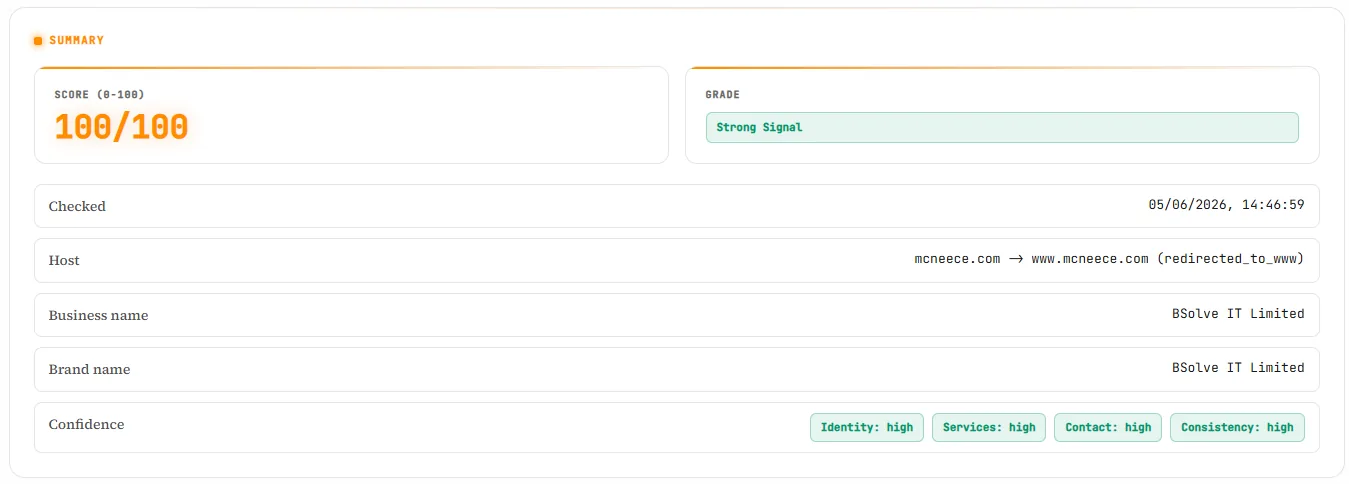
And the files do their job. Running mcneece.com through this checker returns a perfect AI Snapshot, with high confidence on every identity signal:
The plugin generates all 10 files from your WordPress dashboard. Each section has an "Import from my site" button that uses the AI Connectors built into WordPress 7.0 core (added in version 2.0 of the plugin): point it at a page on your own site and the AI reads that page and fills in the details for you to review before saving. For the full method behind this evidence, read our server-log case study.
The window is open, and now is the moment to step through it. AI crawlers already fetch these files every day, yet barely 7% of websites publish any. Add and maintain your AI Discovery Files today and you are established, machine-readable, and accurately understood while the other 93% are still catching up. The cost of being early is small. The cost of being late is being misread.
Common AI visibility problems this checker finds
Most websites fail in the same handful of ways. These are the issues the AI Visibility Checker surfaces most often when it scans a domain, and every one of them is fixable.
No llms.txt at all
The single most common gap. Without it, AI systems have no plain-language summary of who you are or what you do, so they fall back to guessing from scattered page text.
A crawler blocked in robots.txt
A blanket Disallow: / rule or an over-zealous security plugin quietly shuts out GPTBot or ClaudeBot, so those systems never reach your content at all.
Business name differs across files
Your trading name, legal name and contact details disagree between files. AI systems read inconsistency as a trust risk and tend to hedge or leave you out.
No structured identity
identity.json is missing, so there is no authoritative, machine-readable record of your name, services, location and exclusions for AI to cite with confidence.
A stale brand or old trading name
An old company name, former address or retired product still lingers in your AI-facing files, quietly teaching AI systems outdated facts about your business.
A missing or contradictory AI policy
ai.txt says one thing and robots.txt says another. Conflicting permissions leave AI crawlers unsure what they are actually allowed to use.
Recognise one of these on your own site? Our Quick Start guide walks through each fix step by step, or the AI Discovery Files Pack has us research and write all 10 files for you.
Generate AI Discovery Files from your dashboard
Using WordPress? Install the plugin and create all 10 files in minutes. No coding, no configuration files to edit manually.
Get the PluginWhat the AI Visibility Checker does not do
Being clear about the boundaries is part of being trustworthy. The AI Visibility Checker is a checking tool, not a tracking tool.
- It does not guarantee AI mentions. No tool can promise ChatGPT, Gemini, Claude, or Perplexity will name your business. The AI Visibility Checker makes you discoverable and accurately readable; it cannot force a citation.
- It does not measure your share of AI answers. It will not tell you how often AI systems currently mention you versus a competitor. That is brand monitoring, a different discipline.
- It does not replace AI tracking or monitoring tools. If you need to watch outputs over time, pair the AI Visibility Checker with a tracking tool. They are complementary.
- It does not store history. Each check is generated in real time and not retained, so there is no built-in trend line or change log for your domain.
What the AI Visibility Checker does do: verify that your website provides the technical inputs AI systems need to discover, interpret, and cite you accurately. Fix the inputs and the outputs follow.
Worried something is blocking AI crawlers?
The AI Visibility Checker validates the full standard. The 365i AI Crawler Checker is the focused companion: it tests 14 named AI crawlers against your robots.txt and live server responses in seconds, then drafts the exact message to send your host if any are blocked.
Run the AI Crawler Checker