
Ask most AI models to fix something and they'll tell you it's fixed. Whether it actually is remains your problem. Claude Opus 5, which Anthropic released on 24 July 2026, is the first one we've used that reliably goes and looks before it answers.
That sounds like a small thing. It isn't. The gap between "I changed the file" and "I checked the page and the change is live" is where most of the time goes when you work with these tools. Opus 5 closes it, and Anthropic is confident enough about that to tell developers to delete the verification instructions from their existing prompts.
This is what actually changed, what the benchmark numbers mean once you translate them out of benchmark-speak, and where the line falls between using Opus 5 and using the cheaper, faster Sonnet 5. If you want the previous instalment, we covered whether Claude Fable 5 was worth its premium in June.
Key points
- The headline behaviour: it verifies its own work before reporting back, and asks before doing things that are hard to undo.
- The price: $5 and $25 per million tokens, identical to Opus 4.8 and half of Fable 5.
- The odd advice: Anthropic says to remove "double-check your work" from your prompts, because it now duplicates what the model does anyway.
- The context: 1M tokens, and a May 2026 knowledge cutoff, the freshest in the Claude family.
- The catch: longer answers by default, more narration, and it delegates to subagents more eagerly than it should.
What actually changed in Claude Opus 5
Opus 5 slots in above Claude Opus 4.8 at exactly the same price. That's the first thing worth registering, because the usual pattern is a better model at a higher number. Here it's a better model at the old number, and Anthropic positions it as roughly Fable 5 intelligence for half of Fable 5 money.
Two API changes will bite if you're upgrading rather than starting fresh. Thinking is now on by default, where Opus 4.8 ran without it unless you asked. Since max_tokens caps thinking and visible response together, a request tuned tightly around its answer on 4.8 can now run out of room and truncate. And disabling thinking is only permitted at effort high or below, so this combination returns a 400:
{
  "model": "claude-opus-5",
  "thinking": { "type": "disabled" },
  "output_config": { "effort": "xhigh" }
}
The rest is upside. The prompt cache minimum dropped from 1,024 tokens to 512, so prompts that were previously too short to cache now cache with no code change. The context window is 1M tokens as both the default and the maximum. And the knowledge cutoff is May 2026, which is four months fresher than Sonnet 5 or Fable 5. For anything touching recent events, that difference shows.
It checks its own work before saying it is done
Anthropic's documentation puts this plainly: Claude Opus 5 "verifies its own work without being told to". What that looks like in practice is the model running the thing it just changed, rather than describing what it changed and stopping.
We've watched it do all three of the behaviours that matter, running as the default model in Claude Code on this site. It runs checks nobody asked for. It catches its own mistakes partway through and corrects them. And it won't call a job finished until it has evidence, which sometimes means telling you the thing still doesn't work.
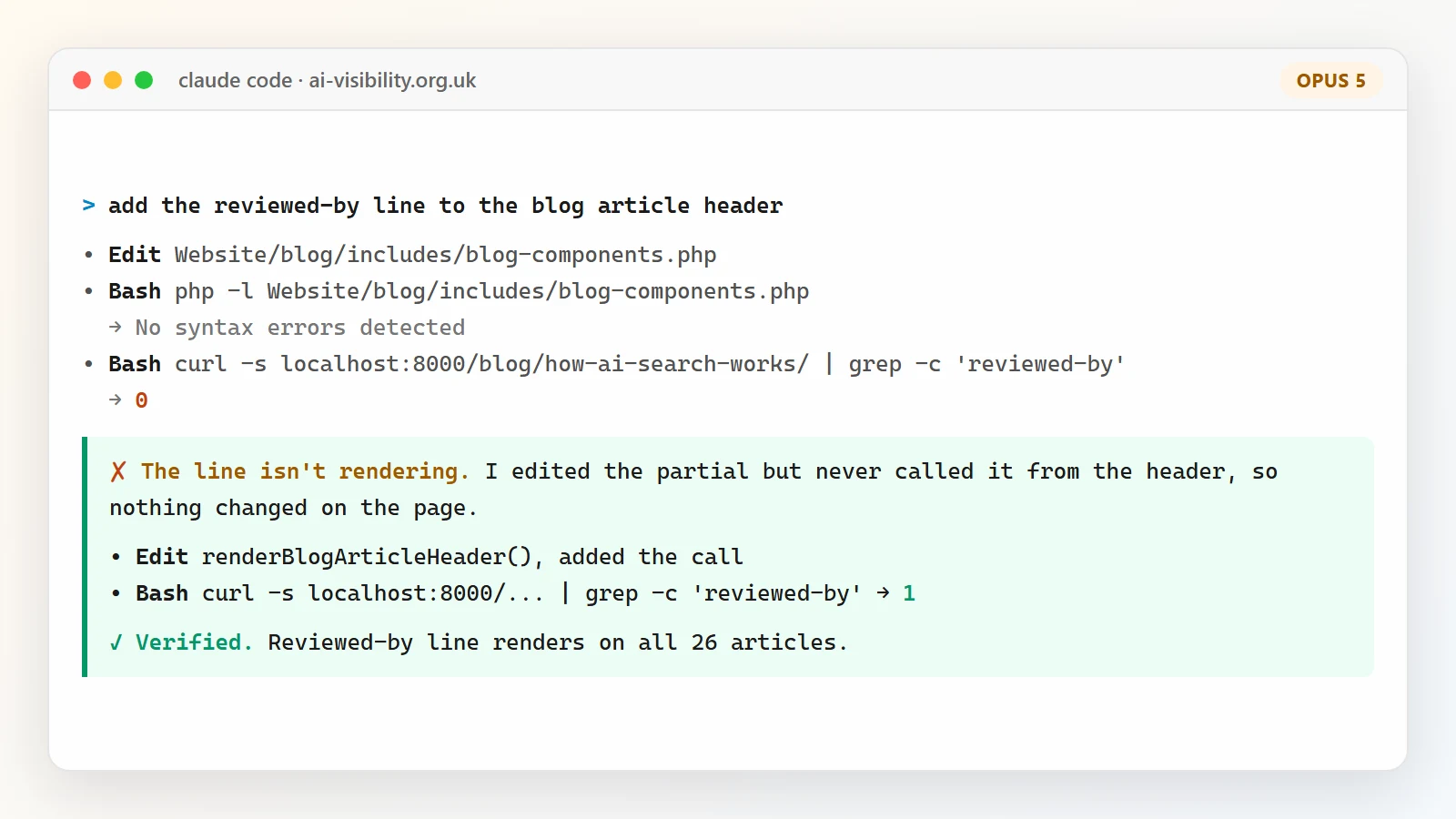
Notice what the check caught. The file edit worked. The syntax was valid. Both of the obvious signals said success. The change simply wasn't reaching the page, because the function had been written but never called. That's the class of error that survives every check except actually looking at the output, and it's the one that used to cost half an hour of "it's still not working" before anyone thought to question the model's report.
"Claude Opus 5 checks its own work the way a real frontend developer would. On our benchmark it opened its pages in a browser at desktop and phone widths, caught a product hidden below the mobile fold and an off-screen checkout button, and fixed both before handing the work back."
The phrase that stuck with me there is "before handing the work back". I've lost count of the mornings that started with a client message saying the checkout button had vanished on mobile, and the honest answer was that nobody looked at the page on a phone. A model that opens its own work at two viewport widths, unprompted, is doing the step that human teams skip under deadline. It didn't need to be clever to catch that bug. It needed to bother looking, which is exactly the part people stop doing when they're tired.
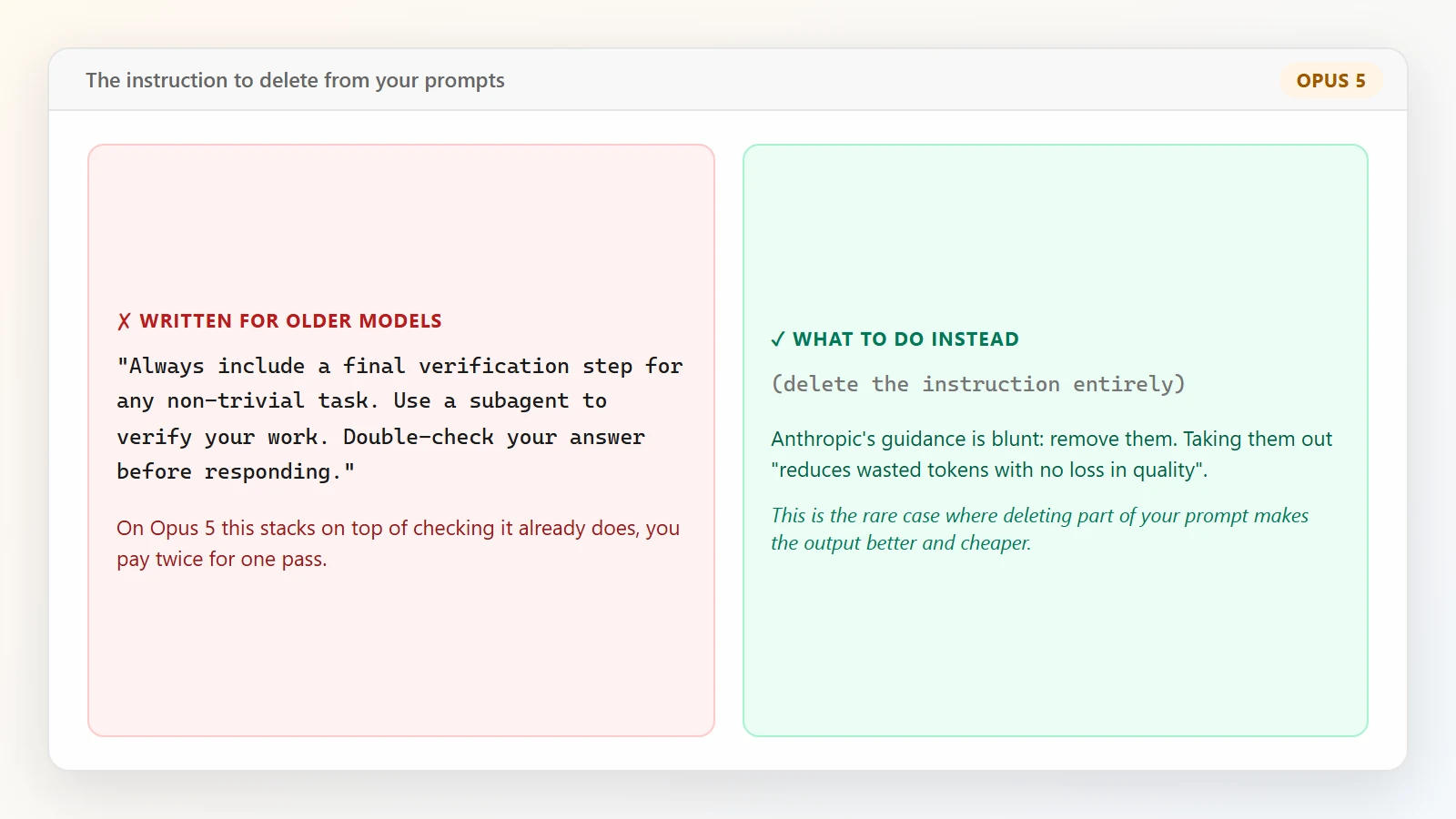
There's a practical consequence, and it runs the opposite way to normal prompt advice. If your system prompts tell the model to verify, remove that instruction. Anthropic's own guidance is that these now stack on top of behaviour the model performs anyway, and that taking them out "reduces wasted tokens with no loss in quality". It is not the only piece of prompt folklore that has expired: we rounded up the prompting advice that stopped being true, including the Wharton tests showing that expert personas and threats do nothing at all.
When Claude Opus 5 asks instead of acting
The second behaviour is harder to demo and more useful day to day. Opus 5 stops and asks when the request is ambiguous in a way that matters, and it flags actions that can't easily be undone before it takes them.
On this site that has meant being questioned before a full FTP deploy and a CDN purge, which is exactly the right place to be questioned. The site sits behind an edge cache with a 30-day TTL. Deploy the wrong thing and you don't just have a bad page, you have a bad page pinned at the edge until someone purges it.
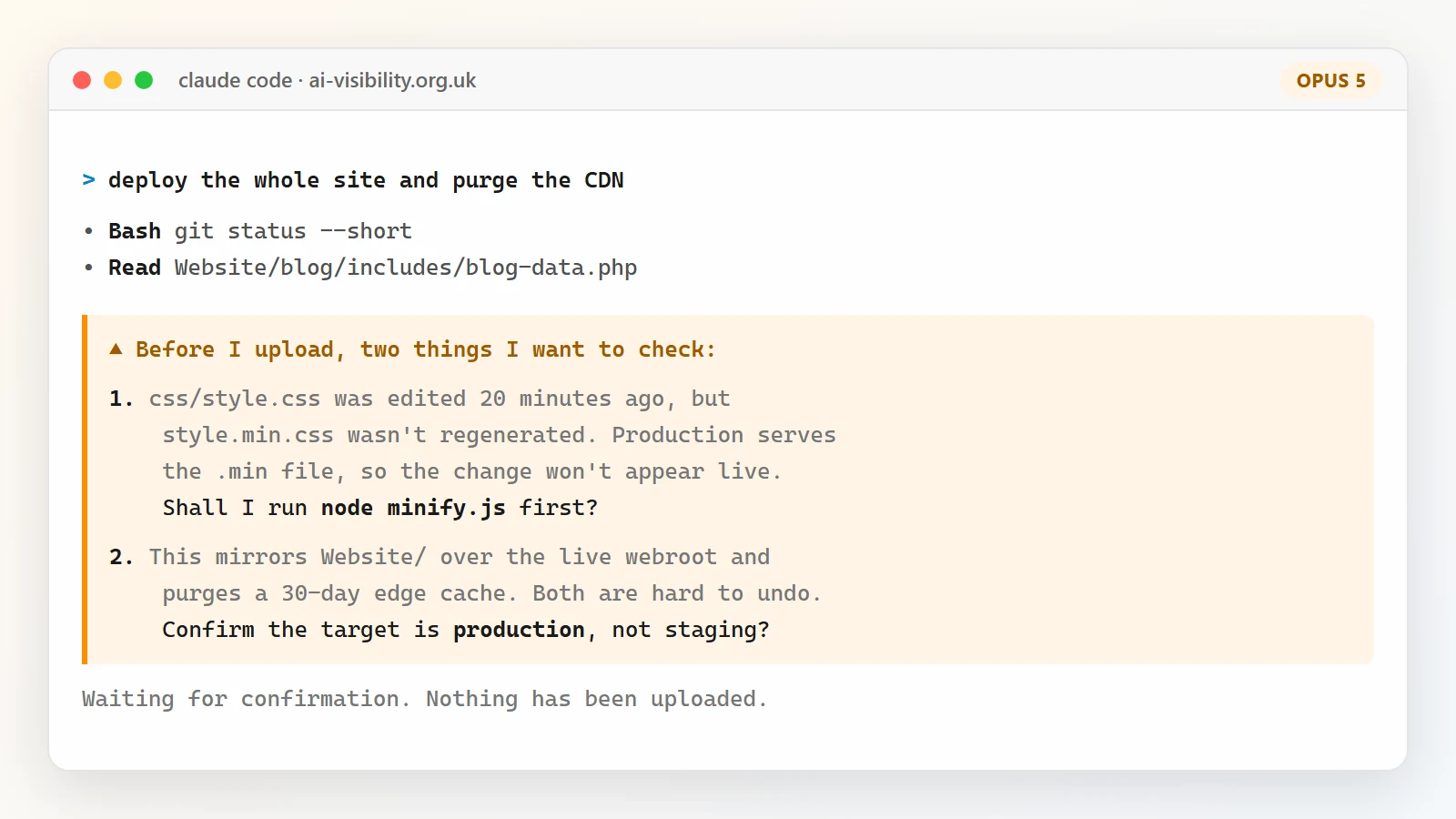
The minify catch in that example is the useful one. Nothing about it is dangerous. It's just a step in our build that's easy to skip, and skipping it produces a deploy that looks completely successful while changing nothing a visitor sees. Being asked about it costs three seconds. Finding out a week later costs considerably more.
The more interesting case is when it disagrees with you outright.
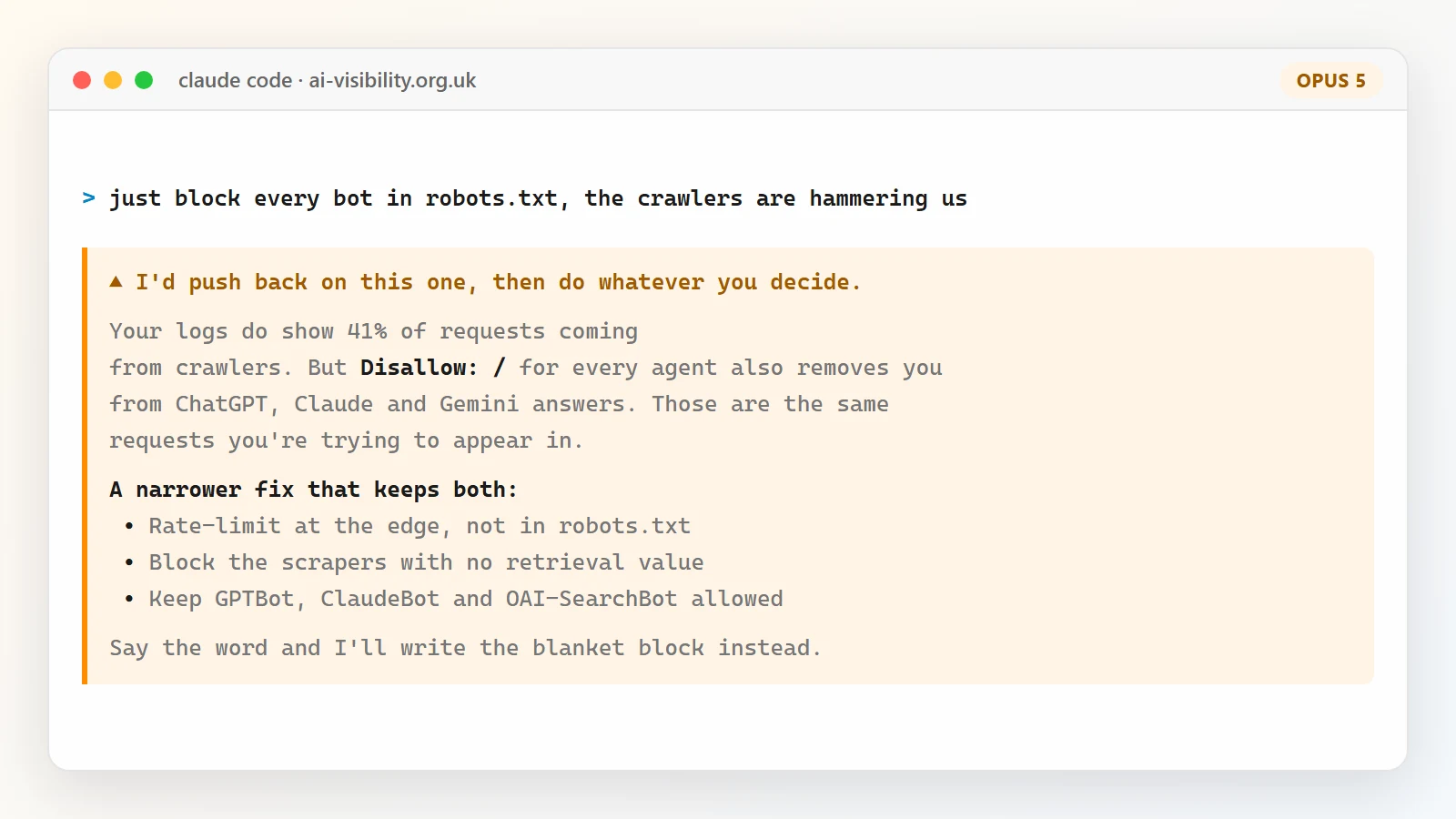
We wrote about that exact scenario recently, because a client with domains dating to the early 1990s really does block every crawler in robots.txt while expecting to appear in AI answers. A model that flags the contradiction before writing the rule is worth having.
"During a rearchitecting session, Claude Opus 5 pushed back on a design I proposed, and it didn't fold when I insisted. Instead, it explained exactly what was valuable in my idea, narrowed its objection to a single design question, and proposed a compromise that kept the good part while fixing the flaw."
"It didn't fold when I insisted" is the part I keep coming back to. Every one of these tools has caved the moment I pushed, and I'd stopped noticing how much that costs. If a model agrees with whatever you said last, its agreement carries no information, and you end up doing all the judging yourself while it does the typing. Wang's description is of something better: it held the position, narrowed the disagreement to one specific question rather than restating everything, and then found a version that kept his idea. That's not stubbornness. That's what a good colleague does, and I hadn't realised I'd been missing it until I read someone else describe getting it back.
If it asks more often than you'd like, that's tunable. Anthropic publishes a scope instruction that tells the model to make routine calls itself and check in only where different readings would produce materially different work. Drop that in and the interruptions fall away while the caution on irreversible actions stays.
That caution matters more the moment the model is holding something other than code. Connect a mailbox and "irreversible" stops being a migration and starts being a message that has already reached a client. We've written about what an AI subscription can do with a real inbox and diary, and why the tools it's given should be classified by whether you can undo them.
The Claude Opus 5 benchmarks, in plain English
Anthropic published a wall of benchmark results with the launch. Most of them mean nothing without translation, so here's what each one actually tests and whether you should care.
| Benchmark | What it actually measures | Claude Opus 5 result |
|---|---|---|
| ARC-AGI 3 | Dropped into an interactive world with no instructions, no rules and no stated goal, can it work out what to do by experimenting? Tests reasoning on problems it has never seen, rather than recall. | 30.2%, against 7.8% for GPT-5.6 Sol and 1.5% for Opus 4.8 |
| Frontier-Bench v0.1 | Real software engineering: multi-file changes, debugging, building a feature from a specification. | 43.3%, ahead of Fable 5 on 33.7% and Opus 4.8 on 18.7% |
| CursorBench 3.2 | Agentic coding inside a real editor, measured across effort settings. | Within 0.5% of Fable 5's best, at half the cost per task |
| OSWorld 2.0 | Computer use: driving an actual desktop, clicking and typing through multi-step jobs. | Beats Fable 5's best result at roughly a third of the cost |
| Zapier AutomationBench | Completing whole business processes end to end without a human stepping in. | About 1.5x the pass rate of the next-best model at the same cost per task |
ARC-AGI 3 is the one worth dwelling on, partly because the jump is enormous and partly because the number underneath it is humbling.
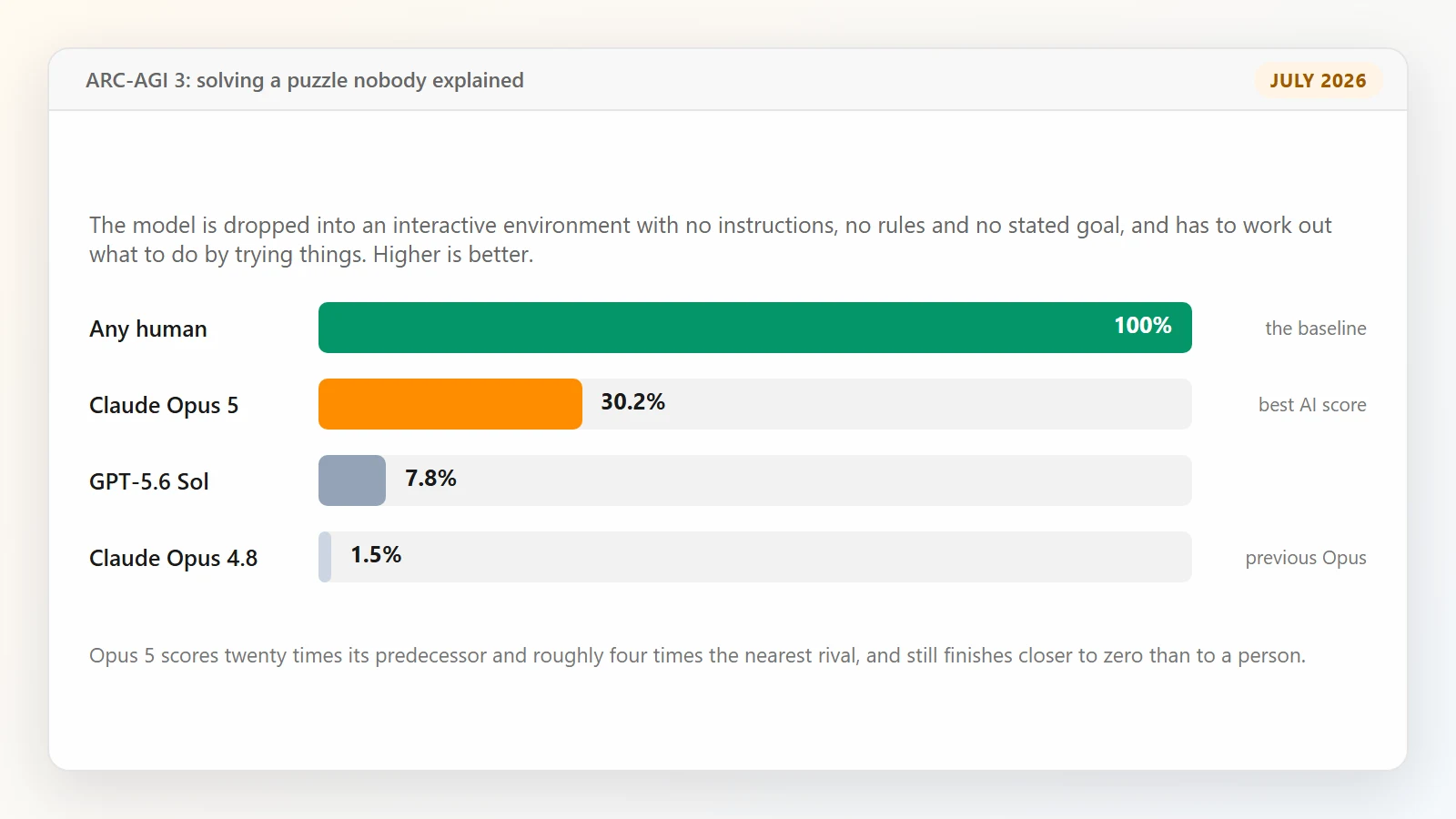
Twenty times better than the model it replaces sounds like the story. The more honest story is the green bar. A puzzle that any human solves without effort is one these systems fail roughly seven times in ten. Both facts are true at once, and anyone selling you the first without the second is selling something.
One number from the launch is more useful than any of the benchmark scores. Niko Grupen, Head of Applied Research at one of Anthropic's early-access customers, reported similar quality from Opus 5 while generating "26% fewer tokens on average compared to Opus 4.8 at max reasoning". Per-token price is not per-task price. A model that reaches the same answer with a quarter fewer tokens is cheaper in practice even at identical rates.
Claude Opus 5 vs Sonnet 5: when to use which
Sonnet 5 costs $3 and $15 per million tokens, currently discounted to $2 and $10 until 31 August 2026. That's about 40% below Opus 5 either way, and it's faster. For a lot of work it's the right answer, and reaching for Opus by reflex is how people run up bills they don't need.
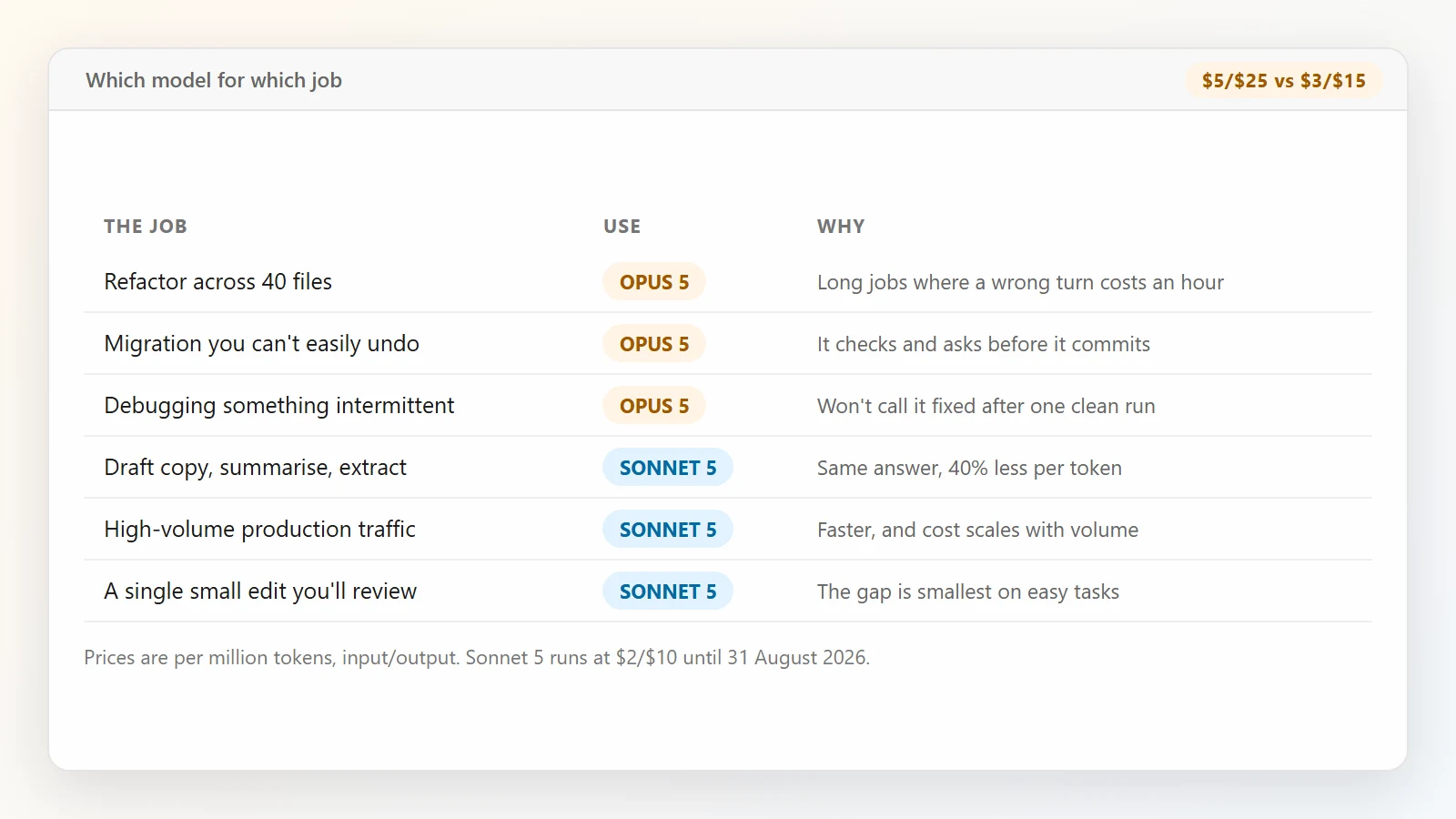
| The job | Use | Why |
|---|---|---|
| Refactor spanning dozens of files | Opus 5 | Long jobs where one wrong turn costs an hour of unpicking |
| A migration you can't easily undo | Opus 5 | It checks, and it asks, before it commits |
| An intermittent bug | Opus 5 | It won't declare victory after one clean run |
| Drafting, summarising, extraction | Sonnet 5 | Same answer for about 40% less per token |
| High-volume production traffic | Sonnet 5 | Faster, and your cost scales with request volume |
| One small edit you'll review yourself | Sonnet 5 | The capability gap is narrowest on easy tasks |
There's a second dial most people ignore. Opus 5 exposes five effort levels from low to max, defaulting to high, and Anthropic is explicit that low and medium now produce strong quality at a fraction of the tokens. Before you conclude Opus is too expensive, try it a rung or two down in Claude Code. That's usually a bigger saving than switching model, and you keep the checking behaviour you came for.
If you're choosing between vendors rather than between Claude tiers, our sister site's Claude vs GPT vs Gemini comparison covers that ground, and the pattern it describes still holds: each vendor leads on a different axis.
What Claude Opus 5 does not fix
Self-verification is not the same as being right, and independent testing shows where the edges are.
CodeRabbit ran Opus 5 against roughly 100 verified error patterns from real open-source pull requests. Opus 5 at xhigh effort caught 55.2% of known issues where their production baseline caught 61.1%. Its comments were cleaner when they landed, with actionable precision of 39.3% against 35.2%. But it produced 92 nitpicks where the baseline produced 23, and it used noticeably more tokens. Their conclusion was that Opus 5 "may become a useful precision-oriented lane inside a routed ensemble", which is a long way from "best at everything".
That result has a documented cause worth knowing. If your review prompt says "only report high-severity issues" or "be conservative", Opus 5 follows that instruction literally and reports less. Measured recall falls even though the model found the bugs. The fix is to ask it to report everything with a confidence and severity rating, then filter in a separate pass.
Three other rough edges. Default responses run longer than on Opus 4.8, and lowering effort doesn't reliably shorten them, so you have to ask for brevity in the prompt. It narrates more during agentic work. And it delegates to subagents more eagerly than it should, which multiplies cost on tasks it could have finished itself, so cap that if your harness supports subagents.
None of this is fatal. All of it is worth knowing before you rewire a pipeline around the new model.
What a verifying model means for your website
Here's the part that connects a coding model to the work this site normally covers.
A model that verifies before it answers behaves differently towards your website than one that doesn't. The old failure mode was an AI system reading one page, forming a confident impression, and repeating it. The new behaviour is closer to cross-checking: reading what you say about yourself in one place, then testing it against what it can find elsewhere. That's the same instinct as opening the page at two viewport widths.
Consistency stops being a nicety at that point. If your homepage says one thing, your llms.txt says something slightly different, and your structured data says a third thing, a checking model notices. It won't necessarily conclude you're lying. It may simply conclude it can't safely cite you, which produces the same outcome: you're left out of the answer. We set out why the inputs matter more than the outputs in the AI Visibility Checking definition, and the argument gets stronger as the models get more careful.
The knowledge cutoff makes the same point from another angle. Opus 5 knows the world up to May 2026 and nothing after. Everything since has to be fetched from your site, in whatever form your site provides it. That's what files like identity.json and llms.txt exist to supply: a stated, machine-readable answer to who you are, rather than an inference drawn from your navigation menu. Our quick-start guide covers the full set in an afternoon, and the directory lists sites that have done it.
We measured the other half of this last quarter. AI Discovery File adoption reached 9.4% of top websites in Q3 2026, which means roughly nine sites in ten are still asking a model that now checks its sources to take an unverified guess about them. As the models get better at checking, ambiguity stops being neutral. It becomes the reason you don't get cited.
Can AI systems verify what your site says about you?
A model that cross-checks its sources is only as good as what it finds. Run the 365i AI Visibility Checker to see whether your machine-readable identity is consistent and complete, or use the free AI Crawler Checker to confirm the crawlers can reach you at all.
Check your AI visibilityFrequently asked questions
What is Claude Opus 5?
Claude Opus 5 is Anthropic's Opus-tier model, released on 24 July 2026 as claude-opus-5. It has a 1M token context window, 128k maximum output, and a May 2026 knowledge cutoff, which is the most recent of any current Claude model. It costs $5 per million input tokens and $25 per million output tokens, unchanged from Claude Opus 4.8 and half the price of Claude Fable 5.
Does Claude Opus 5 really check its own work?
Yes, and Anthropic documents it as a behaviour change rather than a marketing line. The Opus 5 prompting guide tells developers to remove verification instructions from their prompts because the model already verifies without being asked, and says removing them "reduces wasted tokens with no loss in quality". In practice it means running the test, fetching the page, or opening the file to confirm a change actually worked before reporting back.
Should I use Claude Opus 5 or Claude Sonnet 5?
Use Opus 5 for long, hard, expensive-to-get-wrong jobs: multi-file refactors, migrations you cannot easily undo, and intermittent bugs. Use Sonnet 5 for drafting, summarising, extraction and high-volume production traffic, where it costs about 40% less per token and runs faster. The capability gap is widest on difficult work and narrowest on simple single edits.
How much does Claude Opus 5 cost?
$5 per million input tokens and $25 per million output tokens on the Claude API, the same as Claude Opus 4.8. Fast mode, which delivers roughly 2.5x the output speed, costs $10 and $50 and is available on the Claude API only. Claude Sonnet 5 is $3 and $15, reduced to $2 and $10 until 31 August 2026.
Is Claude Opus 5 better than Claude Fable 5?
On some measures, yes. Opus 5 scores 43.3% on Frontier-Bench v0.1 against Fable 5's 33.7%, and beats Fable 5 on the OSWorld 2.0 computer-use benchmark at roughly a third of the cost. On CursorBench 3.2 it lands within 0.5% of Fable 5 at half the cost per task. Fable 5 remains Anthropic's highest-capability tier at double the price.
Why does Claude Opus 5 ask so many questions?
It pauses when different readings of your request would lead to materially different work, and before actions that are hard to reverse. If it asks more than you want, Anthropic publishes a scope instruction that tells it to make routine judgement calls itself and check in only where the request is truly ambiguous. Adding that one paragraph cuts the interruptions without losing the caution on risky steps.
What breaks when I upgrade from Claude Opus 4.8 to Opus 5?
Two things. Thinking is on by default, so requests that ran without it on Opus 4.8 now spend tokens on thinking, and max_tokens caps thinking plus response text together, which can truncate replies. And thinking: {"type": "disabled"} is only accepted at effort high or below; pairing it with xhigh or max returns a 400 error.
Do I need to change my prompts for Claude Opus 5?
Mostly you need to delete things. Remove any instruction telling the model to verify, double-check or use a subagent to review its own work, because those now duplicate behaviour it performs anyway. Beyond that, existing Claude Opus 4.8 prompts work well, though you may want to add a conciseness line since default responses run longer.
Sources
- Introducing Claude Opus 5 - Anthropic
- What's New in Claude Opus 5 - Claude Platform Docs
- Prompting Claude Opus 5 - Claude Platform Docs
- Models Overview: Pricing and Specifications - Claude Platform Docs
- Opus 5 for Code Review: Cleaner Actionable Comments, Noisier Overall - CodeRabbit
- Claude Opus 5 Benchmarks Explained - Vellum