
A week later: the phone is ringing
A week ago we published the cold-test results for Lockerfella. A three-week-old locksmith site in a south Staffordshire village had taken the top recommendation slot on both ChatGPT and Gemini for "brewood locksmith", with zero backlinks, no Google authority, and a brand the AI engines had never seen before. We described what we measured. We linked to the screenshots. The full breakdown is in the original Lockerfella case study.
Then the phone started ringing. Sean Hamilton, the actual locksmith, sat down with us a few days later. Not for another technical breakdown, but to talk about what the experience felt like from his side. He had never heard of AI Discovery Files when the build started. He didn't ask for schema markup. He didn't write a brief that mentioned ChatGPT. He asked, in his words, for a website that "looked proper". What he got was AI Visibility he didn't know he needed, and a phone that fills up before backlinks exist.
This article is about that gap. The gap between what small business owners can sensibly brief and what a serious build in 2026 actually has to deliver. It's evergreen because the gap will be there for a while, and Lockerfella is the cleanest worked example we have. If you run a small business, want to be visible in AI search, and don't know what to ask for, this is the playbook.
What owners actually ask for, and what they get
Sean's brief, in his own words: "I wanted it to look proper. Not a call centre. Not one of those national locksmith sites pretending to be local. Just me. One man, one van, one phone number."
That is a complete brief from the owner's side. It says everything that matters about positioning, identity, and trust. It says nothing about the dozen technical layers that have to be right for a website to be findable, parseable, and citable in 2026. That asymmetry is the thing.
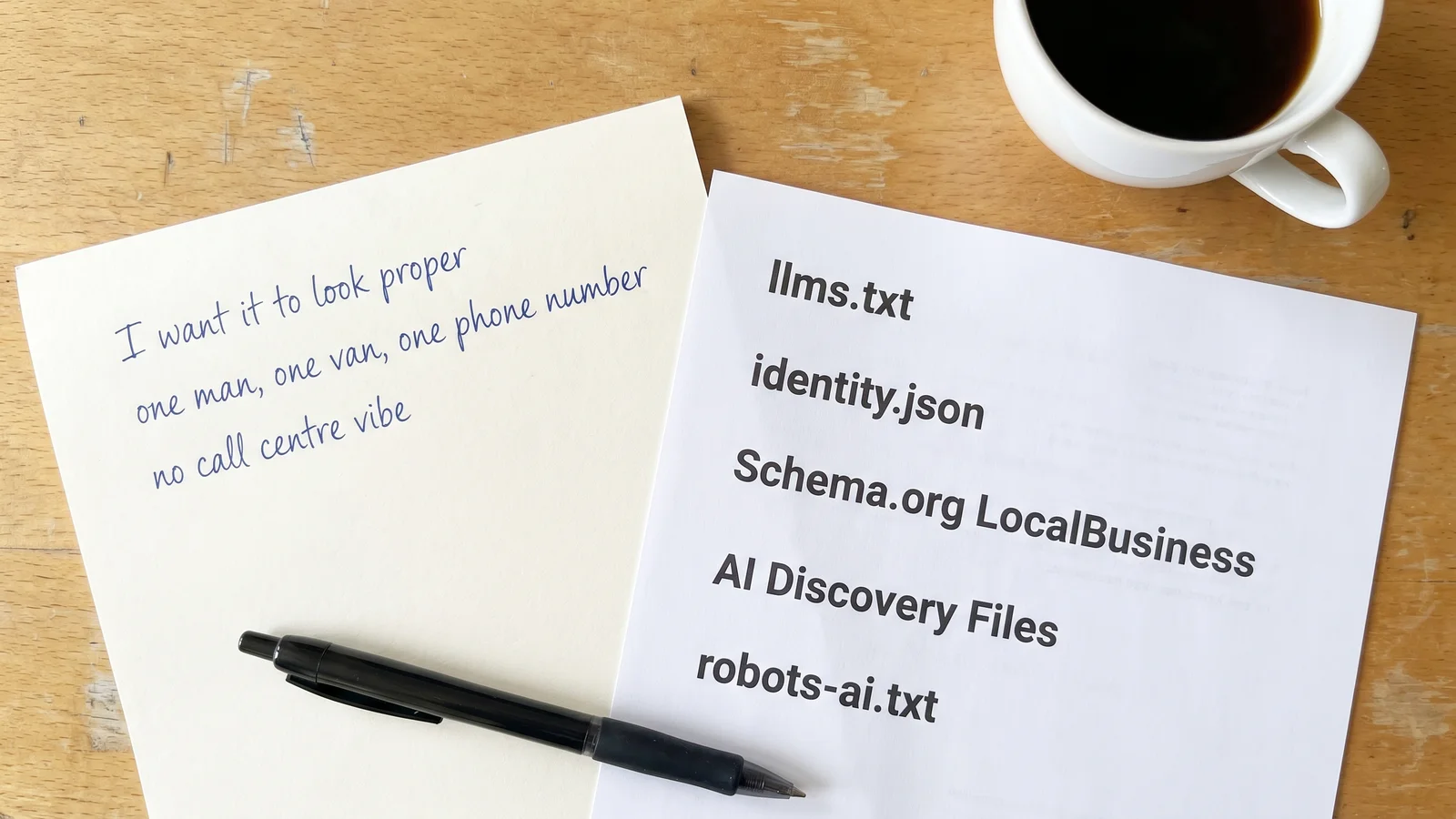
An owner-side brief that strong should produce a build that handles every technical layer underneath it. Identity clarity in machine-readable form. Schema that matches the visible content. AI Discovery Files declared at the root. Crawler access for the right AI bots and refusal for the rest. None of that should appear on the owner's brief, because none of it is the owner's job to know about.
The mistake most small business websites make is treating that asymmetry as a feature rather than a bug. The brief comes in plain-English. The build is delivered in plain-English. And nothing happens underneath that connects the brief to the way AI systems actually decide who to recommend. Lockerfella shows the opposite is achievable on any budget. The owner brief stays plain. The technical layers get done anyway.
Identity clarity is the cheapest AI-readable signal a sole trader can give
"One man, one van, one phone number" sounds like a marketing line. It isn't. For a sole trader, it's the cleanest AI-readable signal available, and it costs nothing to give. AI engines retrieve from sources that are accessible, machine-readable, and consistent. A business with one identity is a business an AI engine can describe without hedging. A business with three trading names, two phone numbers, and a website that talks about "our team" while the Google Business Profile says "owner-operator" is a business an AI engine has to pick a story about, and will often pick the wrong one.
Lockerfella's identity.json, llms.txt, schema markup, and visible website copy all say the same thing. Sean Hamilton. ST19. One person. One phone number. Brewood and the surrounding villages. No call centre. The single source of truth runs from the machine-readable layer to the human-readable layer with no contradictions. When ChatGPT pulls a recommendation for "brewood locksmith", every layer it checks confirms the same identity, and the AI's confidence in citing the brand goes up accordingly.
"Does your content clearly demonstrate first-hand expertise and a depth of knowledge (for example, expertise that comes from having actually used a product or service, or visiting a place)?"
Google Search Central, in Creating helpful, reliable, people-first content (verify quote at source)
The first time I read this question I treated it as a hint about author bios. Read it again after the Lockerfella result and it lands differently. Google isn't asking whether the byline mentions an expert. It's asking whether the words on the page could only have been written by someone who has been there. For Sean's Brewood page, the answer is obviously yes. For the templated competitor pages he was outranking, the answer is obviously no. The same test the search quality raters apply is the test the AI engines are increasingly applying too. A sole trader who actually lives in the area gets full marks on it for free. A national chain pretending to be local fails it before the AI even reads the schema.
The strategic takeaway for any small business: don't dilute the identity to look bigger. The dilution is the problem. AI engines reward businesses that are exactly one thing. Your "scrappy" weakness is also your AI-visible strength.
Honesty as a trust signal AI can read
Sean again: "A lot of websites do that, don't they? 'Our team of specialists', 'our expert engineers', all that stuff. But if it's one bloke in a van, people find out eventually. I'd rather they know straight away."
That instinct is also good AI Visibility practice, and most owners do not know it. AI engines flag inconsistency. A page that talks about "our team of specialists" but lists one phone number, one address, one named person, and one van photo is a page the AI either has to pick a side on (and may pick the embarrassing one) or has to discount entirely. Either way, the engine's confidence in citing the brand drops. The "look bigger than you are" reflex, which agencies have been talking owners into for years, is now an active liability in AI search.
The Lockerfella site states the things a small business is sometimes shy about. Sole trader. No call centre. No call-out fee. Quote-on-the-phone before the van moves. DBS checked. Insured. A 12-month workmanship guarantee that will be honoured by the same person who turned the key. None of that is decorative. Each line is an independent fact an AI engine can corroborate against the rest of the site, the schema, and the owner's behaviour on calls. They reinforce each other. They give the AI a clean, consistent story to retell.
For a small business that is, in fact, one person or a small team, the most counterintuitive AI Visibility move is the most freeing one: lean into the truth of the operation, name the limits, name the owner, name the area, name the price. The AI rewards what the customer rewards. They've always rewarded the same thing. The AI just makes it cheaper for the customer to find.
Discovery questions make the non-commodity content
Sean's third notable line: "I just thought, 'Mark's asking a lot of questions.'"
The questions were the build, in a sense. Asking a working locksmith about the housing stock in Brewood, the lock failures common in Codsall, the gearbox patterns on the School Road estates, and the difference between Stafford and Cannock callouts is what produced the area pages that AI engines now cite. Without the questions, the area pages would have been the same templated paragraphs every locksmith site has, and the AI would have cited someone else.
The Telford page is what one good answer looks like once it reaches the page. Sean's point was that Telford is the one town on his patch where the usual lock advice inverts: it was designated a New Town in 1968, the housing is modern, and the mortice-lock conversation that fills his Stafford days barely comes up. What he gets called to instead are euro cylinders and multi-point gearboxes, in clusters, because the estates went up together and the uPVC doors were retrofitted together, so the gearboxes are failing together too. That is roughly four sentences from a man in a van. It is also something no competitor can lift, no template can generate, and an AI can quote with confidence. The whole discovery process is a search for those four sentences per town.
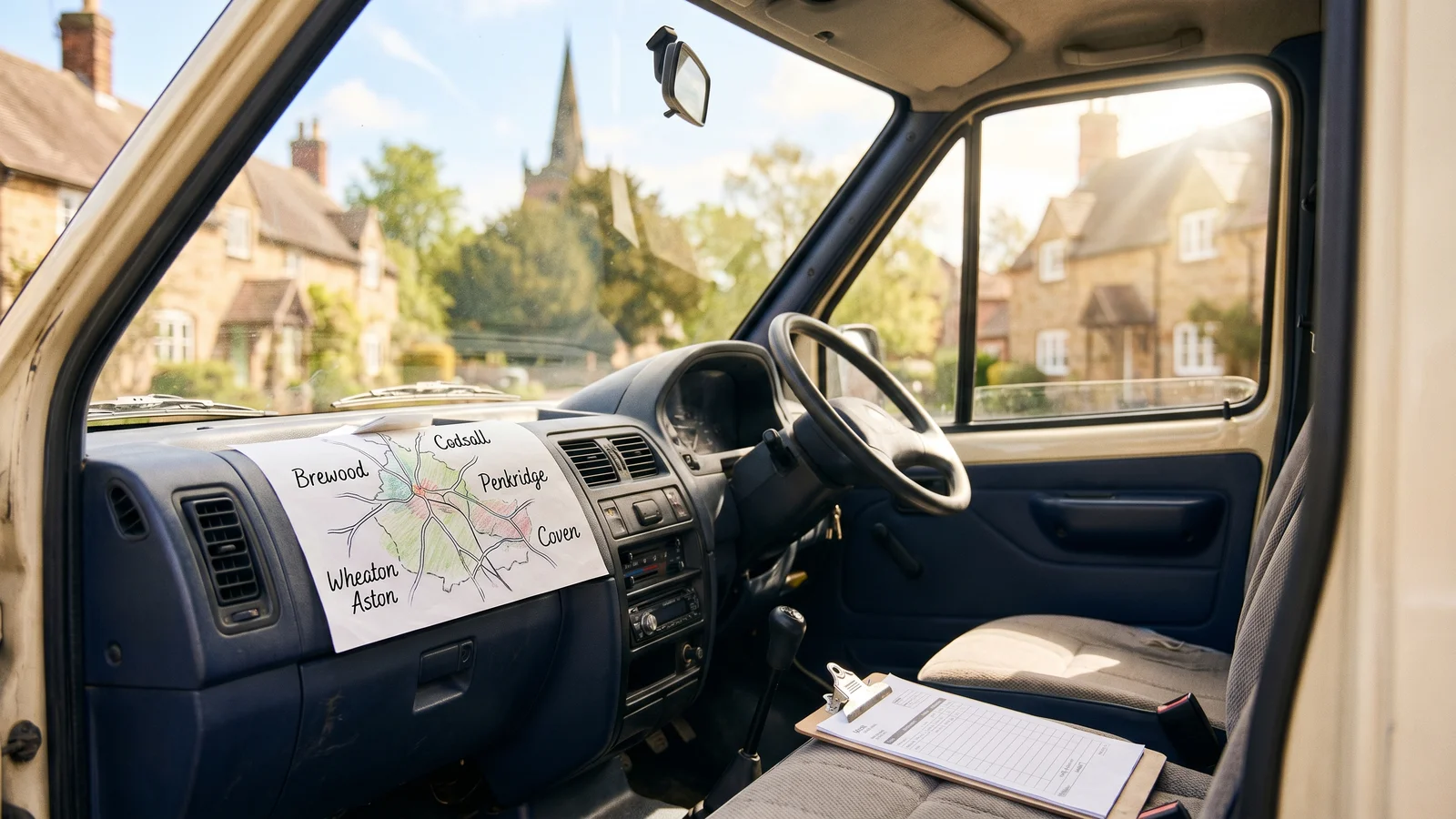
This is the part of AI Visibility that no plugin can deliver. The technical layers are commodity. The local-knowledge content is not. A small business owner who can describe, in concrete detail, what they actually see on the job is sitting on the most defensible AI ranking signal there is. The job of a serious build is to mine that knowledge through structured discovery and put it on the page in a form the AI can quote.
"Target and focus more on answering the long tail queries of your users."
Aleyda Solis, International SEO consultant, in SEO in 2025: Focus on the long tail, Majestic (verify quote at source)
I read this in late 2025 and noted it as decent advice. After the Lockerfella result it reads as the strategic key. "Brewood locksmith" is a long-tail query by definition: a small village, a niche service, a customer with a stressed, immediate intent. Long-tail queries are exactly where AI engines have to dig deeper than the established head-term winners and pick from whoever is most clearly the right answer. For small local businesses, this is hugely freeing. You don't have to outrank a national chain on a generic head term. You have to be the obvious answer when someone types your village name plus your service. AI Visibility is what makes you the obvious answer.
The shift this implies for every small business: stop trying to write content for "locksmith" or "plumber" or "accountant". Start writing it for "locksmith in [village]" or "uPVC door won't lock [town]" or "mortice lock upgrade [postcode area]". That is the territory AI engines are actively sourcing from, and it is territory a real local operator owns by definition.
What AI Visibility actually delivers in human terms
From the owner's chair, AI Visibility looks like the phone ringing earlier than it should. Sean's exact response when we told him the AIs were citing him within three weeks of launch: "Already? More than surprised me. I was buzzing." That single word, "buzzing", is what AI Visibility actually delivers. Not better technical scores. Not more impressions in a dashboard. The phone ringing, in the real van, before the slow signals (backlinks, reviews, Google Business Profile verification) have had time to compound.
You can verify the technical side independently. Lockerfella's profile in the public AI Visibility Directory scores 10 out of 10, with all ten AI Discovery Files present and validated. That's not a self-reported figure or an internal audit; it's a live, deterministic check anyone can re-run. The same checker is open to any site that wants to submit, and the same approach scales beyond a sole trader: we ran the numbers on a Complete-conformance removals firm in how a local removals firm scored a perfect 10/10 for AI visibility.
For a small business, that compression of the timeline is the value. Traditional local SEO assumes a six-to-eighteen-month runway: build, index, earn citations, accumulate reviews, climb the map pack, eventually be visible enough to rely on. AI Visibility runs in parallel and runs much faster. A three-week-old domain can be the top recommendation in ChatGPT for a long-tail query while the Google Business Profile is still in the verification queue. That isn't a temporary anomaly. It's a structural property of how AI engines retrieve, and it's only going to be more relevant as more searches happen inside AI assistants rather than on Google.
The other thing AI Visibility delivers, less obviously, is a website that is harder to copy. The technical files are open. The schema vocabulary is public. Anyone can implement them tomorrow. What can't be copied is the local-knowledge content that the discovery process produced, because that content is keyed to one real person's experience of one real place. A competitor can clone the structure. They can't clone the streets, the lock types, the response times, or the pricing approach without also being there and doing the work. AI engines can tell the difference. Customers can too.
Five questions every small business owner should ask their builder
The single biggest lever a small business owner has is the conversation at the start of a build. The right five questions force a builder to either include AI Visibility from day one or admit they don't know how. Either answer is useful.
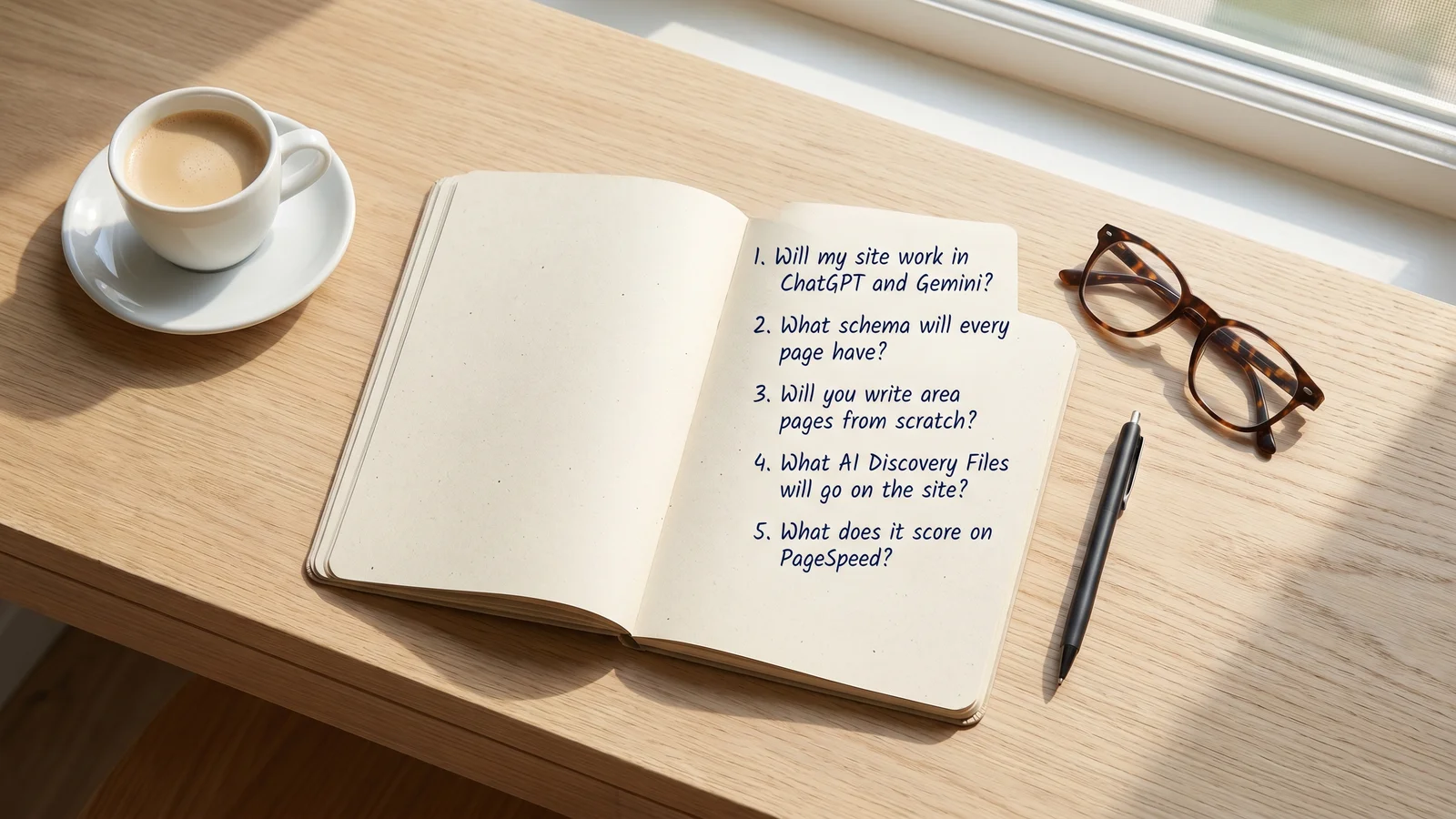
1. "Will my site work in ChatGPT and Gemini?" The right answer is yes, with a description of what makes it work: AI Discovery Files, structured data, and crawler access. The wrong answer is "we focus on Google" or "AI is too new". Both signal a build pattern that won't ship the AI layer.
2. "What schema will every page have?" The right answer names the schema types per page (LocalBusiness on the homepage, Service on services, FAQPage on FAQs, BreadcrumbList everywhere) and confirms it'll be validated against Google's Rich Results Test before launch. The wrong answer is "schema is a hint" or "we add it on key pages". On Lockerfella, every page has it.
3. "Will you write the area pages from scratch?" The right answer is yes, with discovery questions, based on real local knowledge from the owner. The wrong answer is "we'll template them and swap the town name". A templated area page is worse than no area page in 2026. AI engines have nothing distinct to cite, and Google's quality systems may flag the pages as doorway content.
4. "What AI Discovery Files will go on the site?" The right answer names them: llms.txt at minimum, ideally the full suite (identity.json, ai.txt, brand.txt, faq-ai.txt, robots-ai.txt and the rest). The wrong answer is "what files?", which means the build will not ship them, and the owner will need a separate retrofit later.
5. "What does it score on mobile PageSpeed?" The right answer is a target in the high 90s, with a confirmation that the build is lean enough to hit it. Lockerfella's hand-coded build hits a clean 100/100/100/100. A tuned WordPress build can hit the high 90s. Anything in the 60s or 70s is a signal the build is bloated, which compounds every other AI Visibility weakness because slow sites are read as low-effort by AI engines.
None of these questions require an owner to be technical. They require the owner to be willing to ask, and willing to redirect the conversation if the answers are vague. A serious builder welcomes the questions. A defensive one fails the conversation, which is itself the most useful answer the owner could get.
Find out which AI Discovery Files your site is missing
The free AI Visibility Checker runs the same audit we used on Lockerfella. AI Discovery Files, schema coverage, identity consistency, crawler access. Deterministic, no AI guessing, finished in under a minute.
Check your siteFrequently asked questions
What does AI Visibility actually do for a small business?
AI Visibility makes a small business legible to AI systems like ChatGPT, Gemini, and Perplexity, so it can be cited and recommended when someone asks one of those tools for help. For Lockerfella, that produced top-of-answer recommendations on ChatGPT and Gemini for "Brewood Locksmith" within three weeks of launch, with no backlinks and no Google domain authority. The mechanism is machine-readable identity (AI Discovery Files), structured data, and content written from real first-hand knowledge.
Do I need to ask my web designer for AI Visibility specifically?
You shouldn't have to. A serious build in 2026 should include AI Visibility by default, the same way it includes basic SEO. If your designer treats AI Visibility as a future problem or an upsell, that is a signal to ask harder questions about how the rest of the site is being built. The five-question checklist later in this post is a useful gauge.
Can a brand new website really appear in ChatGPT before it has any backlinks?
Yes. AI assistants don't use Google's backlink-driven authority graph to decide who to recommend for a local query. They retrieve from sources that are accessible, machine-readable, and consistent. Lockerfella did this in three weeks. The mechanism is well covered in how AI search actually works.
What are AI Discovery Files and how many do I need?
AI Discovery Files are a set of plain-text and JSON files (llms.txt, identity.json, ai.txt and others) that declare a site's identity, services, and crawler permissions in a format AI systems can read directly. The full specification defines 10. Lockerfella shipped with all 10 from day one. The Quick Start guide covers the priority order if you're retrofitting.
My website builder has never heard of AI Discovery Files. Is that a red flag?
It's a calibration question rather than a red flag. Most builders haven't heard of them yet, the way most builders hadn't heard of structured data ten years ago. The right reaction is curiosity. If a builder is dismissive ("not relevant for small business", "wait and see"), that is a stronger signal because the build will reflect that posture across every layer of the site.
Will AI Visibility help if my website content is generic?
Not much. AI engines pull specific phrases out of pages to back up specific recommendations. Generic content gives them nothing to cite. The Lockerfella result was driven as much by hyper-local, first-hand area pages as it was by the technical files. Non-commodity content is the part most local-services sites still skip.
How long does AI Visibility take to start working?
For a brand-new domain in a non-saturated category, days to weeks. Lockerfella was visible in ChatGPT and Gemini within three weeks of launch. For a retrofit on an existing site, it depends on how often the AI engines re-crawl. The technical work (files, schema, identity consistency) is quick; the content work (writing pages from real local knowledge) is the slower, more important investment.
Can I check whether my own site is AI-visible?
Yes. The free AI Visibility Checker runs the same audit we use during builds: AI Discovery Files, schema coverage, identity consistency, and crawler access. It's deterministic, finishes in under a minute, and reports exactly which files are present, which are missing, and where the gaps are.
Sources
- Lockerfella Locksmiths (the case study site)
- Lockerfella profile in the AI Visibility Directory (10/10 score)
- Lockerfella llms.txt (live)
- Sean Hamilton: The Full Lockerfella Interview - 365i Web Design
- Lockerfella locksmith website case study - 365i Web Design
- Lockerfella in AI Search, 10 days after launch - Press Forge
- 100 mobile PageSpeed at launch: the Lockerfella case study - 365i
- Creating helpful, reliable, people-first content - Google Search Central
- SEO in 2025: Focus on the long tail - Aleyda Solis (Majestic)