
The 1.2% problem most local businesses don't know they have
Ask ChatGPT to recommend a removals firm near you and it will name two or three. Not a list of forty. A short, confident shortlist. Everyone else is invisible. One study of more than 350,000 business locations found that AI search recommends just 1.2% of local businesses, and the rest may as well not exist as far as the assistant is concerned.
That matters more every month. BrightLocal's 2026 survey found 45% of consumers now use AI tools to find local services, up from 6% a year earlier. The shortlist is getting more important at the same time as most businesses are being left off it. And being good at Google does not save you: analysis of AI answers keeps finding that a large share of the firms winning Google's local map pack never appear in AI recommendations at all.
So which businesses make the shortlist? We can answer that with a worked example, because one of the firms we build for sits at the very top of the readiness scale. Brewood Removals, a removals company in south Staffordshire run by Sean Hamilton, scores a perfect 10 out of 10 for AI visibility. This is the case study of why, measured rather than asserted.
What an AI visibility check actually measures
It helps to be precise about what we are scoring, because the phrase "AI visibility" gets used loosely. AI Visibility Checking validates inputs. It looks at the machine-readable signals a website publishes and asks a deterministic question: can an AI system discover this business, interpret it correctly, trust it, and cite it safely? It does not ask whether ChatGPT happened to mention the brand last Tuesday. That is tracking, and it measures outputs, which fluctuate. The fuller case for why the inputs are the thing to measure is in what AI visibility actually is.
The distinction is the whole point of this site. Outputs move around with every model update and every prompt. Inputs are stable, and they are the thing you actually control. A business that gets the inputs right has done the part it can do. The AI Visibility Checker runs that input audit: it fetches the AI Discovery Files, validates each one, checks that the business identity is consistent across them, and confirms AI crawlers are allowed in. Every result is reproducible. Re-run it tomorrow and you get the same answer unless the site changed.
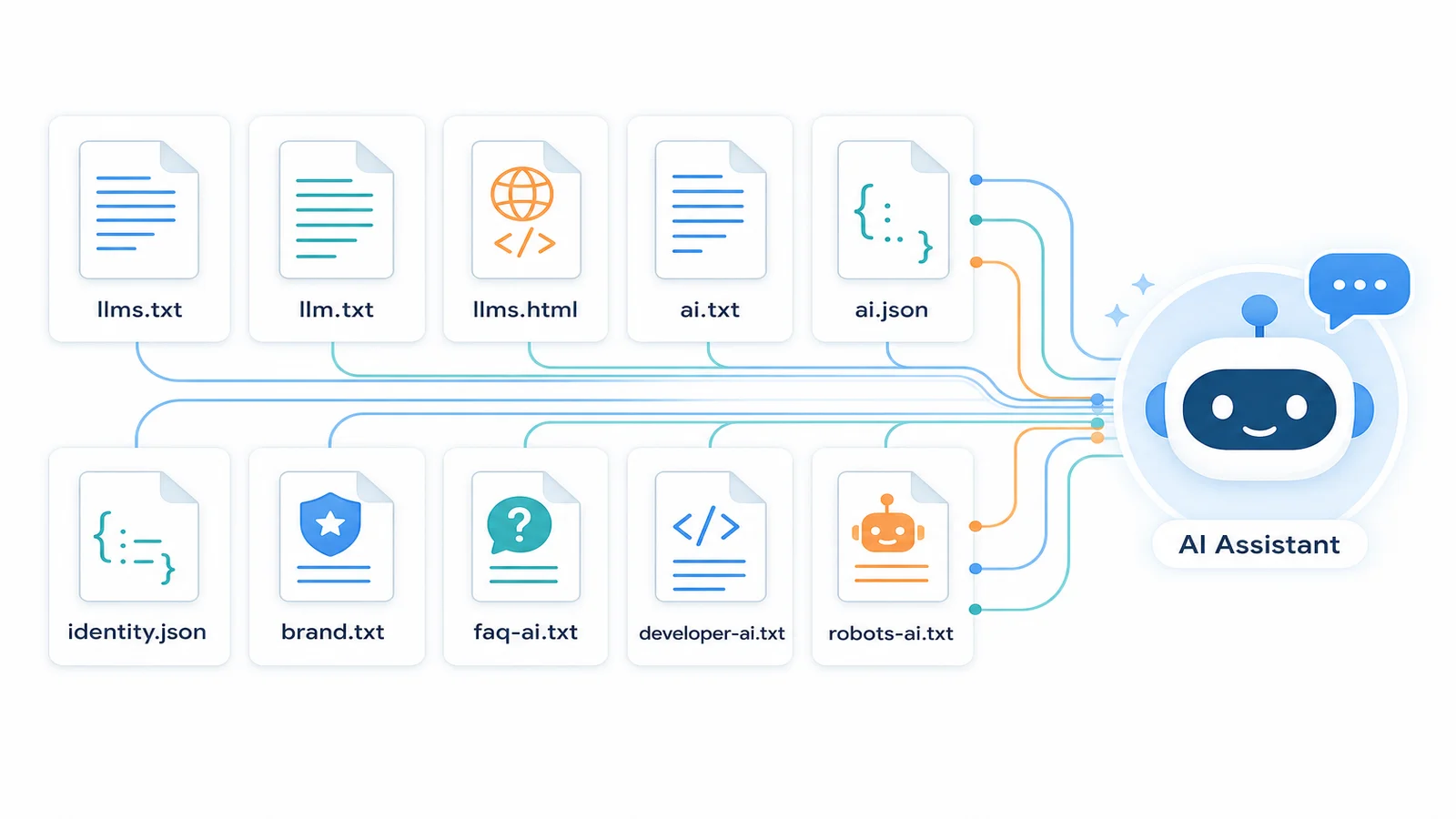
For a local service business, that audit covers four things: the presence and validity of AI Discovery Files like llms.txt and identity.json; whether the business presents a single unambiguous identity; whether AI crawlers are allowed or accidentally blocked; and whether the site structure supports clean, deterministic interpretation. Why AI visibility matters sets out the reasoning behind each one.
A perfect 10/10 AI visibility score: inside the directory listing
Brewood Removals has a public profile in the AI Visibility Directory. It reads as follows, and every figure is a live check anyone can re-run:
- Tier: Platinum
- AI Visibility score: 10 / 10
- Files found: 10 of 10
- Files correctly attributed: 9
- Files missing: 0
- Conformance class: Complete
- Directory-verified: 13 June 2026
The "Complete" conformance class is the highest the specification defines. It means every file in the suite is present and valid: llms.txt, llm.txt, llms.html, ai.txt, ai.json, identity.json, brand.txt, faq-ai.txt, developer-ai.txt, and robots-ai.txt. Nine of the ten also carry explicit attribution back to the publisher, which is what lifts the listing to Platinum rather than a lower tier with the same file count.
To put that in context: our own crawl of nearly 2,000 top websites found that most publish nothing at all, and of the files that do exist, more than half are invalid. A Complete-conformance local removals firm is technically ahead of a large share of the FTSE and the Fortune 500. That is not hyperbole. It is what the data says.
When the inputs check and ChatGPT's opinion agree
A deterministic 10/10 is an inputs measurement. It tells you the groundwork is right. It does not, on its own, tell you how an AI model reads the site once all that groundwork is in place. So we ran the other half of the experiment. We asked ChatGPT, cold, what it could tell us about the AI visibility of Brewood Removals.
It scored the business 92 out of 100. Its own breakdown: AI discovery setup 98, entity clarity 95, non-commodity content 95, E-E-A-T signals 93, local relevance 92, and external corroboration 78. Worth stressing what this is and isn't. It is not a measurement. It is one model's opinion, the kind of soft, output-side signal this site usually treats with caution. But that is exactly why it is interesting here.
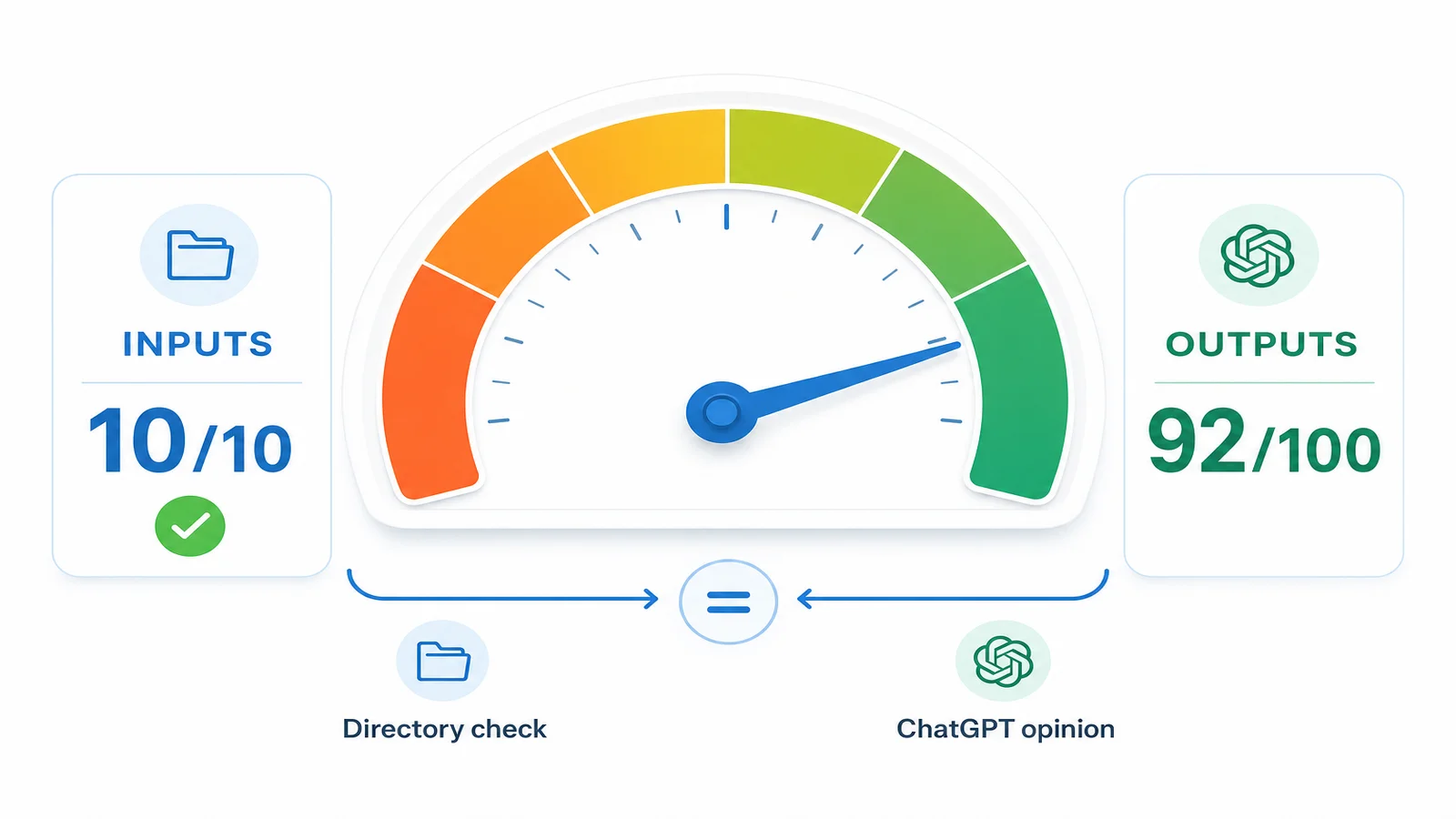
The deterministic check and the model's freeform read agree. The inputs are right, and a model with no prior knowledge of the brand arrives at the same conclusion the directory does. When the thing you control and the thing you don't both point the same way, you are no longer hoping. You have done the work and the work shows. ChatGPT's one real reservation, external corroboration at 78, is the honest one: the business could use more independent mentions, local press, and supplier links. We will come back to that.
Why the score is high: the things AI can actually read
The files are the easy part. Any competent build can generate them. What separates Brewood from a site that ships ten valid files and still gets ignored is everything the files point at. Five things do the heavy lifting.
One identity, stated once, everywhere. Sean Hamilton. Brewood, south Staffordshire. One phone number. A defined list of services and a defined list of towns. The identity.json, the schema markup, and the visible pages all say the same thing with no contradictions. That single source of truth is the cheapest, highest-value signal a local business can give, because it removes every reason a model might hedge or guess.
"When Google's agent is the one calling, disorganization becomes an automatic disqualification."
Karim Al Chamaa, Founder of Implemnt, as quoted in Search Engine Journal, 30 May 2026 (verify quote at source)
That line stuck with me because of how unforgiving it is. The agent does not deduct points for being small. It deducts points for being confusing. Brewood is the opposite of confusing: a model can answer "what do they do, where, for how much, run by whom" in one structured lookup. Most removals firms cannot pass that test, not because they are worse at moving furniture, but because their websites never gave a machine a clean answer. The penalty for disorganisation is silent. You are simply not in the shortlist, and nobody tells you why.
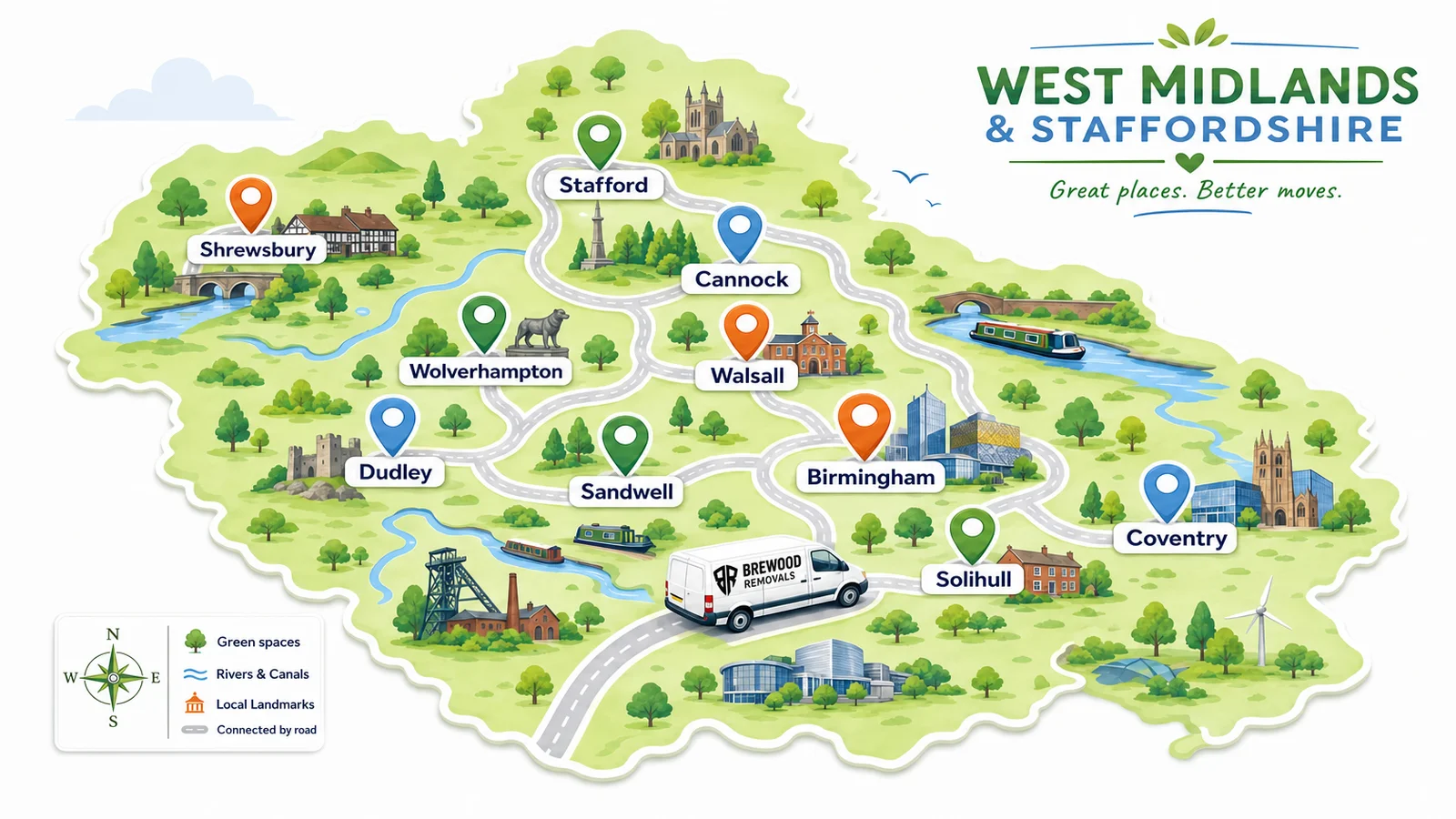
Local coverage that names real places. The site has an areas hub with specific pages for Birmingham, Wolverhampton, Walsall, Cannock, Stafford, Dudley, Sandwell, Solihull, Coventry, and Shrewsbury. Each one names postcodes, nearby villages, and real dated jobs, not a swapped town name on a boilerplate paragraph. The Stafford page talks about ST16 to ST18, Penkridge and Gnosall, and specific moves with grandfather clocks and steep driveways. That is content a model can quote when someone asks for removals in a named town.
Non-commodity content, written from the work. This is the part nothing can fake. Brewood's advice guides were built from 131 real dated jobs out of the owner's diary. The house removals page names the Harrison, Chambers, Bennett and Walsh family moves with months and bedroom counts. The other service pages, from piano removals and man and van to packing, storage, office moves, student moves and house clearances, read like they were written by someone who has actually done the job, because they were.
"Creating content that people find unique, compelling, and useful will likely influence your website's presence in generative AI search in the long run more than any of the other suggestions in this guide."
Google Search Central, in the Generative AI search optimization guide, 15 May 2026 (verify quote at source)
Google buried the most important sentence in its own guide near the bottom, and then said it outranks everything else in the document. Read that twice. The technical suggestions matter, but the thing that matters most over time is whether a human would find your page actually useful and unlike anyone else's. When I first read it I thought, well, that is convenient for Google to say. Then I looked at Brewood's removal costs page, which publishes actual 2026 price ranges that competitors hide behind quote forms, and I understood. The page is useful because a real person decided to tell the truth on it. A model can tell. So can a customer. The two judgments have quietly merged.
![Flat-vector contrast of two website pages: a dull grey template page with repeated 'removals in [town]' placeholder text and a red cross, versus a colourful detailed page showing a real dated job, a named crew member, a star review and a clear price, with a green tick.](/images/blog/2026/06/removals-ai-visibility-case-study-non-commodity.webp)
Visible, accountable authorship. Every page carries a byline from Sean Hamilton with published and last-reviewed dates, and the site has a public editorial standards page that states plainly the author and the reviewer are the same person. No fake editorial board. The about page names 25 years in the trade and DBS checks. That transparency is a trust signal a model can read directly, and most local sites still skip it.
Reviews it does not hide. Brewood publishes its reviews from Google (74 at 5.0), Trustpilot (35 at 4.8) and removalreviews.co.uk verbatim, including any lower scores. Recent, specific, corroborated across more than one platform: that is the review pattern AI systems weight, far more than a single star average sitting in isolation.
There is one more thing worth singling out, because an AI system can actively recommend it: the site has a free moving planner, a week-by-week countdown checklist that saves in the browser and can be printed or emailed. A working tool is a practical asset an assistant can point a user toward, not just another page asserting the firm is friendly and reliable.
The honest caveat: files are not a guarantee
It would be easy to end there and let the perfect score do the talking. That would also be dishonest, so here is the limit. AI Discovery Files are an emerging standard. They make a site legible and they remove the reasons a model might get you wrong, but they do not force ChatGPT, Gemini, Claude, or Google AI Overviews to use that information a particular way on any given prompt. We have made this point before, at length, in what Google actually said about llms.txt: the files are not a ranking back door, and nobody honest sells them as one.
The other limit is the one ChatGPT flagged itself. External corroboration scored lowest, at 78. The site is strong, but its evidence is still mostly first-party. More independent citations, local press, supplier links, and partner pages would make the business harder for any AI system to overlook. A perfect inputs score is the floor you build from, not the finish line. The groundwork is done. The off-site reputation work is the next phase, and it is slower because you do not fully control it.
Not a one-off: another local business hit a perfect AI visibility score
One business hitting Complete conformance could be a fluke or a vanity project. It is neither, and the cleanest proof is a second business in the same village, in a different trade, with the same result. Lockerfella, a Brewood locksmith, launched as a brand-new site on 8 April 2026. Within three weeks, with zero backlinks and no Google authority, it was the top recommendation on ChatGPT and Gemini for "brewood locksmith". It also scores 10/10 in the directory. The full breakdown is in our Lockerfella case study, and the owner's-side view is in AI visibility for small businesses.
Two firms, one village, two trades, the same playbook, the same outcome. That is the part that should interest anyone running a small business. This is not a trick that worked once. It is a repeatable way of building a site so that AI systems can read it, and it works precisely because so few competitors have bothered yet. The standard is published. The window where doing this is rare is the window where it is most valuable.
See where your own site scores
The free AI Visibility Checker runs the same deterministic audit behind Brewood's 10/10: AI Discovery Files, validity, identity consistency, and crawler access. No AI guessing, no opaque score, finished in under a minute.
Check your siteHow to replicate this on your own site
None of what Brewood did is secret, and none of it depends on budget. The pattern is the same one we use on every build, and it comes in two layers: the technical groundwork and the content that gives the groundwork something to point at.
The technical layer is the quick part. Publish the AI Discovery Files, starting with llms.txt and identity.json. Make sure your business identity is stated identically in the files, the schema, and the visible pages. Confirm AI crawlers are not blocked by a stray robots rule or a CDN setting, a trap covered in is your website blocking AI. Then validate the lot with the AI Visibility Checker and fix whatever it flags. The strongest builds generate the files and the schema from one data layer, so the visible site, the structured data, and the machine-readable files can never contradict each other.
For the itemised version of both layers, we have since set out the ten things a website must publish before an AI agent will shortlist it, using Brewood's own pricing instructions, service-area list and stated exclusions as worked examples.
The content layer is the slower, more valuable part, and it is the part a competitor cannot copy. Write your area and service pages from real, first-hand knowledge: actual jobs, real place names, honest prices, named people. Publish your reviews in full. State who is accountable for the content and when it was last checked. That is the work that took Brewood from "ten valid files" to "the firm an AI names". If you would rather not assemble this yourself, 365i Web Design builds it in by default, and you can submit any site to the directory to see where it stands today.
Frequently asked questions
How does ChatGPT decide which local business to recommend?
It assembles a picture from whatever it can read about you: your website, your structured data, directory listings, and review profiles. It then recommends the handful of businesses it has the most complete, consistent, and trustworthy information about. Clarity wins. A business that states one identity, one service area, and one set of facts across every source is far easier to recommend than one the model has to guess about. How AI search actually works walks through the full retrieval pipeline.
What counts as a good AI visibility score for a small business?
The measured baseline is low: most sites publish no AI Discovery Files at all, and over half of the files that do exist are invalid. A 10 out of 10 on the deterministic AI Visibility Checker, with every file present and correctly attributed, puts a site in a tiny minority. Brewood Removals sits there, at the Complete conformance class.
Can AI Discovery Files guarantee ChatGPT will recommend my business?
No, and anyone who promises that is overselling. AI Discovery Files make your site legible and remove the reasons an AI system might get you wrong. They do not control how ChatGPT, Gemini, or Google AI Overviews weight that information on any given prompt. They are necessary groundwork, not a switch. The honest version of this is covered in what Google actually said about llms.txt.
What is the difference between AI Visibility Checking and AI visibility tracking?
AI Visibility Checking validates inputs: the machine-readable signals a site publishes, checked deterministically. AI visibility tracking observes outputs: whether your brand gets mentioned in AI answers over time. Checking tells you if the groundwork is right. Tracking tells you what happened. This case study is mostly about the first one.
Do I need all 10 AI Discovery Files?
Not to start. llms.txt and identity.json carry most of the weight for a local business. Brewood Removals ships all 10 because the build generates them from one data layer, so there is no extra cost to completeness. The Quick Start guide sets out the priority order if you are retrofitting an existing site.
How much do reviews affect whether AI recommends a business?
A lot, and not just the star count. AI systems read review content and recency. Specific, recent, corroborated reviews across more than one platform give a model something to cite. Brewood publishes its Google, Trustpilot and removalreviews.co.uk profiles verbatim, low scores included, which is exactly the kind of consistency a model can trust.
How can I check my own site's AI visibility?
Run the free AI Visibility Checker. It performs the same deterministic audit behind the directory score: which AI Discovery Files are present, whether they are valid, whether identity is consistent, and whether AI crawlers are allowed in. It finishes in under a minute and reports exactly what is missing.
Is AI visibility different from local SEO?
They overlap but are not the same. Local SEO targets Google rankings and the map pack. AI visibility targets being understood and recommended by AI assistants, which retrieve differently. There is only partial overlap between the businesses that win Google's map pack and the ones AI tools name. AI Visibility vs SEO covers where they meet and where they part.
Sources
- Brewood Removals (the case study site)
- Brewood Removals profile in the AI Visibility Directory (10/10, Complete conformance)
- AI Search Recommends Only 1.2% of Local Businesses (SOCi 2026 Local Visibility Index, via MapAtlas)
- Local Consumer Review Survey 2026 - BrightLocal
- Generative AI search optimization guide - Google Search Central
- Google's I/O Demos Reveal the New Business Visibility Problem - Search Engine Journal
- The removals website rebuild case study - 365i
- How we built a removals site ChatGPT rates 99/100 - Press Forge