
Two different problems
If you work in digital marketing, you have almost certainly been asked a version of this question: "Is AI Visibility just the new SEO?" The short answer is no. The longer answer is that they solve very different problems, even though both involve making a website work better for machines.
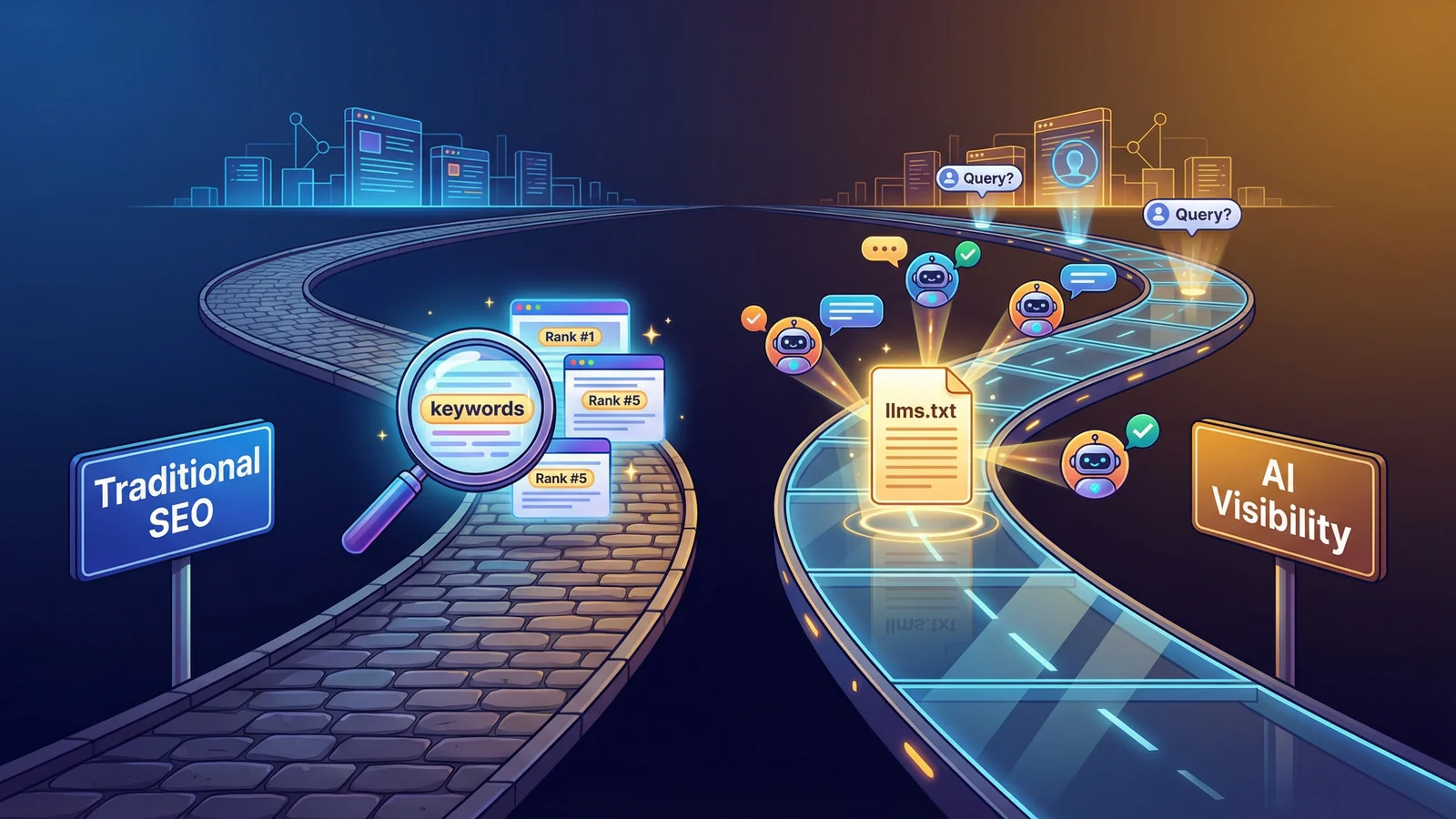
SEO answers the question: "How do I rank in search results?" It's about positioning. It's about visibility in a list of ten blue links, a featured snippet, or a map pack. The machinery of SEO is well-understood: keywords, backlinks, technical performance, and structured data all contribute to where a page appears when someone types a query into Google or Bing.
AI Visibility answers a different question entirely: "How do AI systems understand and represent my business?" When someone asks ChatGPT for a recommendation, or Claude for an explanation, or Gemini for a comparison, the response isn't a list of links. It's a synthesised answer. And the accuracy of that answer depends on whether the AI system has access to clear, explicit, machine-readable signals about who you are and what you do.
Both questions are legitimate. Both matter. But conflating them leads to poor decisions. For a broader look at what AI Visibility actually means and how it works, our expert Q&A covers 13 key questions in depth. A business that optimises only for search rankings may find itself accurately ranked but inaccurately described by AI. A business that focuses only on AI Visibility may be perfectly understood by language models but invisible in search results. The two disciplines are complementary, not interchangeable.
What is SEO?
Search engine optimisation is the practice of improving a website so that it performs well in search engine results. The core mechanic has remained broadly consistent for over two decades: search engines crawl web pages, index their content, and rank them according to relevance, authority, and user experience. SEO is the discipline of aligning a website with those ranking criteria.
The signals that search engines use are well-documented. Keyword relevance tells the engine what a page is about. Backlinks from other websites signal authority and trust. Page speed, mobile responsiveness, and core web vitals reflect the quality of the user experience. Structured data using Schema.org helps search engines understand content types, product details, reviews, and events. Meta tags guide how results appear in the listings themselves.
SEO is a mature discipline with sophisticated tooling. Google Search Console, rank tracking platforms, crawl auditors, and analytics suites provide detailed feedback loops. The goal is clear and measurable: appear higher in search results, attract more clicks, and convert that traffic into business outcomes. It works. It's well-understood. And it isn't going away.
What is AI Visibility?
AI Visibility is the process of ensuring that AI systems can correctly discover, interpret, trust, and cite your business. It isn't about rankings or traffic. It's about whether the information an AI system holds about your organisation is accurate, complete, and unambiguous.
When a user asks an AI assistant "What does [your company] do?" or "Who provides [your service] in [your area]?", the response is generated from whatever information the model has ingested or can retrieve. If that information is scattered, contradictory, or absent, the AI system may hallucinate details, confuse your business with a competitor, or omit you entirely. AI Visibility addresses this by providing explicit, machine-readable signals that AI systems can consume directly.
It's worth being careful with the term, because most tools sell something different under the same name. They count how often an AI mentions your brand, an output that shifts every time you ask. What AI visibility actually is draws the line between that mention-tracking and the input-side checking this site means, and our buyer's guide explains why paying to track those mentions is usually a waste of money.
These signals take the form of AI Discovery Files: a set of standardised files placed at your website's root that declare your identity, services, brand terminology, permissions, and preferred citation format. Files like llms.txt, identity.json, and brand.txt give AI systems a clear, authoritative source of truth. The goal isn't to rank higher but to be represented correctly. The distinction matters because AI-generated answers are increasingly where people encounter your brand for the first time.
Side-by-side comparison
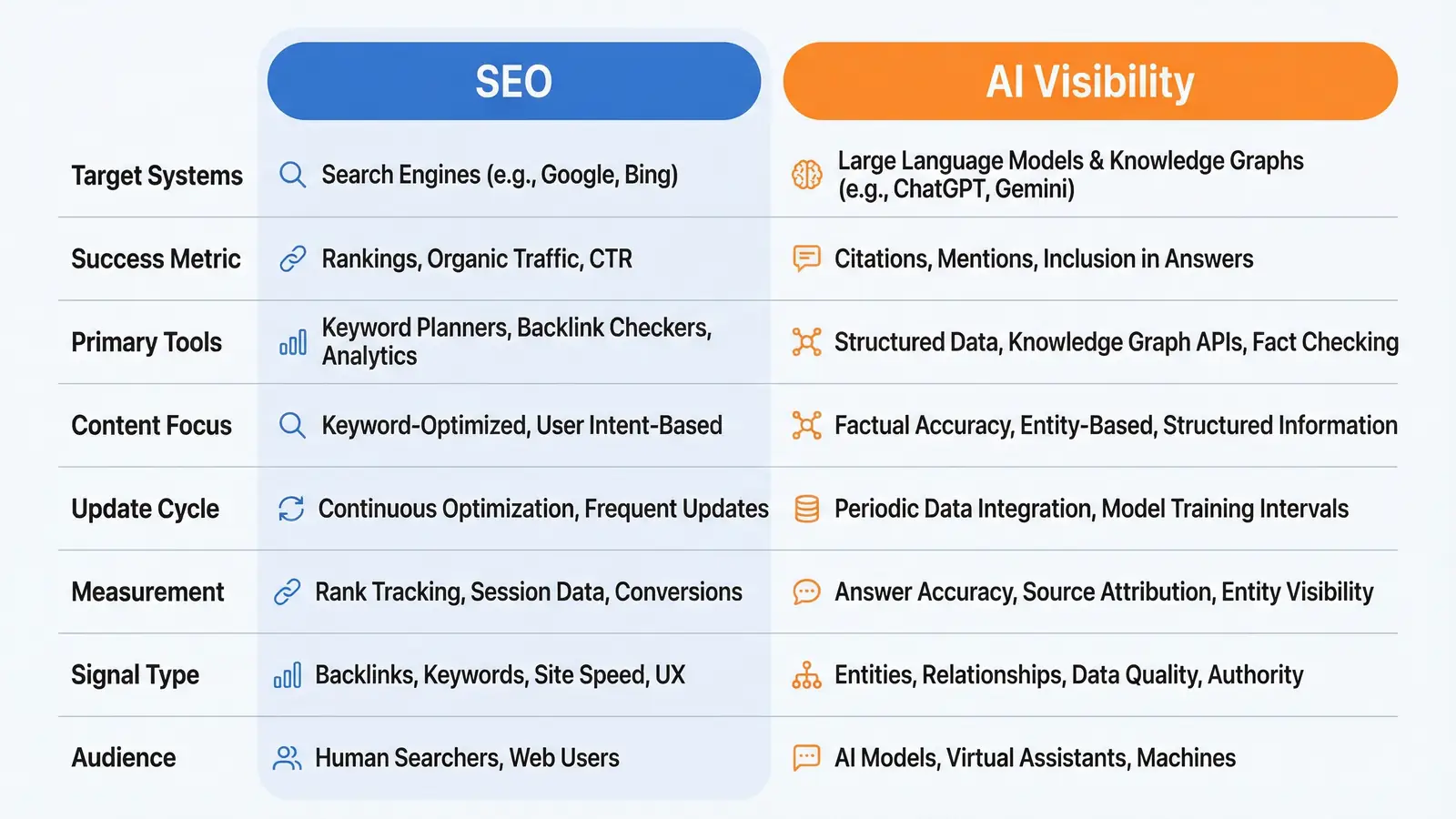
The following table sets out the core differences between SEO and AI Visibility across eight dimensions. These aren't opposing forces but parallel disciplines with distinct objectives, signals, and measurement criteria.
| Aspect | SEO | AI Visibility |
|---|---|---|
| Target system | Search engines (Google, Bing, Yahoo) | AI systems and LLMs (ChatGPT, Claude, Gemini, Perplexity) |
| Goal | Higher rankings and more organic traffic | Accurate representation and correct citation |
| Key signals | Keywords, backlinks, page speed, structured data | AI Discovery Files (llms.txt, identity.json, brand.txt, ai.txt) |
| What it measures | Position, click-through rate, organic traffic | Correctness, consistency, completeness of AI-facing signals |
| Time horizon | Ongoing optimisation and monitoring | Foundational setup with periodic review |
| What it controls | Visibility in search results | Representation in AI-generated answers |
| Core question | "Can they find me?" | "Do they understand me?" |
| Primary tools | Analytics, rank trackers, crawl auditors | AI Discovery Files, AI Visibility Checker |
The table makes the distinction clear. SEO is about being found. AI Visibility is about being understood. Both contribute to how your business appears online, but they operate through entirely different mechanisms.
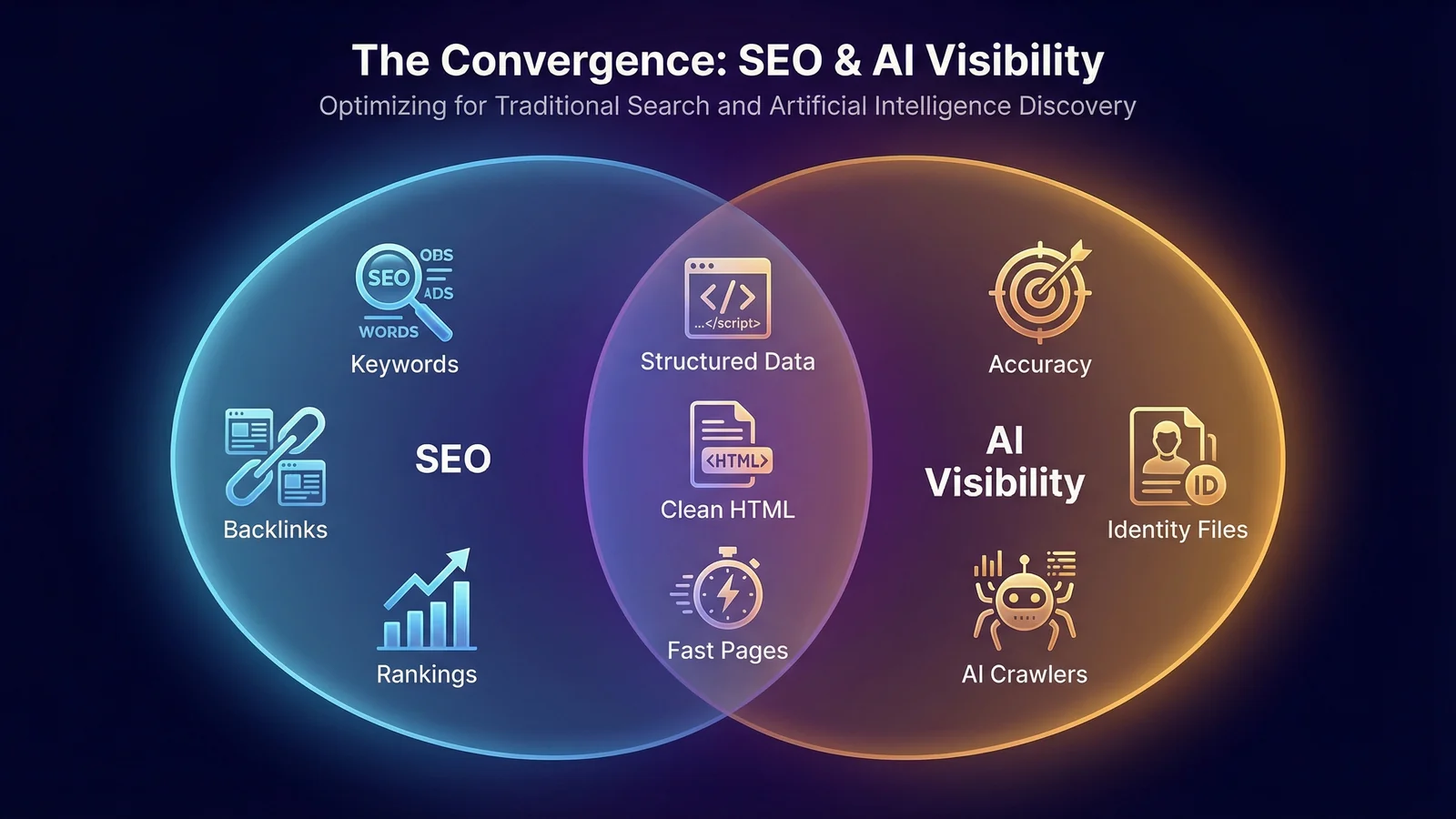
Where SEO and AI Visibility overlap
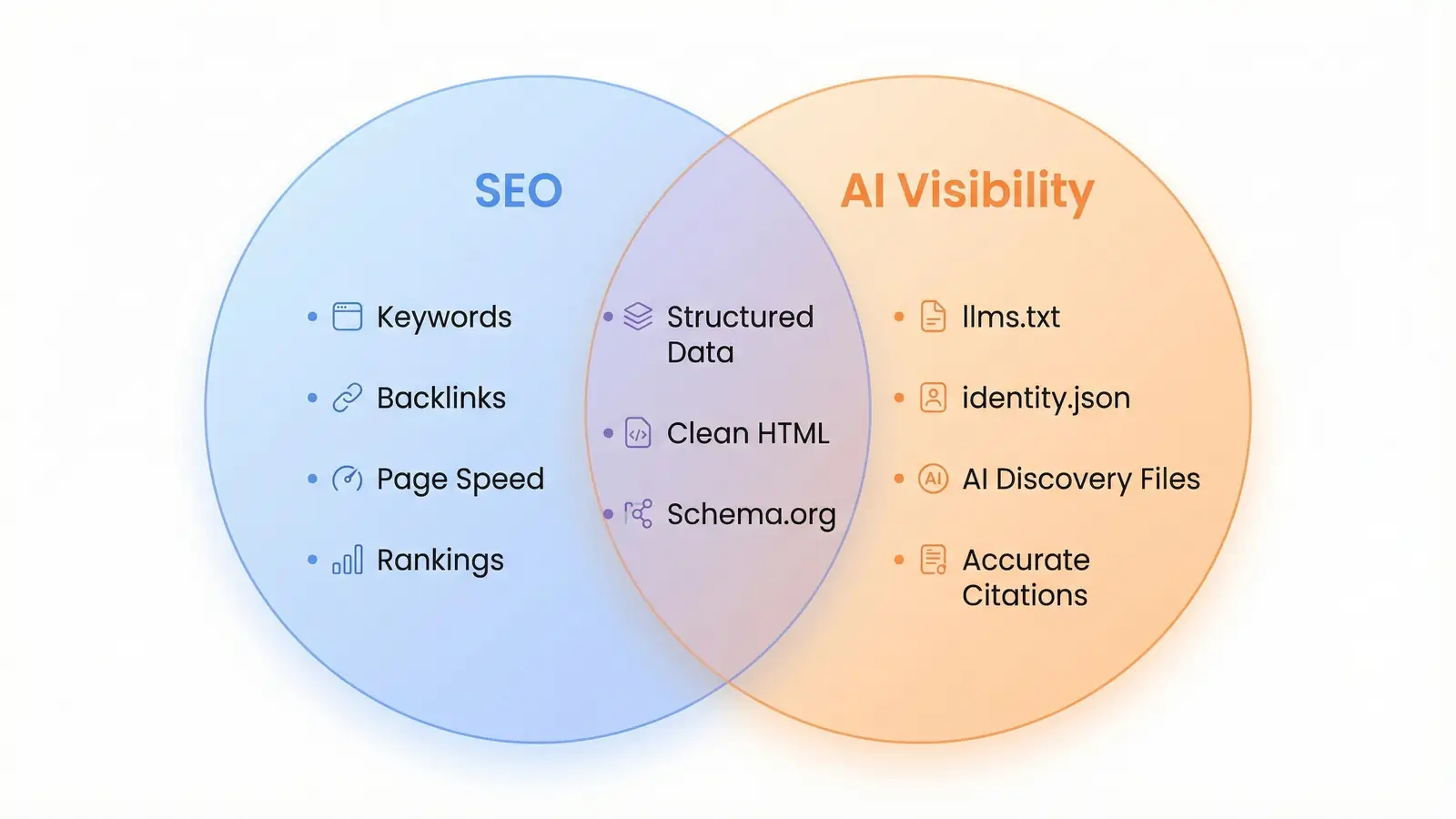
Despite their differences, SEO and AI Visibility aren't entirely separate worlds. Several practices benefit both disciplines simultaneously, and a website that is well-optimised for search engines has a meaningful head start on AI Visibility.
Schema.org structured data is the most obvious point of overlap. Adding JSON-LD markup for your organisation, products, services, and FAQs helps search engines display rich results. It also helps AI systems extract factual information about your business. A well-structured Organization schema with clear name, description, address, and sameAs properties gives both search engines and AI models a consistent identity to work with.
Clean, semantic HTML benefits both audiences. Search engine crawlers parse heading hierarchies, paragraph structure, and landmark elements to understand page content. AI systems, particularly those using retrieval-augmented generation, do the same. A page built with proper <article>, <section>, and <nav> elements is easier for any machine to interpret, whether that machine is Googlebot or GPT-4.
Page speed and accessibility, while primarily SEO concerns, also contribute to AI Visibility indirectly. AI crawlers need to be able to access your content quickly and reliably. A site that blocks crawlers, loads slowly, or hides content behind JavaScript rendering barriers is less likely to be accurately represented by either search engines or AI systems. The foundation of good technical SEO is also the foundation of good AI Visibility.
"AI will be the most powerful engine for discovery that the web has ever seen, helping people discover even more of what the web has to offer and find incredible hyper relevant content."
When the CEO of the world's largest search engine calls AI "the most powerful engine for discovery," it's worth paying attention to what that means for your website. Discovery in AI isn't the same as discovery in search. Google shows you a list. AI picks an answer. If your site isn't structured for both systems, you're relying on one channel while a second, faster-growing one operates without your input. The overlap between SEO and AI Visibility is real, but the stakes are different: in search, you compete for position; in AI, you compete for accuracy.
Where they diverge
The overlap is real, but it has limits. There are problems that SEO can't solve for AI Visibility, and problems that AI Visibility can't solve for SEO. Understanding these boundaries prevents wasted effort and misplaced expectations.
What SEO doesn't solve
AI hallucination. Search rankings have no bearing on whether an AI system fabricates information about your business. Only explicit, machine-readable identity signals can reduce hallucination risk.
Brand confusion in AI answers. Even if you rank first on Google, an AI system may confuse your business with a similarly named competitor. AI Discovery Files like brand.txt and identity.json disambiguate your identity at the source.
Incorrect service attribution. A high search ranking for "web design London" doesn't prevent an AI from incorrectly listing your services as "SEO consulting". AI Visibility files declare your services explicitly.
AI crawler access control. robots.txt controls search engine crawlers. ai.txt and robots-ai.txt provide specific directives for AI systems, including permissions and usage constraints.
What AI Visibility doesn't solve
Search rankings. AI Discovery Files aren't indexed or used by Google's ranking algorithm. They serve a different audience entirely.
Organic traffic volume. Even if every AI system on the planet understands your business perfectly, that doesn't drive users to your website through search. SEO is still how you attract search traffic.
Keyword targeting. AI Visibility doesn't help you rank for specific search queries. That requires content strategy, on-page optimisation, and link building.
Click-through rate optimisation. Meta titles, meta descriptions, and rich snippets influence how users interact with search results. These are SEO concerns, not AI Visibility concerns.
The point isn't that one discipline is more important than the other. It's that they address different failure modes. SEO failure means you aren't found. AI Visibility failure means you are found but misrepresented. Both are damaging, and both require dedicated attention.
Do you need both?
Yes. The short answer is unambiguous, and the reasoning is simple.
SEO drives discovery. It ensures that when someone searches for the services you provide, your website appears in the results. Without SEO, you rely on direct traffic, paid advertising, and referrals. For most businesses, organic search remains the largest single source of website visitors, and that isn't likely to change in the near term.
AI Visibility ensures accuracy. It ensures that when an AI system mentions your business, the information is correct. As AI-generated answers become more prevalent (embedded in search results, used in customer research, cited in reports and comparisons) the cost of being misrepresented grows. A business that ranks well but is described inaccurately by ChatGPT has a problem that no amount of keyword optimisation will fix. Our guide on getting your website into AI search results covers the practical steps for both channels.
The two disciplines also reinforce each other over time. Strong AI Visibility signals can improve how AI-powered search features represent your business within search results themselves. Google's AI Overviews, Bing's Copilot, and Perplexity's answers all draw on the same kinds of structured, machine-readable signals that AI Discovery Files provide. As search engines integrate more AI-generated content into their results pages, the line between SEO and AI Visibility will continue to narrow at the edges, even as their core objectives remain distinct. And AI capabilities are advancing fast: Claude Mythos, Anthropic's latest frontier model, demonstrates just how quickly the systems processing your website are improving.
"While there are distinct differences, many, if not most, of the actual tactics to drive AI visibility haven't changed much. They are simply evolved versions of existing SEO, branding, and digital PR processes."
Ray's take matches what we see in practice. If your website already has solid technical SEO, clean markup, and well-structured content, you're closer to AI Visibility than you think. The gap isn't a complete rebuild; it's the last mile. The specific signals AI systems need (explicit identity files, machine-readable permissions, brand naming rules) sit on top of the foundation SEO already built. The businesses that treat AI Visibility as a natural extension of their existing work, rather than a separate discipline to panic about, tend to get there faster. Our case study of a three-week-old locksmith site that topped AI search shows what happens when AI Visibility is built in from day one rather than retrofitted.
How to get started with AI Visibility
If you already have an SEO strategy in place, adding AI Visibility doesn't require starting from scratch. The foundational work is relatively contained, and the most impactful steps can be completed in a single afternoon.
Check your current AI Visibility
Before creating any files, run your website through the AI Visibility Checker. It analyses your site for the presence, validity, and consistency of AI Discovery Files and gives you a deterministic score. This tells you exactly where you stand and what needs attention first.
Start with llms.txt
The single most impactful file you can create is llms.txt. It declares your business identity, services, and key facts in a format that AI systems can consume directly. Our step-by-step guide to creating llms.txt walks through the process from start to finish, including format requirements, examples, and verification steps.
Consider the full set of AI Discovery Files
Beyond llms.txt, the complete AI Discovery Files specification includes ten files covering identity, permissions, brand terminology, FAQs, and technical context. You don't need all ten immediately, but understanding the full set helps you plan a phased implementation. The specifications hub provides detailed documentation for each file. For a small-business worked example of all ten in production, see AI Visibility for Small Businesses: What It Actually Delivers.
Use the WordPress plugin
If your site runs on WordPress, the AI Discovery Files plugin generates and maintains your files automatically. It handles formatting, validation, and updates without requiring manual file editing.
Review how AI Discovery Files relate to existing standards
If you're already using robots.txt, sitemap.xml, and Schema.org markup, you may wonder how AI Discovery Files fit alongside them. The AI Discovery Files vs Web Standards comparison explains the relationship and shows how the two sets of standards complement each other.
Check your AI Visibility score
Find out how AI systems see your website. The AI Visibility Checker analyses your AI Discovery Files and gives you a clear, actionable score.
Run a free checkDoing both well does not mean doing both yourself. The SEO half is ordinary work your existing team or agency already understands; the machine-readable half is what our done-for-you setup pack exists to handle.
Frequently asked questions
Will AI Discovery Files improve my Google rankings?
AI Discovery Files aren't a direct Google ranking signal, and Google confirmed this in its May 2026 AI Search Optimization Guide. They're designed for AI systems, not search engine crawlers. However, the structured data practices that support AI Visibility (such as Schema.org markup and clean HTML) can also benefit SEO indirectly. Think of AI Discovery Files as a parallel channel: they serve a different audience using a different set of signals. We unpack the nuance in what Google actually said about llms.txt.
Should I do AI Visibility instead of SEO?
No. AI Visibility and SEO serve different purposes and you need both. SEO drives discovery through traditional search engines. AI Visibility ensures accuracy when AI systems represent your business. Neglecting either creates a gap. Strong SEO with poor AI Visibility means AI systems may misrepresent you, while perfect AI Discovery Files without SEO means fewer people find you through search.
Do AI systems use the same signals as search engines?
There is some overlap, but the emphasis is different. Both benefit from clean HTML and Schema.org markup. However, AI systems place far greater weight on explicit, machine-readable identity signals such as llms.txt, identity.json, and brand.txt. Search engines prioritise backlinks, keyword relevance, and page speed. AI systems prioritise clarity, consistency, and unambiguous identity.
How do I measure AI Visibility?
AI Visibility is measured by checking whether your AI-facing infrastructure is correctly configured. The AI Visibility Checker at ai-visibility.org.uk/ai-visibility-checker/ analyses your site for the presence, consistency, and validity of AI Discovery Files. Unlike SEO, where rankings fluctuate, AI Visibility checking produces deterministic, verifiable results: your files are either correct or they aren't.
Does Schema.org markup count as AI Visibility?
Schema.org markup contributes to AI Visibility but doesn't replace AI Discovery Files. Schema.org helps AI systems understand what type of content a page contains. AI Discovery Files go further by declaring your business identity, permitted uses, preferred citations, and brand terminology. The two work best together: Schema.org provides context at the page level, while AI Discovery Files provide identity at the site level.
Will SEO become less important as AI grows?
SEO is evolving, not disappearing. Traditional search engines still drive the majority of web traffic, and search behaviour isn't going away. What's changing is that AI-powered features are being integrated into search results themselves. This means SEO and AI Visibility are converging at the edges. Businesses that invest in both will be best positioned regardless of how the balance shifts.