
AI Visibility is one of those terms that sounds like it should be self-explanatory. It isn't. It gets confused with SEO, conflated with mention tracking, and bundled together with concepts like GEO and AEO that are doing different things entirely. The result is that many businesses think they're covered when they're not, and many tools claim to measure AI Visibility when they're measuring something else.
To cut through the noise, we put a series of questions to Mark McNeece, founder of 365i (a web design and managed hosting provider) and the person behind the AI Visibility Definition, the AI Discovery Files specification, and the AI Visibility Checker. Mark has spent the past year building tools, writing specifications, running quarterly adoption research, and testing how AI systems actually respond to different website configurations. His answers are grounded in that hands-on work, not theory.
"AI Visibility is not about being found. It is about being understood."
What is AI Visibility?
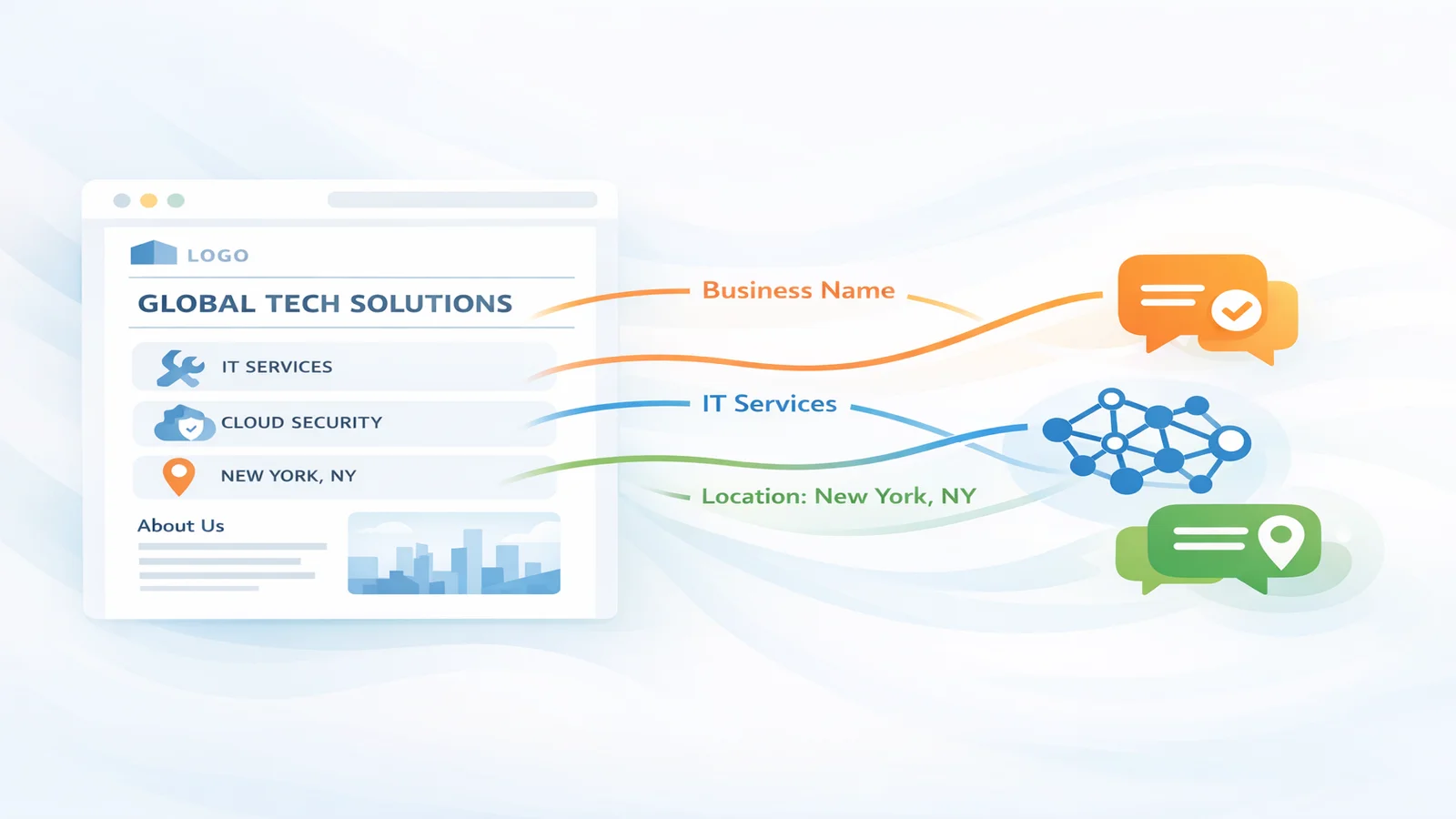
I spent a long time trying to find the right words for this. The formal definition I landed on is: AI Visibility is the process of technically verifying whether a website can be correctly discovered, interpreted, trusted, and safely used by AI systems. But in plain terms, it comes down to one question: can ChatGPT, Claude, Gemini, and Perplexity actually understand who you are and what you do?
It's not about popularity. It's not about rankings. It's not about whether an AI mentions your name when someone types the right prompt. It's about the infrastructure underneath all of that. I've been building and hosting websites since the mid-1990s, and I've watched every major shift in how machines consume web content. This one is different. For the first time, machines aren't just indexing your pages. They're trying to understand your business and then speak on your behalf. That demands a completely different set of signals.
Most websites don't have those signals. They have human-readable content, and they have some SEO signals for search engines. But they have nothing that speaks directly to AI systems. I started seeing that gap clearly when I tested how AI crawlers interacted with the WordPress sites we host at 365i. The results were eye-opening. Sites with great content but no structured identity data were being misrepresented or ignored entirely.
Why is AI Visibility becoming so important now?
Quite simply, it's because the way people find information is changing. I've seen it firsthand with the businesses we work with at 365i. A growing number of their customers now start research with an AI tool rather than a search engine. They ask ChatGPT for recommendations. They use Perplexity to compare services. They rely on Claude to summarise options. Google itself is embedding AI-generated answers at the top of search results through AI Overviews.
That changes the equation for every business with a website. In traditional search, you compete for position in a list of links. In AI, you compete for accurate representation in a synthesised answer. And here's the critical difference that took me a while to fully appreciate: search engines link to you, but AI systems speak for you. They put words in your mouth. If the information an AI system has about your business is incomplete, contradictory, or absent, it won't link to a wrong answer. It simply won't mention you at all. If you've never seen the retrieval pipeline that produces those answers, it's worth reading how AI search actually works first, because every signal we talk about from here maps to a specific stage of it.
If AI is not sure who you are, it often just leaves you out.
That's the quiet cost of poor AI Visibility, and it's a big part of why AI Visibility matters so much right now. You don't get a wrong answer; you get silence. Your competitors who have clearer signals get the mention, the recommendation, the citation. You get nothing. I've tested this with dozens of real businesses, and the pattern is always the same: the sites with explicit identity signals get cited. The ones without them get skipped. And the business owner never knows it happened because there's no analytics dashboard showing you the answers AI chose not to give.
How is AI Visibility different from SEO?
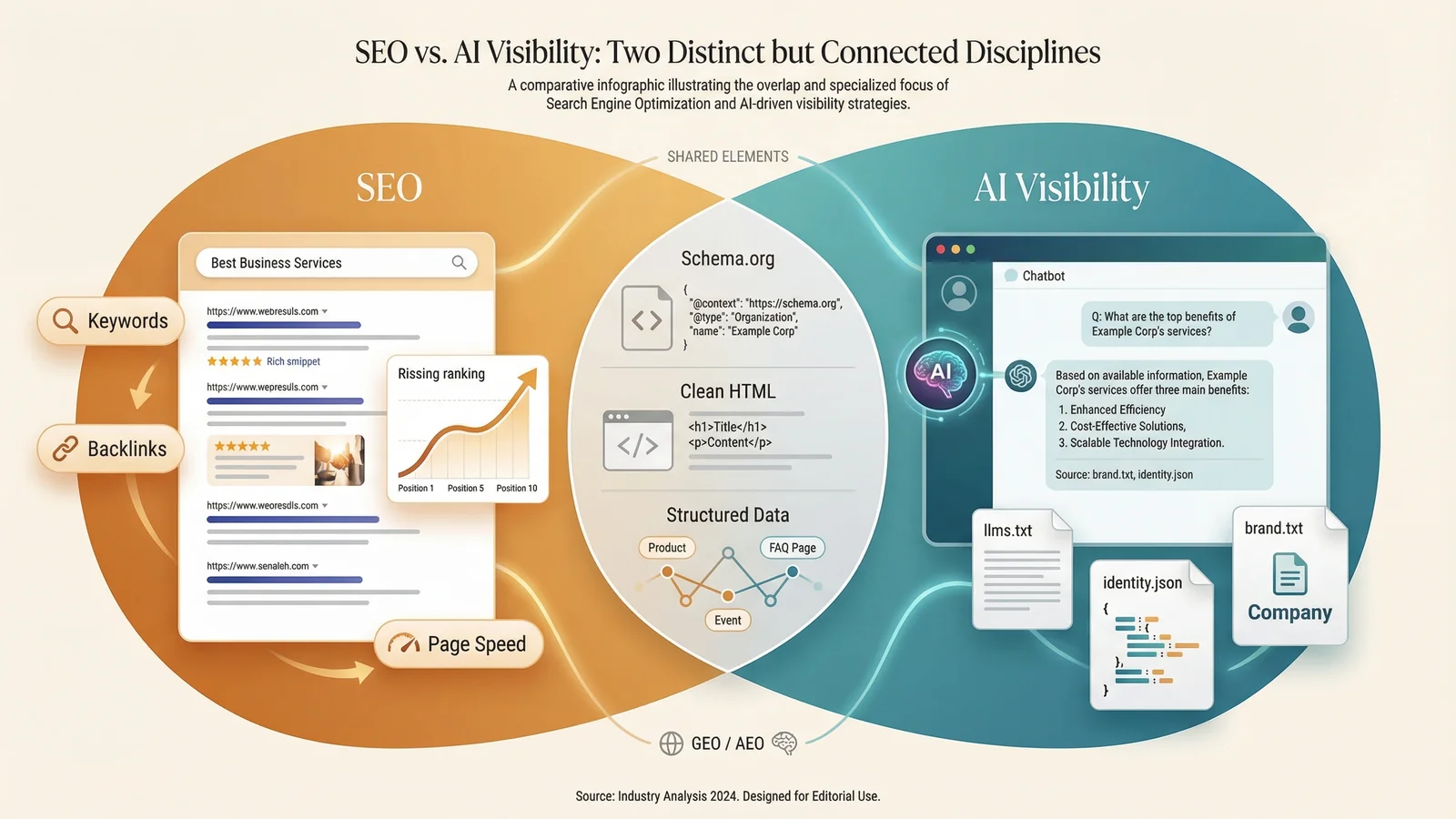
I've been involved in SEO for over 20 years, so I understand the instinct to lump everything into that bucket. But SEO and AI Visibility are answering different questions. SEO asks: how do I rank higher in search results? The tools are well understood: keywords, backlinks, page speed, content quality, structured data. It works. It's mature. And it isn't going away.
AI Visibility asks something different: how do AI systems understand and represent my business? I'll give you a concrete example. When someone asks ChatGPT "Who provides managed WordPress hosting in the UK?", the answer isn't a list of links. It's a generated response that names specific companies. Whether 365i shows up in that answer depends on whether the AI system had access to clear, explicit signals about who we are and what we do. Our SEO ranking has no bearing on that. I know, because I tested it.
The two disciplines overlap at the edges. Both benefit from clean HTML, good Schema.org markup, and well-structured content. But they diverge on the specifics. SEO cares about backlinks, keyword density, and core web vitals. AI Visibility cares about AI Discovery Files, identity consistency, machine-readable permissions, and explicit brand terminology. I wrote a detailed comparison of AI Visibility and SEO that breaks this down across eight dimensions, because the confusion between them was one of the most common questions I kept hearing.
They're complementary, not competing. You need SEO to be found. You need AI Visibility to be understood correctly once you are found. Dropping one for the other leaves a gap.
How does AI Visibility differ from GEO and AEO?
This is one I get asked about a lot, and I'll be honest, the terminology is a mess. GEO (Generative Engine Optimisation) and AEO (Answer Engine Optimisation) are terms that have picked up momentum in the SEO community over the past year. They're both about influencing what AI systems say about you. GEO focuses on crafting content that's more likely to appear in AI-generated answers. AEO targets answer engines specifically: Google's AI Overviews, Bing Copilot, featured snippets, and similar.
AI Visibility is doing something different. It's not about influencing the output. It's about fixing the input.
The way I explain it to people is this. GEO and AEO ask: "How can I get AI to say good things about my business?" AI Visibility asks: "Does AI have the right information about my business in the first place?" Those are very different questions, and I've watched people waste months on the first one while ignoring the second.
I had a conversation recently with a business owner who'd hired someone to "optimise for ChatGPT" by rewriting all their blog posts. Meanwhile, their website didn't even have a clear statement of what the company was called or where it operated. No llms.txt. No structured identity. Nothing. They were trying to optimise the output without fixing the input. That's like trying to improve your search ranking without having a website.
AI Visibility is the foundation. GEO and AEO are strategies you build on top of it. They're not the same thing, and confusing them leads to wasted effort.
Why are so many websites still unclear to AI systems?
Because nobody told them they needed to be. I've been building websites since the mid-1990s. I ran one of Britain's earliest internet service providers back then. And for the whole of that time, the assumption has been: write good content, add some meta tags, build some links, and the machines will figure out the rest.
That worked for search engines because search engines index pages. They crawl your HTML, extract text, and match it against queries. The relationship between your content and your ranking is relatively direct. I understood that system well. I spent 20 years working within it.
AI systems work differently, and this caught me off guard at first. They don't index individual pages in the same way. They ingest information, synthesise it, and generate answers from a blend of sources. If your website has inconsistent information across pages, if your business name appears differently in different places, if your services are described in vague marketing language rather than clear statements, the AI system has to guess. And when AI has to guess, it either gets it wrong or plays it safe and leaves you out. I've seen it happen with sites I know intimately. A business I've hosted for years, ranking well on Google, completely absent from ChatGPT's answers. That's what made me realise this was a problem worth solving properly.
Our quarterly research paints a stark picture. In Q2 2026, only 7.2% of the top 1,905 websites we crawled had any AI Discovery File at all. The vast majority of the web is still invisible to AI in any structured, explicit way. Websites have content, yes. But they don't have machine-readable identity. There's a big difference, and I wish I'd understood it sooner.
What are AI discovery files?
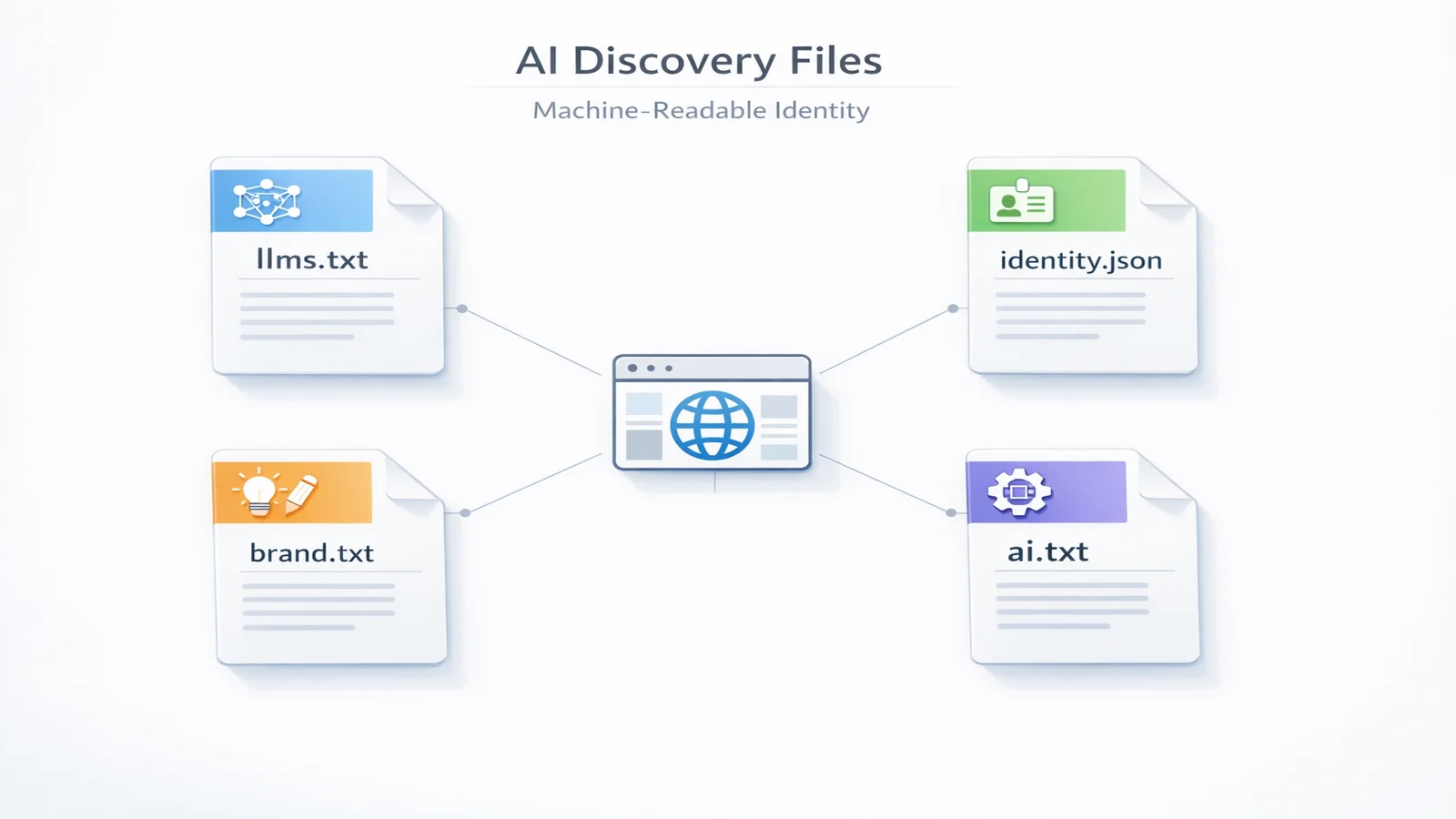
AI Discovery Files are a set of 10 standardised, machine-readable files that a website publishes to help AI systems correctly identify, understand, and cite it. I wrote the specification because I kept running into the same problem: websites had no standardised way to tell AI systems who they were. We had robots.txt since 1994 and sitemap.xml since 2005, but nothing that said "Here's who this business is, here's what we do, and here's how to refer to us." That gap needed filling.
The spec covers 10 files, each addressing a different aspect of your identity:
llms.txtdeclares your business identity and key factsidentity.jsonprovides structured identity databrand.txtdefines your naming conventions and brand terminologyai.txtsets permissions and usage rules for AI systemsfaq-ai.txtprovides answers to common questions about your businessdeveloper-ai.txtoffers technical contextrobots-ai.txtcontrols AI crawler access specifically
You don't need all 10 on day one. Start with llms.txt. It's the most widely adopted and the most impactful single file you can create. We have a step-by-step guide that walks through the process.
The point of these files is to make your website the authoritative source of truth about your business, not something AI has to infer from scattered third-party references, outdated directory listings, and inconsistent social profiles.
"The problem this solves is that today, constructing the right context for LLMs based on a website is ambiguous."
Howard nailed the core problem in four words: "constructing the right context." That's the gap. An AI system lands on your website and has to figure out what matters, what's current, and what represents you versus what's a blog comment from 2019. I spent months watching AI crawlers hit websites and seeing what they made of the content. The results were sobering. A homepage with a clever tagline like "We make things better" gives an AI nothing to work with. A clean llms.txt file that says "365i provides managed WordPress hosting and AI Visibility services in the UK" gives it everything. The difference between ambiguity and clarity is often just one well-structured file.
Why do AI systems need identity clarity?
This is something I've come to understand through testing, not theory. AI systems are cautious by design. They're trained to avoid making confident claims about things they're uncertain about. If an AI model can't determine with confidence what your business does, where it's located, or what it's called, it won't fabricate an answer. It will either hedge with vague language, confuse you with a similarly named business, or skip you entirely.
I learned this the hard way with our own business. 365i has been operating since 2005, but when I first tested how AI systems described us, the results were patchy. Some got our services right. Others confused us with unrelated companies. A couple didn't mention us at all. And this is a company I've been running for over two decades with a solid web presence. If AI was struggling with us, I could only imagine what it was doing with businesses that had less online history.
The problem is ambiguity. An AI system might have ingested your homepage, a few blog posts, your Google Business Profile, a LinkedIn page, some review sites, and a couple of directory listings. If those sources use different names, describe different services, or give conflicting information about your location, the AI system has ambiguity to resolve. And its default resolution strategy is: don't mention you.
AI Discovery Files solve this by giving AI a single, authoritative source. Instead of piecing together your identity from 15 different signals of varying reliability, the AI system can read your identity.json or llms.txt and get a clear, consistent, machine-readable declaration of who you are. No guessing required. After I added our own AI Discovery Files to 365i's site, the difference in how AI systems described us was immediate and measurable.
Your website should be the source of truth about your business, not something AI has to infer from scattered third-party references.
Are most AI visibility tools actually measuring visibility properly?
Honestly? Most of them aren't measuring visibility at all. They're measuring mentions. And that distinction matters more than people realise.
I've looked at a lot of these tools. The typical one works like this: it sends a handful of prompts to ChatGPT, Gemini, and maybe Perplexity. It records whether your brand name appears in the response. It tracks this over time and gives you a chart showing how often AI mentions you. Some of them charge hundreds of pounds a month for this.
That's mention tracking. It's a valid thing to measure, but it's not AI Visibility. It tells you what happened in a specific set of prompts on a specific day. It doesn't tell you whether AI systems can accurately understand your business, and it doesn't tell you whether the structural signals your website sends to AI are correct, consistent, or even present. I've seen businesses with great mention scores that had completely broken identity signals. The AI was mentioning them, but getting their services wrong.
A mention tracker is not the same thing as visibility.
That's why I built the AI Visibility Checker to work differently. It's deterministic. It looks at your website's infrastructure: are the right files present? Are they valid? Is the information consistent? Can AI crawlers access your content? Are your identity signals unambiguous? These are yes-or-no questions with verifiable answers. It checks your actual signals, not what an AI happened to say on Tuesday.
The difference matters because prompt-based tracking is volatile. I've tested this myself. Ask ChatGPT the same question twice and you'll often get different answers. The responses change based on the model version, the user's location, the conversation context, and factors nobody outside the AI company fully understands. Building your strategy on that is like building your SEO strategy by Googling yourself once a week and seeing what comes up.
"Any tool that gives a 'ranking position in AI' is full of baloney."
Fishkin doesn't mince words, and his data backs it up. SparkToro ran 2,961 prompts across ChatGPT, Claude, and Google AI Overviews. The finding: there's less than a 1 in 100 chance that any AI tool will produce the same brand list when asked the same question twice. Less than 1 in 1,000 that they'll return the same list in the same order. When I first read that, it confirmed something I'd been suspecting from my own testing. The output is noise. You can't rank in noise. What you can do is make sure the inputs are right: clear identity files, consistent signals, unambiguous declarations of who you are. That's infrastructure, not optimisation. That's what the Checker tests, and it's why deterministic validation matters more than volatile prompt tracking.
What are the biggest mistakes businesses make?
The first one I see all the time: assuming that good SEO means good AI Visibility. It doesn't. I've looked at sites that rank on the first page of Google for competitive terms but are completely invisible to ChatGPT. They share some DNA, but they're solving different problems.
The second is treating AI mentions as the goal. If your strategy is "get ChatGPT to mention us more," you're optimising for a symptom, not a cause. Mentions are the output. The input is whether your website provides AI with clear, machine-readable identity signals. Fix the input and the output improves as a consequence. I've watched this happen repeatedly with the sites we work on.
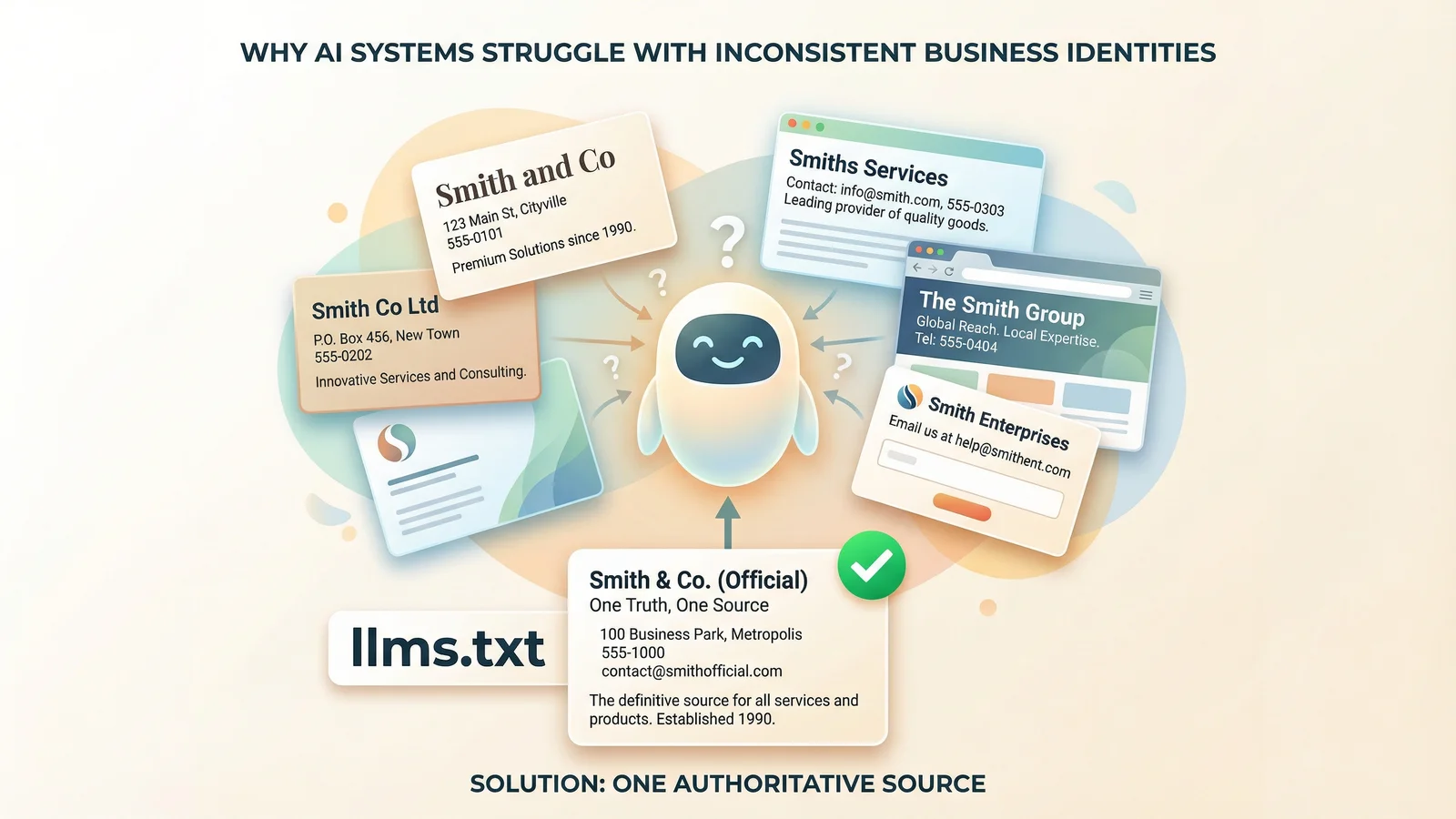
The third is inconsistency, and this is the one that keeps me up at night. I see it constantly in my hosting and web design work. A business uses one name on its website, a slightly different name on its Google Business Profile, another variation on LinkedIn, and yet another on a directory listing. Humans can resolve these differences easily. AI systems can't. To an AI, "365i," "365i Hosting," and "365i Web Design" might be three different companies. I know because I've tested exactly that scenario. Brand consistency across all signals is not optional.
The fourth is blocking AI crawlers without realising it. When we run our quarterly crawls, we find a surprising number of websites that unintentionally prevent AI systems from accessing their content through overly broad robots.txt rules, CDN configurations, or web application firewalls. I put together a full technical checklist for identifying and fixing AI crawler blocks because it was one of the most common problems I was seeing.
And the fifth is doing nothing and assuming it'll sort itself out. It won't. AI systems are conservative. If you don't give them clear signals, they default to caution, which means silence.
What should a business do first if it wants to improve AI Visibility?
This is what I tell everyone who asks me: check where you stand first. Run your site through the AI Visibility Checker. I built it specifically for this. It takes seconds and tells you exactly what's present, what's missing, what's valid, and what needs attention. You can't fix what you haven't measured, and most people are shocked by their results.
After that, create an llms.txt file. It's the single most impactful thing you can do, and it takes less than an hour. It declares your business identity, services, and key facts in a format that AI systems consume directly. The step-by-step guide covers everything you need. If your site runs WordPress, I built a plugin that generates all the files automatically from your dashboard.
Then review your broader identity consistency. Does your website say the same thing about your business as your Google Business Profile, your LinkedIn page, and your directory listings? If there are contradictions, AI systems will notice. Fix them. This part isn't glamorous, but it's some of the most impactful work you can do.
From there, work through the rest of the AI Discovery Files at your own pace. The Quick Start guide gives you a sensible implementation order. You don't need everything at once. But doing nothing is no longer a neutral choice. It's an active decision to be invisible.
If you're a small business owner who is wondering what this looks like in practice, the cleanest worked example we have published is AI Visibility for Small Businesses: What It Actually Delivers. It walks through the Lockerfella case from the owner's chair, including the five questions every owner should ask their builder before signing a brief.
Where do AI discovery files fit into the broader future of search and AI recommendations?
I've watched the web evolve through every major protocol change. I was there when robots.txt became a thing in 1994. I was running an ISP when sitemap.xml arrived in 2005. I implemented Schema.org markup on client sites from 2011 onwards. Each one established a standard way for websites to tell machines something specific: what to crawl, where to find content, what type of thing a page describes.
AI Discovery Files are the next step in that progression. They address a question that previous standards didn't need to answer: who is this business, and how should an AI system represent it? Search engines could answer that from backlinks and anchor text. AI systems can't. They need explicit declarations. That's what motivated me to write the specification and publish it under a Creative Commons licence. This needs to be an open standard, not a proprietary product.
As AI becomes a larger part of how people discover businesses, the websites that have invested in clear, machine-readable identity will have a structural advantage. Not because they gamed a system, but because they made it easy for AI to get it right. The comparison between AI Discovery Files and existing web standards shows how these files complement, rather than compete with, the standards you're already using.
I think we'll look back on this period the same way we look back at the early days of SEO. The businesses that moved first didn't do anything magical. They just took machine communication seriously before everyone else did. I've seen that pattern play out three times now in my career. The window is open. It won't stay open forever.
What should website owners stop obsessing over?
Prompt testing. I've sat with business owners who spent an entire afternoon typing variations of their company name into ChatGPT, Perplexity, and Claude, panicking when they didn't show up and celebrating when they did. I understand the impulse. But it's not productive, and it can be actively misleading.
I've done this testing myself, extensively, as part of building the Checker. Prompt responses are volatile. They change based on the model, the phrasing, the user's history, and a dozen other variables. I've asked ChatGPT the same question five minutes apart and received different company recommendations each time. Building a strategy around that is like building your SEO strategy by Googling yourself in an incognito window once a week. It tells you what happened in that moment. It tells you nothing about the underlying system.
The other thing to stop obsessing over is "AI SEO" as if it's a single discipline with a clear playbook. It isn't. There's no equivalent of "rank for this keyword" in AI. The closest thing is: make sure AI systems have accurate, consistent information about your business. That's infrastructure work, not content marketing. I wish more agencies understood this distinction.
Stop checking whether AI mentions you. Start checking whether AI can understand you.
What should they focus on instead?

I keep it simple when people ask me this. Three things.
First, clarity. Make your website the clearest possible source of truth about your business. Not clever marketing copy. Not vague taglines. Clear statements about what you do, where you operate, who you serve, and what you're called. I review websites every week through my hosting and web design work, and the number of homepages where I can't extract the business name, location, and primary service within a few seconds is staggering. If I can't do it, an AI definitely can't.
Second, consistency. Make sure every signal your business sends to the outside world says the same thing. Your website, your Google Business Profile, your social media, your directory listings, your AI Discovery Files. If these disagree, AI systems lose confidence. And when AI loses confidence, it stays quiet. I've helped businesses fix this, and the improvement in how AI represents them is often immediate.
Third, machine-readable identity. Create the files that give AI systems a direct line to your identity. Start with llms.txt. Add identity.json and brand.txt when you're ready. Use the specification to guide you. This is the part that moves the needle because it gives AI something it can trust without interpretation.
None of this replaces SEO. None of it replaces good content. It's an additional layer that addresses a gap most businesses don't know they have. The businesses that close that gap first will have a quiet but lasting advantage.
This is still early. Most businesses haven't heard of AI Discovery Files yet. Most websites don't have a single one. But the direction is clear, and the cost of acting now is low. A few files, an hour of work, and you move from invisible to understood. That's a good trade. I've been building websites for 30 years, and I can't think of another time when such a small amount of work could have such a lasting impact on how a business is perceived by machines.
Check your AI Visibility now
Find out how AI systems see your website. The AI Visibility Checker analyses your AI Discovery Files, crawler access, and identity signals, then gives you a clear, actionable score.
Run a free checkFrequently asked questions
What is AI Visibility?
AI Visibility is the process of ensuring your website can be correctly discovered, interpreted, trusted, and safely cited by AI systems like ChatGPT, Claude, and Gemini. It's not about rankings or traffic. It's about whether AI understands who you are and what you do.
Do I need AI Visibility if I already do SEO?
Yes. SEO helps search engines find you. AI Visibility helps AI systems understand you. They serve different purposes and target different systems. Strong SEO with poor AI Visibility means AI systems may misrepresent your business or leave you out of answers entirely. You need both.
What are AI discovery files?
AI Discovery Files are a set of 10 machine-readable files that websites publish to help AI systems correctly identify, understand, and cite them. They include files like llms.txt, identity.json, brand.txt, and ai.txt. The full specification documents each file in detail.
How do I check my website's AI Visibility?
Use the free AI Visibility Checker to analyse your site. It checks your AI Discovery Files, crawler access, identity consistency, and structural readiness, then gives you a clear, deterministic score with specific recommendations.
Is AI Visibility the same as GEO or AEO?
No. GEO (Generative Engine Optimisation) and AEO (Answer Engine Optimisation) focus on influencing AI outputs through content and prompt strategies. AI Visibility focuses on the infrastructure: making sure AI systems can read your identity accurately in the first place. GEO and AEO try to shape what AI says about you. AI Visibility ensures AI has the right information to work with.
Will AI replace traditional search engines?
Not entirely, but AI is absorbing an increasing share of how people find information. Google now shows AI Overviews for many queries, and tools like ChatGPT and Perplexity are becoming research tools in their own right. The businesses that prepare for both traditional search and AI-powered answers will be best positioned.
How long does it take to improve AI Visibility?
The foundational work can be completed in a single afternoon. Creating an llms.txt file takes under an hour. The full set of AI Discovery Files can be implemented within a day. If your site runs WordPress, the AI Discovery Files plugin automates the entire process.
Do AI systems actually read AI discovery files?
Yes. AI crawlers including GPTBot (OpenAI), ClaudeBot (Anthropic), and others actively crawl websites and consume machine-readable files. Our quarterly research tracks adoption rates and shows growing implementation among major websites including NVIDIA, Dell, and ASUS.