
The hot take, and why it has gone further than the source
Google published its first official guide to optimising for generative AI search on 15 May 2026. Within hours, the SEO field had a summary version of it bouncing around LinkedIn. Lily Ray, who is well-followed and usually careful, posted a four-bullet TL;DR that included the line "Ignore most 'GEO/AEO hacks like chunking and llms.txt." The post did the thing posts do. People agreed, paraphrased, and the paraphrases were sharper than the original. By the next day the consensus was that Google had told the industry to delete llms.txt and stop wasting time on AI Discovery Files. It hadn't.
"Big news! Google just put out its first official article on optimizing for AI search (AEO/GEO)! TL;DR: SEO is still the foundation for AI search. Google sees optimizing for AI search as SEO, so they're still calling it SEO. Create non-commodity, 'people-first' content. Ignore most 'GEO/AEO hacks like chunking and llms.txt."
Lily Ray, Founder of Algorythmic and VP, SEO & AI Search at Amsive, in a public LinkedIn post on 16 May 2026 (verify quote at source)
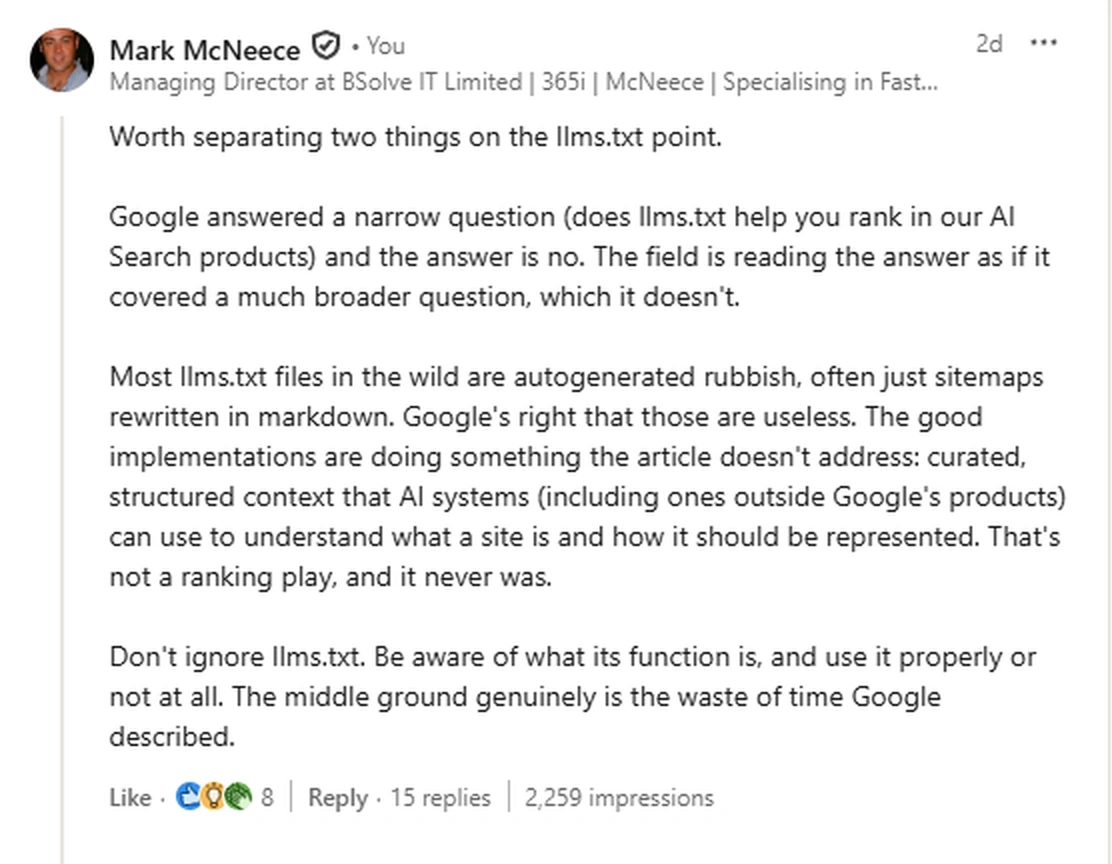
I read this when it came across my feed, and the first bullet stopped me in my tracks more than the fourth. "SEO is still the foundation for AI search" is a useful, sensible line. If anything it overcorrects a year of breathless GEO-is-different content. The fourth bullet is the one that's been quoted out of context everywhere since, and it's the one worth taking apart, because the bullet itself is fair and the way the field is reading it is not. Lily isn't wrong. The reading of Lily is.
I posted a reply on her post saying exactly that, and at time of writing it has 2,259 impressions, 8 reactions, and 15 replies, several of which came from people thanking me for separating the two questions out. The article you are reading is the long-form version of that reply. If you build websites, run a business, or commission web work, the distinction is worth your time, because it changes what you should be doing about llms.txt on your site this week.
What Google actually said, verbatim
It's worth quoting Google directly, because everyone reacting to it is paraphrasing. The full document is the Generative AI search optimization guide published on Google Search Central. Three lines are doing most of the work.
"You don't need to create new machine readable files, AI text files, markup, or Markdown to appear in generative AI search."
Google Search Central, in the Generative AI search optimization guide, 15 May 2026 (verify quote at source)
And, on the same page, on AEO and GEO as labels:
"'AEO' stands for 'answer engine optimization' and 'GEO' for 'generative engine optimization'... From Google Search's perspective, optimizing for generative AI search is optimizing for the search experience, and thus still SEO."
Google Search Central, in the Generative AI search optimization guide, 15 May 2026 (verify quote at source)
And on whether traditional SEO still applies:
"In short, yes! The best practices for SEO continue to be relevant because our generative AI features on Google Search are rooted in our core Search ranking and quality systems."
Google Search Central, in the Generative AI search optimization guide, 15 May 2026 (verify quote at source)
Read all three together and the picture is clear. Google is telling the SEO industry not to invent a parallel discipline. The Overviews and AI Mode features on Google Search rank from the same systems that rank the rest of Google Search. There is no llms.txt back door into Google's AI features. There never was. Anyone who pitched llms.txt as a Google ranking trick was either confused or selling something.
That is the question Google answered. It's worth getting that question precise, because it's the only question Google answered.
Two different questions, one answer
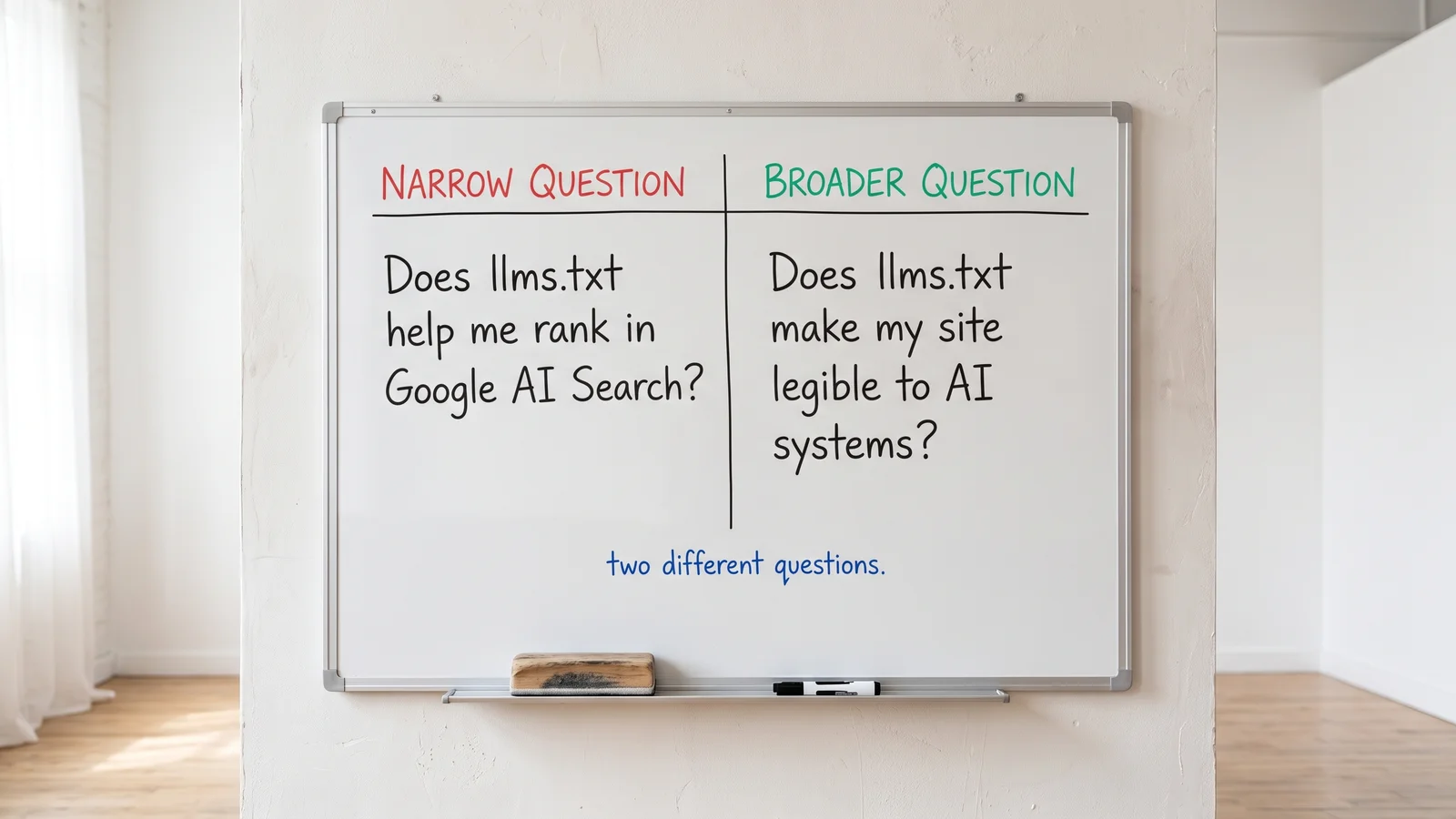
Here is the bit the field has skipped. The question Google answered is, in plain English: "Does llms.txt help me rank in Google's AI Search products?" The answer is no. That is correct. It is also the only question Google was equipped to answer, because Google can only speak for its own ranking systems.
The question the field is hearing it answer is the much broader one: "Is llms.txt useful for anything?" Those are not the same question. Google didn't address the second one. It couldn't have, because the second one is about every AI system that isn't a Google product, and Google can't legislate for those. That second question only gets bigger as AI agents start visiting websites on customers' behalf, since an agent acting on your details needs them declared, not inferred.
ChatGPT, Claude, Gemini (when used directly through Google's Gemini assistant, not via Search), Perplexity, You.com, Brave Leo, DuckDuckGo Assist, Komo, Andi, and the dozen other AI assistants that fetch context at inference time make their own decisions about which signals to read. Some fetch llms.txt directly. Some fetch ai.txt. Some fetch nothing and rely entirely on what their crawlers have indexed. None of them are bound by what the Google Search Central documentation says about Google's own products. We put that to the test on a brand-new site and logged every hit: two major AI operators read the files daily, even as the headline LLM bots stayed away.
That asymmetry is the bit the field keeps missing. Google's guide is excellent advice for ranking in Google's AI Overviews. It is silent on whether your site is legible to the rest of the AI ecosystem. Treating it as a verdict on the whole AI Discovery Files concept is reading something Google didn't write.
Why most llms.txt files in the wild deserve the bin
Here's where I think Google is plainly right, and where the field's instinct to defend llms.txt has gone soft. Most llms.txt files on the web are autogenerated rubbish. A small industry of plugins, generators, and "AI-ready in one click" tools has produced thousands of llms.txt files that are just a site's existing sitemap rewritten as bullet points in markdown, with no editorial content, no curated identity statement, and no judgment about what an AI system needs to know about the business.

Those files are useless to everyone. They tell Google nothing. They tell ChatGPT nothing. They tell Claude nothing. They are noise pretending to be signal. The brands that publish them are usually doing so because a plugin offered to add AI Visibility to their site for free and they took it. The intention was good. The output is decorative.
Google's critique cuts through them cleanly. If your llms.txt is a sitemap in disguise, deleting it costs you nothing because it was doing nothing. That is the legitimate, useful part of what Google said. Anyone running an autogenerated file should take the guide as permission to bin it.
The mistake is generalising from there. Reading "most files in the wild are rubbish" as "the format itself is rubbish" is the kind of category error a careful technical industry shouldn't be making. The same logic would have us conclude that HTML is useless because most HTML in the wild is bloated. The format isn't the problem. The implementations are.
What a proper llms.txt actually does
A real llms.txt, written by a human who knows the business, does something completely different from a sitemap-in-markdown. It declares identity. It states scope. It names services. It disambiguates the brand from competitors who happen to share part of the name. It gives an AI system a small, authoritative, curated document that answers the question "who is this site, in one minute, with no guessing?" The llms.txt specification sets out what that looks like in detail.
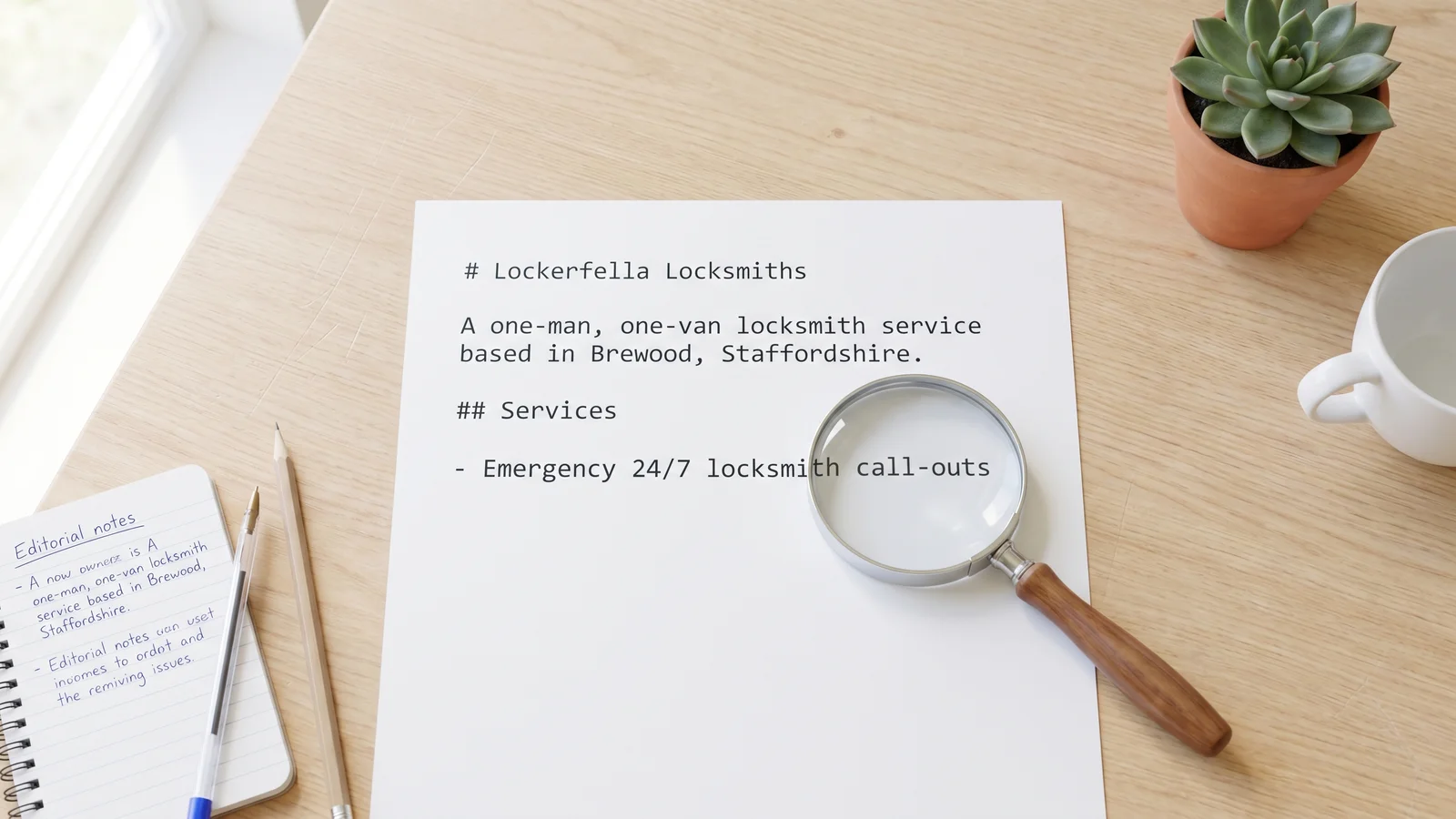
The point is reducing AI hallucination about your brand. When a user asks ChatGPT "what does Lockerfella Locksmiths do?", the model either has retrieved enough context to answer accurately, or it makes something up. A curated llms.txt sitting at the root of the domain is one of the cleanest, fastest ways for a retrieval-augmented system to ground its answer in something authoritative. That is not a ranking play. It is a hallucination-prevention play. Different goal. Different mechanism. Different question. It's also why deploying these files isn't an SEO task and won't lift your rank: the job is being understood and cited accurately, not climbing a results page.
There's a postscript to all this. In May 2026, Google quietly added a check for a valid llms.txt to Lighthouse, the engine behind PageSpeed Insights, as part of a new Agentic Browsing category. So Google doesn't rank you for the file, and it now scores the file as a measure of how ready your site is for AI agents. Both things are true at once, and we unpicked exactly what that means in Agentic Browsing: Google now scores your site for AI agents.
This is exactly what the site has been saying since the first specification was published. From our AI Visibility vs SEO explainer: "Search rankings have no bearing on whether an AI system fabricates information about your business. Only explicit, machine-readable identity signals can reduce hallucination risk." Google's guide doesn't contradict that. It just doesn't address it.
A worked example: Lockerfella at three weeks
If llms.txt were really useless, you'd expect a three-week-old website with no Google authority to be invisible in AI assistants. We have a worked example that shows the opposite. Lockerfella, a one-man locksmith service in a south Staffordshire village, launched on 8 April 2026 with all 10 AI Discovery Files in place from day one, including a carefully written llms.txt. Within three weeks the brand was the top-of-answer recommendation in both ChatGPT and Gemini for the query "brewood locksmith". The full case study is in our Lockerfella AI Search case study and a follow-up on the owner's experience is in AI Visibility for small businesses.
That site has, at time of writing, no backlinks worth speaking of, no established Google domain authority, and no AI-specific Google ranking levers because none exist. What it has is a curated llms.txt, an identity.json, schema markup on every page, and content written from real local knowledge. The AI assistants picked it up. Google's AI Overviews are a separate question we haven't measured yet because Google's AI Overviews haven't rolled out in that geography for that query, but the broader retrieval ecosystem clearly has read and used the files.
That is not a counter-example to Google's guide. Google's guide is about Google. The Lockerfella result is in places Google's guide does not cover. The two are entirely consistent. The mistake is reading one as overruling the other.
Use it properly. Or not at all.
The honest summary of where this leaves things: there are three states an llms.txt file can be in, and only two of them are defensible.

State 1: no llms.txt at all. Defensible. Your site is what it is, AI systems will retrieve and synthesise from your visible content, and you accept the consequences of whatever they retrieve. This is fine, especially for sites where machine-readable identity isn't the point.
State 2: a real, curated llms.txt you have written yourself. Also defensible. It will not help you rank in Google. It will help reduce hallucination about your brand in AI assistants that read the file. You get the benefit you signed up for and none of the benefit you didn't.
State 3: an autogenerated llms.txt that no one has read or edited. Not defensible. It tells AI systems nothing they couldn't already infer. It clutters your domain. It signals to anyone looking that you've outsourced the question. This is the state Google's guide described as a waste of time, and Google was right.
The honest move, if you are in state 3 today, is to either delete the file or replace it with a real one. The middle ground really isn't worth defending. The defensive instinct among AI Visibility advocates this week has been to push back on the entire premise of Google's guide, and that's overcorrecting. Google was right about state 3. The bit they didn't say, because it wasn't their question, is that states 1 and 2 are both legitimate, and state 2 has a real role to play in AI systems Google doesn't run.
What to do with your site this week
If you have skim-read this far and want a practical answer, here is the short version.
Open your llms.txt file if you have one. It's at yourdomain.com/llms.txt. If you've never seen it before and you're not sure how it got there, it's almost certainly an autogenerated one from a plugin or theme that decided to add it for you.
Read what it actually says. If it's a long list of URLs in markdown bullet points and no editorial text, it is the rubbish kind. Delete it, or open it and rewrite it. The specification sets out what a real one looks like and the step-by-step guide walks through writing one from scratch.
Decide which state you want to be in. If you are running a small business and want AI assistants to describe you accurately, write a real one. It takes an hour. If you are running a site where machine-readable identity isn't a priority, delete the autogenerated one and move on. Don't leave the autogenerated one in place out of inertia.
Don't expect it to affect Google rankings. Google has been clear. Build the file because you want AI assistants to describe your brand accurately. Don't build it because you think it'll bump you up a position in AI Overviews. It won't.
Find out what your llms.txt is actually doing
The free AI Visibility Checker reads your llms.txt and the other AI Discovery Files on your domain and tells you whether they are curated, validated, and useful, or whether they are the autogenerated kind Google was right to call out. Deterministic, runs in under a minute, and reports exactly what is there.
Frequently asked questions
Did Google say llms.txt is useless?
No. Google said you don't need to create new machine-readable files to appear in generative AI search on Google. That is a narrow, specific claim about ranking in Google's own AI search products. Google did not address whether llms.txt is useful as a machine-readable identity signal for AI assistants across the wider ecosystem, including ChatGPT, Claude, Gemini, Perplexity, and any AI tool that fetches the file directly when asked about a brand.
Does llms.txt help me rank in Google?
No, and it was never meant to. Ranking in Google's search results is decided by Google's ranking systems, which are based on hundreds of established signals. llms.txt is not a ranking signal. Anyone who pitched it as one was selling a misunderstanding. The llms.txt specification describes a file for declaring identity to AI systems, not a file for influencing search results.
So what is llms.txt actually for?
It is for declaring your business identity, services, scope, and key facts to AI systems in a format they can read directly without having to crawl and synthesise your whole website. The goal is to reduce AI hallucination about your brand and improve the accuracy of any AI-generated answer that mentions you. The specification covers the structure and required sections.
Why did Google say not to create new files?
Because most llms.txt files in the wild are autogenerated rubbish. WordPress plugins and SaaS tools have been generating them automatically, often by dumping a site's entire sitemap into a markdown file. Those files have no curated content, no identity declaration, and no editorial value. Google is right that those files are useless. The mistake is reading "those autogenerated files are useless" as "all llms.txt files are useless".
Should I still publish llms.txt on my site?
Yes, if you are willing to write a real one. A curated llms.txt that you have authored yourself, with accurate identity, services, and scope information, is a useful signal to AI systems outside Google. If you only have the time or inclination to publish an autogenerated dump, don't bother. The specification sets out what a real file looks like.
Does this affect the rest of the AI Discovery Files?
The same logic applies. ai.txt, identity.json, brand.txt, faq-ai.txt and the rest are all about machine-readable identity, not Google ranking. Google's guide doesn't change what they do. It just confirms what we have always said about them: they are not a ranking play, and they never were. The full specification covers all 10 files.
Is "AI Visibility" the same as "AI Search Optimization"?
No. AI Visibility is the technical validation that AI systems can correctly discover, interpret, trust, and cite your site. It is about machine-readable identity and accuracy. AI Search Optimization, in the way Google uses the term, is about ranking in their AI Overviews and AI Mode, which is decided by their core search ranking systems. The two overlap but solve different problems.
How can I tell if my llms.txt is the good kind or the rubbish kind?
Open it. If it looks like a sitemap turned into bullet points, with hundreds of URLs and no editorial text, it is the rubbish kind and should be deleted or rewritten. If it has a clear opening statement of who you are, named services with brief descriptions, and a short list of key facts about your business, it is the good kind. The free AI Visibility Checker will tell you which.
Sources
- Generative AI search optimization guide - Google Search Central (15 May 2026)
- Lily Ray on LinkedIn - the post that summarised the guide
- llms.txt Specification (ADF-001)
- AI Discovery Files - full specification
- AI Visibility - canonical definition
- Lockerfella AI Search case study
- AI Visibility for small businesses
- AI Visibility vs SEO
- How to create your llms.txt - step-by-step
- What are AI Discovery Files - a complete guide
- 365i AI Visibility Checker
- 365i Web Design