
The setup: a query, a village, a three-week-old site
The query was "brewood locksmith". Three letters off the head, no quotes, no operators. The kind of search someone types one-handed because they're locked out and the kettle's still on. I ran it on Google, Gemini, ChatGPT, and Claude on the same afternoon, from the same browser, in temporary or incognito sessions to strip out personalisation.
Brewood is a small village in south Staffordshire. About 2,500 people, sandstone cottages, a market square that's mostly mid-Georgian, and a church spire you can see from a couple of miles out. It's not Birmingham. It's not even Wolverhampton. It's the kind of place where any half-decent locksmith should be able to dominate locally.
Locksmith is also one of the dirtiest niches in local search. National call centres pose as local trades, templated 50-town location pages drown out anyone real, and paid-for directory placements clutter the SERP. London Trading Standards have warned for years about rogue operators who quote £50 over the phone and then present bills in the thousands once the door's open. Trying to win in this niche the traditional way takes years. Building authority, earning real reviews, fighting off the rebrands of yesterday's banned operators.
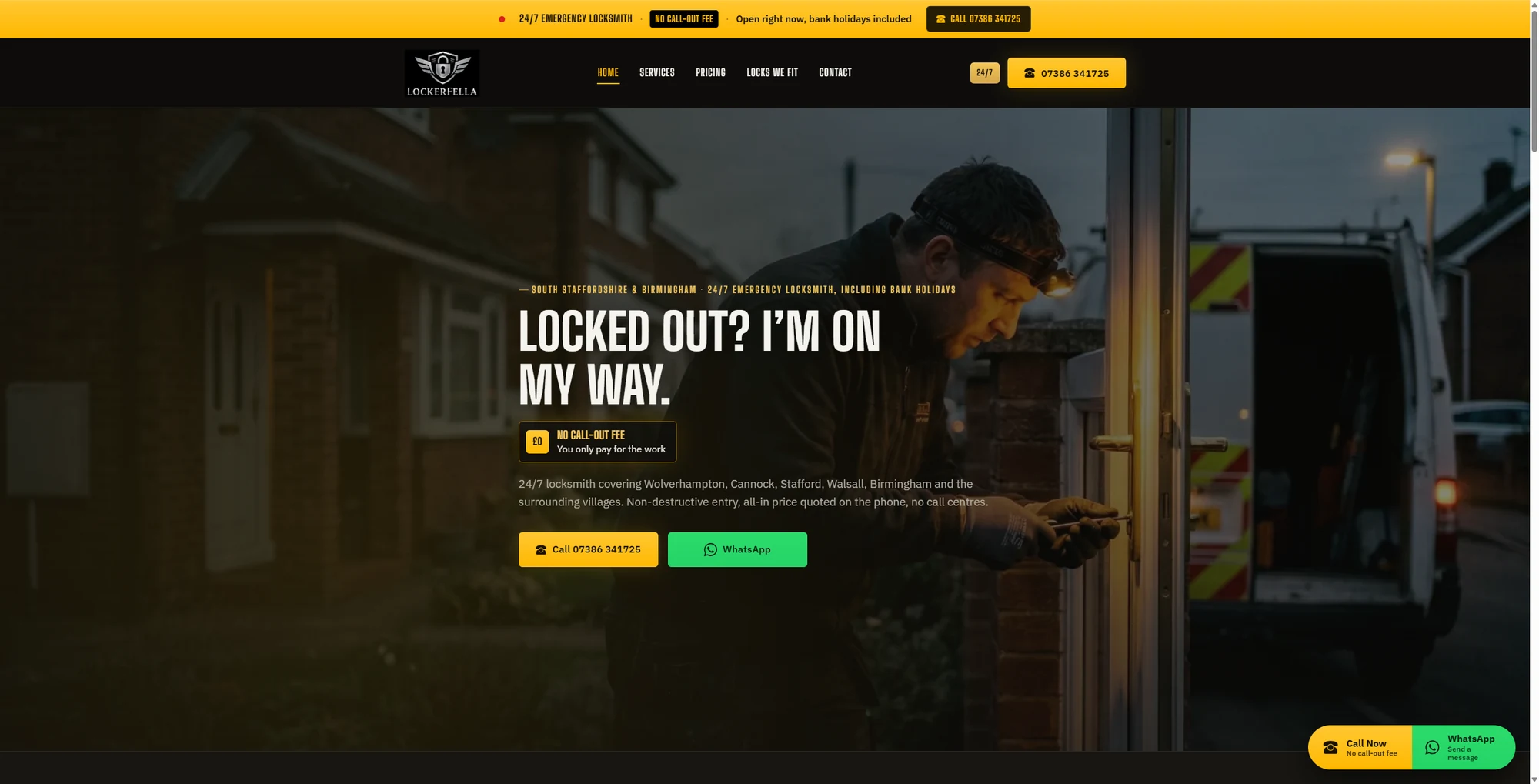
Into that mess, on 8 April 2026, we put a brand new site live: lockerfella.co.uk. Sean Hamilton, a one-man locksmith who actually lives in Brewood, his van parked on his drive in ST19. No call centre. No franchisees. The phone rings on him directly. The site went up. We pointed it at the world. And then nineteen days later, on 27 April, I sat down to see what the AIs would say if you asked them where to find a locksmith in his village.
This is what happened.
The results: what the three AIs said
I'll show you the screenshots. They do most of the work.
Google: position 3, organic, no map pack
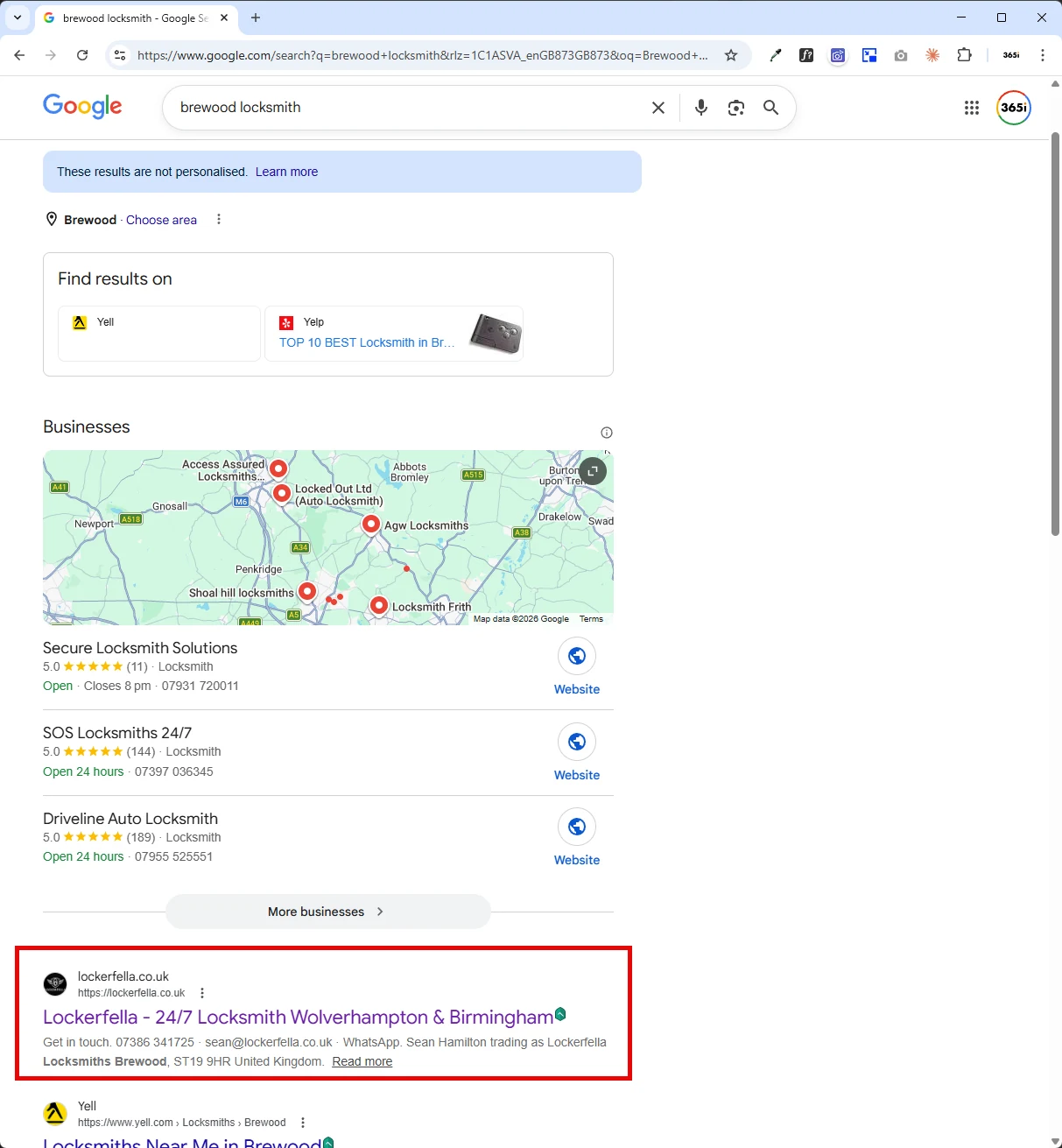
Position 3 in classic Google. Sat above national operators that have been there for years. The map pack is the call-centre lot, because Google Business Profile isn't verified yet and verification on a one-man trade outfit takes weeks. That's expected. What I didn't expect was for the site to be ranking organically at all this fast. Google's gone and worked out that "Brewood" means the Staffordshire village, not the Essex commuter town the AI assistants sometimes confuse it with.
Gemini: number one, by name, with the right specialisms
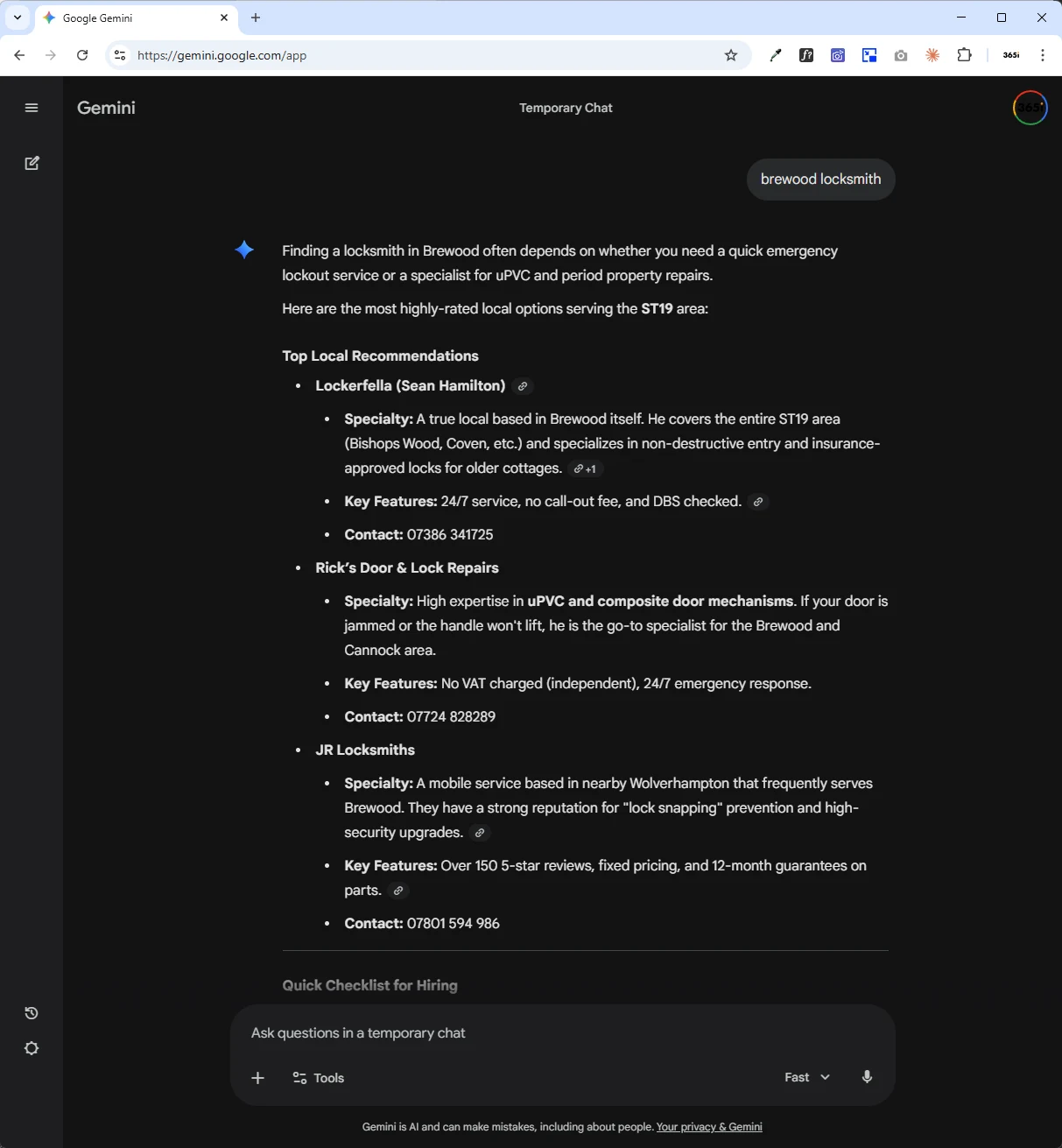
Gemini puts Lockerfella at the top of "Top Local Recommendations". It names Sean Hamilton. It correctly describes him as covering Brewood and the wider ST19. It picks out specialisms that the site actually mentions: "non-destructive entry" and "insurance-approved locks for older cottages". It pulls the 24/7, no call-out fee, DBS checked details. It even has the right phone number. None of this is hallucinated. All of it is in the site's AI Discovery Files and structured data.
ChatGPT: the only entry under "Local Brewood locksmiths"
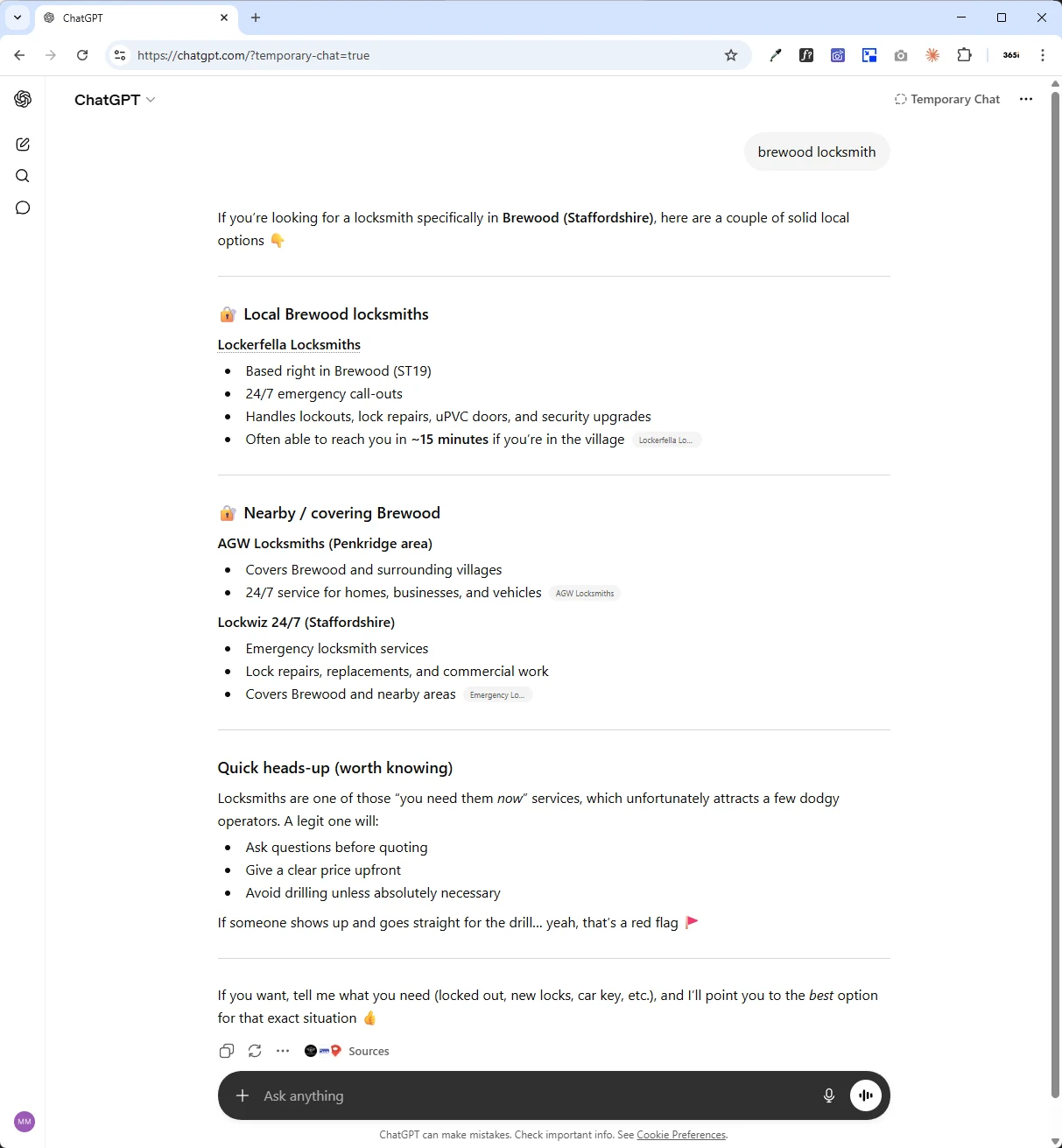
ChatGPT goes further than Gemini. It splits its answer into "Local Brewood locksmiths" and "Nearby / covering Brewood". Lockerfella is the only business in the local section. AGW Locksmiths (in Penkridge) and Lockwiz (Staffordshire-wide) get pushed into the secondary "Nearby" group. ChatGPT pulls the ~15-minute response time straight off Sean's Brewood area page. It cites lockerfella.co.uk as a source. It even tags the bullet about response time with a "Lockerfella Lo..." source citation.
Claude: missed the site entirely (and why that doesn't undermine the result)
Claude was the outlier. Asked the same query, it returned US "Brentwood" results and a couple of UK aggregator pages, and didn't mention Lockerfella at all. That's not a criticism of Claude or its model. It's evidence that AI assistants run on different data pipelines, and a brand new domain doesn't propagate into all of them at the same speed. Anthropic's web search layer hadn't picked up the site yet. ChatGPT's and Gemini's had.
The takeaway from one missed AI isn't "this approach doesn't work". It's "different AIs index different things at different speeds". Two of the three biggest AI assistants made the call inside three weeks. The third will catch up. None of them used Google's traditional ranking signals to do it.
What the site actually has
Two AIs putting a three-week-old site at the top of a niche this competitive isn't luck. Something structural is happening, and it's not the kind of thing you can wait six months and a hundred backlinks to discover. So here's what's actually different about how this site was built.
A full suite of AI Discovery Files
Lockerfella shipped on day one with the full suite of ten AI Discovery Files defined in our specification. Specifically:
llms.txt:plain-text business summary with Sean's name, training, postcode, services, contactllm.txt:singular alias that redirects tollms.txtso AIs that look for either spelling find itllms.html:the same content as a structured HTML pageai.txt:declared permissions for AI training and AI searchai.json:machine-parseable equivalent of ai.txtidentity.json:structured identity record (legal name, trading name, address, postcode, areas served)brand.txt:naming and terminology rules so AIs don't paraphrase the brand wrongfaq-ai.txt:questions and verified answers AIs can quote directlydeveloper-ai.txt:technical context: what the site is built on, what schema is whererobots-ai.txt:explicit allow/deny for each AI crawler
You can fetch any of them yourself. Open llms.txt and you get a calm, structured plain-text business card: who Sean is, what he covers, his certifications, his insurance, what he specialises in, his contact details. No marketing copy. No fluff. Exactly the kind of source AI systems prefer because there's nothing to interpret.
If you'd rather see the audit result without running the file checks yourself, the public Lockerfella profile in the AI Visibility Directory shows 10 of 10 AI Discovery Files present, scored 10/10. It's a deterministic check anyone can re-run. Lockerfella isn't the only business in the village to hit that mark, either: a removals firm a few doors away did the same, which we measured in how a local removals firm scored a perfect 10/10 for AI visibility.
Why does this matter? Because traditional SEO assumes Google reads your HTML and infers what you do. AI systems do that too, but they also look for explicit signals. Give them a file that says "I'm a one-person locksmith based in Brewood, I cover ST19 directly, here's my phone number," and you've eliminated every interpretation step where they might get it wrong.
"Structured data is useful for sharing information about your content in a machine-readable way that our systems consider and makes pages eligible for certain search features and rich results."
John Mueller, Google Search Relations, in Top ways to ensure your content performs well in Google's AI experiences on Search (21 May 2025) (verify quote at source)
When I first read this post in May, I'll be honest: it sounded like Google's standard "schema is a hint, not a ranking factor" line, repackaged for the AI era. I nearly skimmed past it. The Lockerfella result is what made me reread it. We did exactly what Mueller describes, on a new site, with no other authority signals, and ChatGPT and Gemini pulled the structured data straight off the page and used it as the basis of a recommendation. Mueller's caveat is that structured data has to match the visible content. We were strict about that. The Brewood specialisms in the Schema match the Brewood text on the Brewood page. No drift, no decorative claims, no untestable boasts. The signal was clean, and the AIs trusted it.
Schema.org markup on every page, not just the homepage
Most locksmith sites I audit have either no Schema.org markup at all, or a single LocalBusiness block on the homepage that's been broken since 2021. Lockerfella was built with schema as a first-class concern. Every page has it. The homepage has LocalBusiness. The services pages each have Service schema with detailed offerings. The area pages each have LocalBusiness nested with areaServed tied to specific GeoCoordinates and a precise addressLocality. OpeningHoursSpecification says 24/7 in the structured data and "24/7" in the visible copy. sameAs links to Sean's verified profiles.
This isn't fancy. It's what the Schema.org documentation has been telling you to do for a decade. The difference is that on Lockerfella, somebody actually did it.
You don't have to take my word for it. Run the Brewood area page through Google's Rich Results Test and Schema.org's validator yourself and both come back clean.
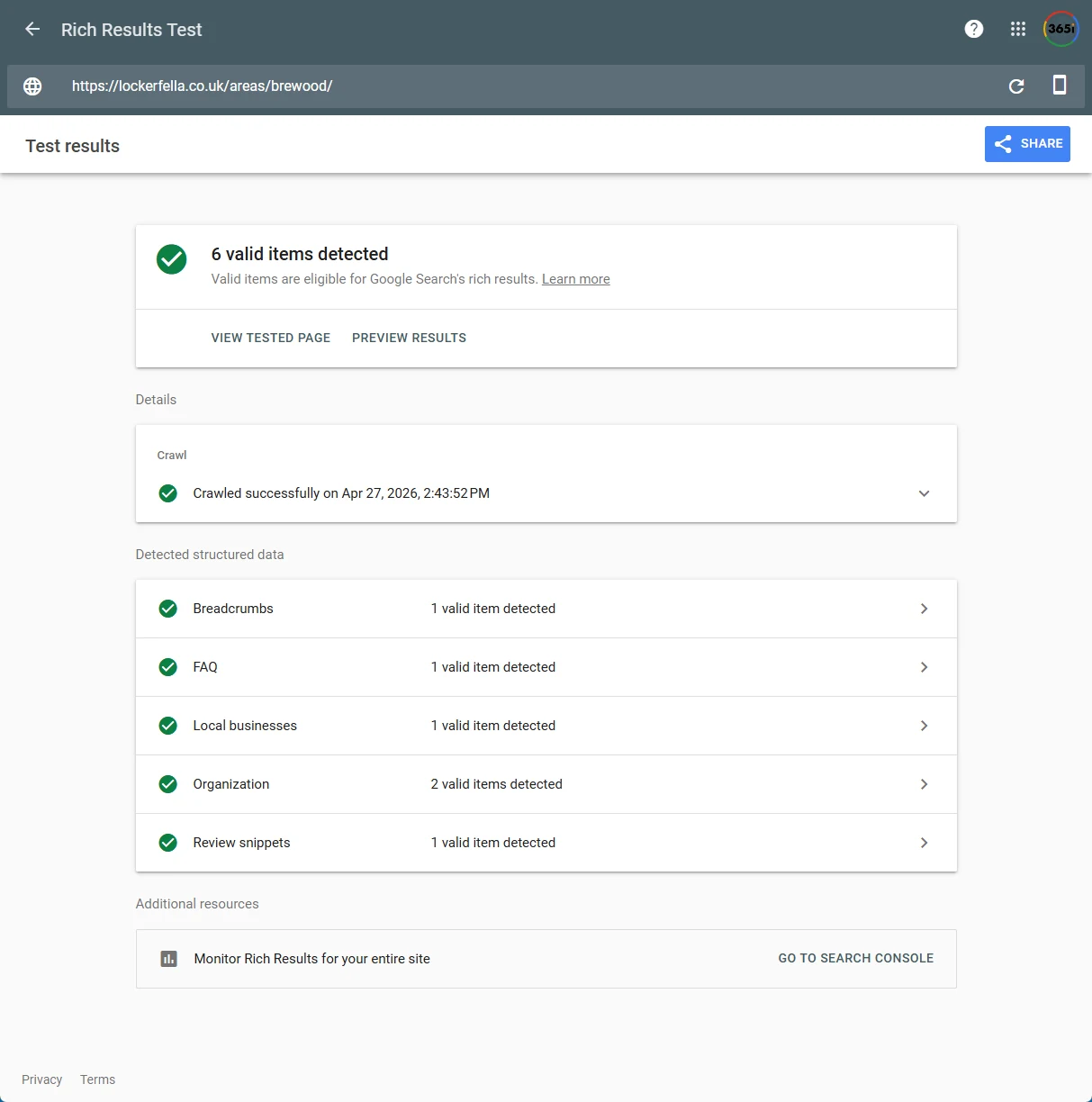
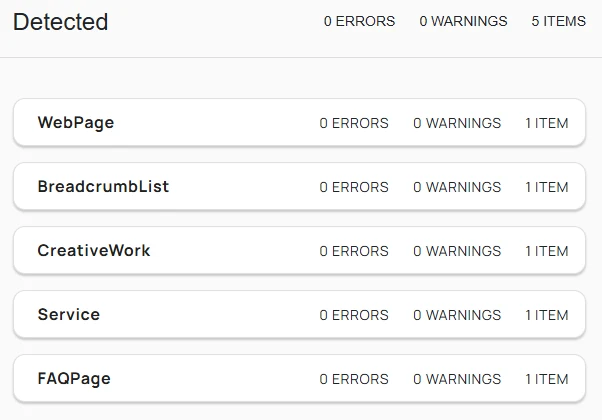
That's the part most local-trade websites can't show. Either there's no schema at all, or the schema is there but flags errors and warnings on every run. Clean schema is what AI systems read first.
Non-commodity content (the part everyone skips)
Now we get to the bit that matters most. Files and schema are the easy part. They're the table stakes. The reason a three-week-old site can outrank a 10-year-old call centre isn't that it has nicer JSON. It's that the words on the page were written by someone who actually lives there.
Here's what commodity locksmith content looks like, on roughly a quarter of every UK locksmith's "areas served" page:
"Our team of experienced professionals provide 24/7 locksmith services in [TOWN NAME]. Whether you need residential, commercial, or automotive locksmith services, we're here to help. We serve [TOWN] and the surrounding areas with fast, reliable, affordable service."
Copy that paragraph onto fifty location pages. Swap the town name. Repeat. That's the model. There's nothing in it that demonstrates anyone at the company has ever set foot in any of those towns. AIs can read it just fine. They just can't think of a single reason to recommend it.
Now look at what Sean's Brewood area page actually says.
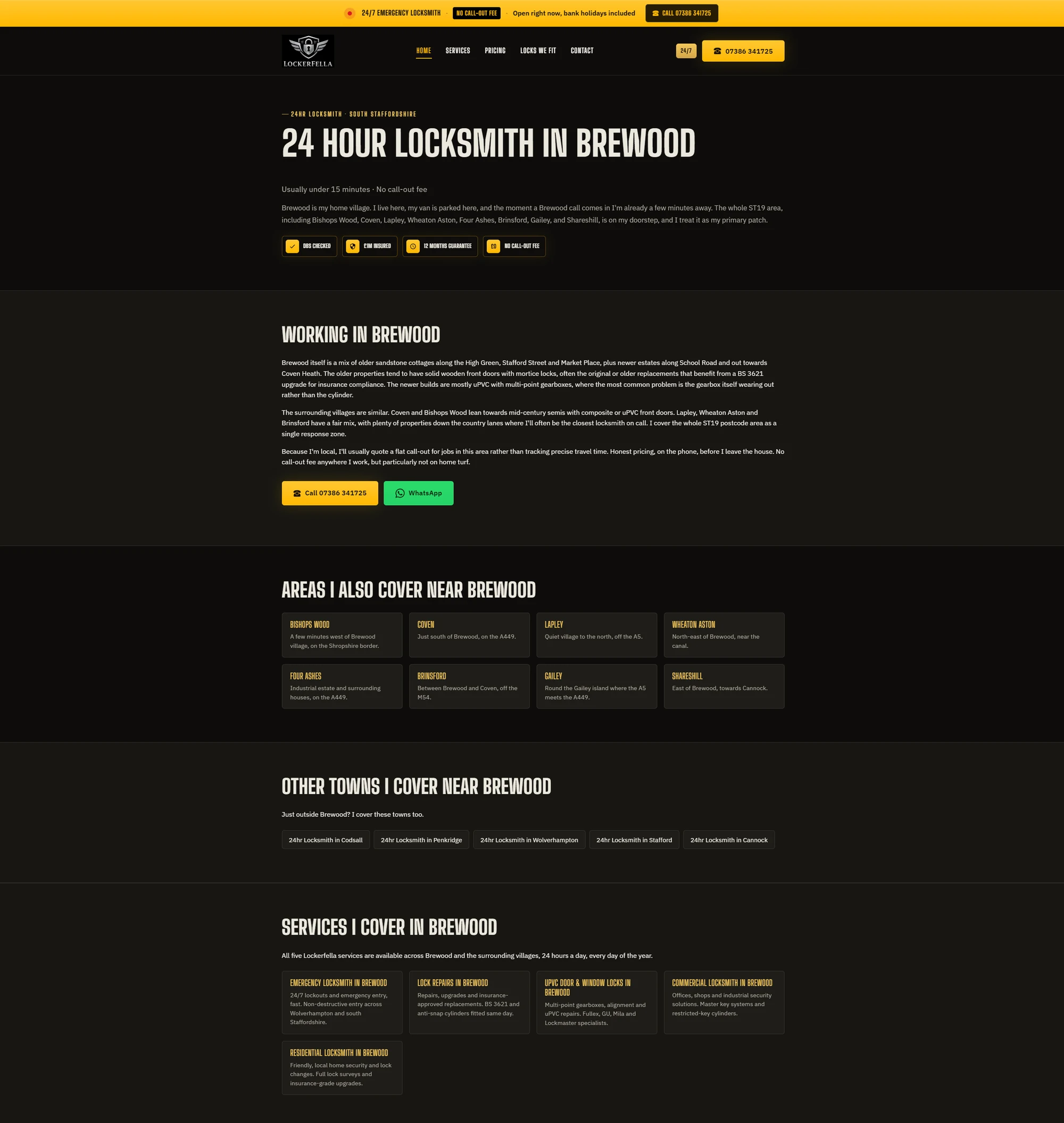
It opens with "Brewood is my home village. No call out fee." That's the headline. Underneath, the body talks about the older sandstone cottages along High Green, Stafford Street and Market Place, the newer estates along School Road and out towards Coven Heath, the mid-century semis in Coven and Bishops Wood, the country lanes in Lapley, Wheaton Aston and Brinsford. The locks section explains that the older cottages tend to have solid wooden doors with mortice locks that often need a BS 3621 upgrade for insurance, and the newer uPVC builds usually have multi-point gearboxes that wear out before the cylinder does. The pricing section flat-quotes a call-out for local jobs because Sean's not tracking travel time on a journey that takes him three minutes.
You can't fake any of that. Nobody at a call centre in Birmingham is writing about which streets in Brewood have BS 3621 problems. Nobody at a 50-location franchise knows that the gearboxes go before the cylinders on the School Road estates. The content is non-commodity by definition. If you removed the brand name from it, you could still tell who wrote it, because the level of specificity is itself the signature.
The method didn't stop at the home village, which is the part I'd want anyone copying this to understand. Every area page added since has gone through the same interview, and the newest of them, Telford, is the clearest illustration of why that matters. Telford was designated a New Town in 1968, so its housing is overwhelmingly modern, and the page says outright that the five-lever mortice conversation which dominates Stafford and older Wolverhampton barely comes up there. It's euro cylinders, composite doors and multi-point gearboxes instead. It then explains a pattern Sean noticed from the van: the estates went up together, the uPVC front doors were retrofitted together in the late nineties, and the gearboxes are wearing out together, which is why he gets called to the same fault three streets apart in the same month. Wellington and Oakengates are flagged as the exceptions, because both were market towns before the New Town was drawn around them and still have Victorian terraces that do take a mortice. The page lists dated call-outs in Priorslee, Wellington and Stirchley with the part fitted and the price paid, published with each customer's permission.
Notice what that page is doing: contradicting its own sibling pages, deliberately. A templated area page cannot disagree with the template. That is the whole test, and it is a useful one to run on your own site. If your Telford page and your Stafford page would survive having their town names swapped, neither of them is telling an AI anything it couldn't get from a competitor.
"I thought I was getting a smart website. I didn't realise I was getting the locksmith version of mission control."
Sean Hamilton, owner of Lockerfella, in the full post-launch interview (verify quote at source)
That's Sean's line about the build, given a few days after launch. He had never heard of AI Discovery Files when the discovery process started. He never asked for schema. He asked, in his own words, for a website that "looked proper". The mission-control bit underneath was bolted on by the build, not by the brief. The owner's-side view of why that gap matters, and what every small business owner should ask their builder, is the follow-up to this case study: AI Visibility for Small Businesses: What It Actually Delivers.
"There are some situations where really what you value most is content produced by someone who has first-hand, life experience on the topic at hand."
Elizabeth Tucker, Google, in Our latest update to the quality rater guidelines: E-A-T gets an extra E for Experience (15 December 2022) (verify quote at source)
I've used this quote in client meetings for three years and it's always landed politely and gone nowhere. Reading it again after the Lockerfella test, it stings differently. Tucker isn't talking about hiring an "expert author" to lend a byline to your templated copy. She's talking about the thing the call-centre locksmiths can't manufacture and Sean got for free by being from Brewood. The first E in E-E-A-T. The one that costs nothing if you're real and is impossible to buy if you're not. AIs can tell. Two of them just did.
And here's the bit that surprised me. Google itself, in its May 2025 post on succeeding in AI search, writes: "Focus on making unique, non-commodity content." They use the exact phrase. It's not my coinage. The biggest signal AI search systems are trained to favour is the one most local SEO operators are still pretending isn't a signal at all.
Why this matters beyond one locksmith
The traditional pipeline for a new business website looks like this: build site, get indexed, earn backlinks, climb rankings, drive traffic. It takes months at best, often years for competitive niches. The AI pipeline is short and ruthless: build site, make it machine-readable, AIs read and understand it, AIs cite it. Lockerfella ran the AI pipeline in three weeks.
This doesn't kill traditional SEO. Sean's organic position 3 on Google is real and worth having. The Google Business Profile will get verified and the map pack will follow. The slow signals will accumulate. But here's what's already true: the AI recommendation layer is a separate system, growing fast, and it's making decisions about who to recommend based on signals that have very little to do with what Google's classic algorithm cares about.
Backlinks didn't get Lockerfella into ChatGPT's response. There aren't any backlinks worth mentioning yet. Domain authority didn't either, by definition. Reviews didn't, because the site was too young. What got it in was a clean, consistent identity declared in machine-readable files, schema that matched the visible copy, and content written from real local experience.
That's an uncomfortable fact for a lot of agencies. Most local SEO retainers in 2026 are still built around citations, link-building, review generation, and Google Business Profile. Those things still matter for Google's map pack, and they should. But if your client's site isn't legible to AI systems, they're invisible to a growing share of search behaviour. People are asking ChatGPT, Gemini, Perplexity, and Claude for local recommendations now. Not "search". Recommendations. The phrasing matters.
Being legible to AI isn't a checkbox you tick by adding one schema block. It's a posture. It's the assumption baked into the build that the site has to make sense to a machine that has never met you, parsing your pages without your CSS, with thirty seconds to decide whether you're real.
What you can do about it
You can't retrofit a personality. You can retrofit the technical signals.
Start with the content. If your area pages read like they were written by someone who's never visited, AIs will treat them that way. Replace at least one location page this month with content from someone who actually works in that area. Specific streets, specific property types, specific local problems. If you can't get that content, hire someone who lives there to write it. The cost is trivial and the difference is the entire game.
Publish the facts an agent has to check. Coverage as a list of named towns, prices with the conditions that move them, credentials with issuers and dates, and the jobs you don't take. Lockerfella's own files are the worked example throughout the ten things your website must publish for AI agents.
Get schema on every page. Not just the homepage. Every service page, every area page. LocalBusiness with proper address, areaServed, openingHoursSpecification, sameAs. Validate it with Google's Rich Results Test. Make sure the schema matches the visible copy.
Add AI Discovery Files. The Quick Start guide walks through the priority order: llms.txt first, then identity.json, then ai.txt and robots-ai.txt. The whole thing is open and free. The WordPress plugin can generate them automatically if your site is on WordPress. The AI Visibility Checker will tell you exactly which files you have, which you're missing, and where the gaps are.
Test your visibility yourself. Stop only checking Google. Open temporary or incognito sessions on Gemini, ChatGPT, Claude, and Perplexity, and ask them the queries your customers actually type. You may be surprised by what they recommend. Or who they don't mention at all.
Audit, then publish, then check again. AIs reindex on different cycles. Check after a week, after a month, after a quarter. Keep the schema and the discovery files in sync as you publish. The Lockerfella result was visible within three weeks because the site went live with all of this in place. A retrofit on an existing site will take longer to register, but the same mechanics apply.
Find out which AI Discovery Files your site is missing
The AI Visibility Checker runs the same analysis we ran when we built Lockerfella: AI Discovery Files, schema coverage, identity consistency, and crawler access. Free, deterministic, and finished in under a minute.
Check your siteFrequently asked questions
How can a brand new website outrank established competitors in AI search?
AI systems don't use the same ranking signals as Google. They retrieve and synthesise from sources that are accessible, machine-readable, and consistent. A three-week-old site with AI Discovery Files, full Schema.org markup, and clear local content can be cited ahead of older sites that have backlinks but lack those structured signals.
Did backlinks or domain authority get Lockerfella recommended?
No. The site had launched three weeks before the test, with no backlinks and no Google domain authority. The recommendations came from machine-readable signals: AI Discovery Files declaring identity and services, Schema.org markup describing the entity, and content written from real local experience.
What are AI Discovery Files and why did they help?
AI Discovery Files are a set of machine-readable files (llms.txt, identity.json, ai.txt, and others) that declare a site's identity, services, and crawler permissions in a format AI systems can read directly. The full specification covers all 10 file types. Lockerfella launched with the full suite of ten in place from day one.
Why did ChatGPT and Gemini find the site but Claude didn't?
Different AI systems use different retrieval pipelines and indexes. Claude returned US "Brentwood" results because the site wasn't in the index Claude's search layer was using at the time. This is normal during early indexing and reflects pipeline differences, not a quality difference in the site itself. We covered the underlying retrieval mechanics in how AI search actually works.
What is non-commodity content and why does it matter for AI?
Non-commodity content is content that couldn't be lifted onto another business's site without being obviously wrong. It contains specifics that only a real practitioner would know: streets, property types, named local features, prices that match a real service area. Google's May 2025 guidance on AI search explicitly recommends "unique, non-commodity content". AI systems rank specificity above template polish.
Will Schema.org markup alone get my site into AI search?
Schema.org markup helps AI systems understand individual pages, but it describes page-level content. AI Discovery Files declare site-level identity, permissions, and brand terminology. The two work together: Schema for the page, AI Discovery Files for the entity. We compare the two in AI Discovery Files vs Web Standards.
How long does it take to build a site that's visible to AI?
Lockerfella was built and shipped over a few weeks. The AI Discovery Files were generated as part of the build, not retrofitted. Adding them to an existing site takes hours, not weeks: creating an llms.txt takes about an hour, and the Quick Start guide covers the rest. The harder part is writing content that reflects an actual local presence.
Do I need to be a developer to get my site AI-visible?
No. The AI Discovery Files are plain text and JSON. WordPress users can install the AI Discovery Files plugin to auto-generate the files. The infrastructure work is small. The harder, more important investment is writing content that reflects actual first-hand experience of your service area and customers.
Sources
- Lockerfella Locksmiths (the case study site)
- Lockerfella profile in the AI Visibility Directory (10/10 score)
- Lockerfella llms.txt (live)
- Lockerfella Brewood area page
- Lockerfella Telford area page - the same method applied to a New Town
- AI Visibility for Small Businesses: What It Actually Delivers - the owner's-side follow-up
- Sean Hamilton: The Full Lockerfella Interview - 365i Web Design
- Lockerfella locksmith website case study - 365i Web Design
- 100 mobile PageSpeed at launch: the Lockerfella case study - 365i
- Lockerfella in AI Search, 10 days after launch - Press Forge
- Top ways to ensure your content performs well in Google's AI experiences on Search - John Mueller, Google
- E-A-T gets an extra E for Experience - Elizabeth Tucker, Google
- Picking a Reliable Locksmith - London Trading Standards