
The short answer
Yes. If AI systems answer questions about your industry, your website needs llms.txt.
People are already using ChatGPT, Claude, Gemini, and other AI systems to find businesses like yours. As we cover in our expert Q&A on AI Visibility, those AI systems are forming opinions about your company right now, with or without your input. Without a llms.txt file, you have no say in what they tell people about you. With one, you give AI systems a verified, structured source of truth about who you are, what you do, and where you operate.
One important caveat. Google's May 2026 AI Search guide states that you don't need llms.txt to rank in Google's own AI Overviews. That is correct, and it has always been correct. llms.txt is not a Google ranking signal. We cover the distinction in what Google actually said about llms.txt. The file's purpose is to reduce AI hallucination about your brand in the wider AI assistant ecosystem, not to lift your position in Google. Anyone pitching it as the latter was selling a misunderstanding.
What llms.txt actually does
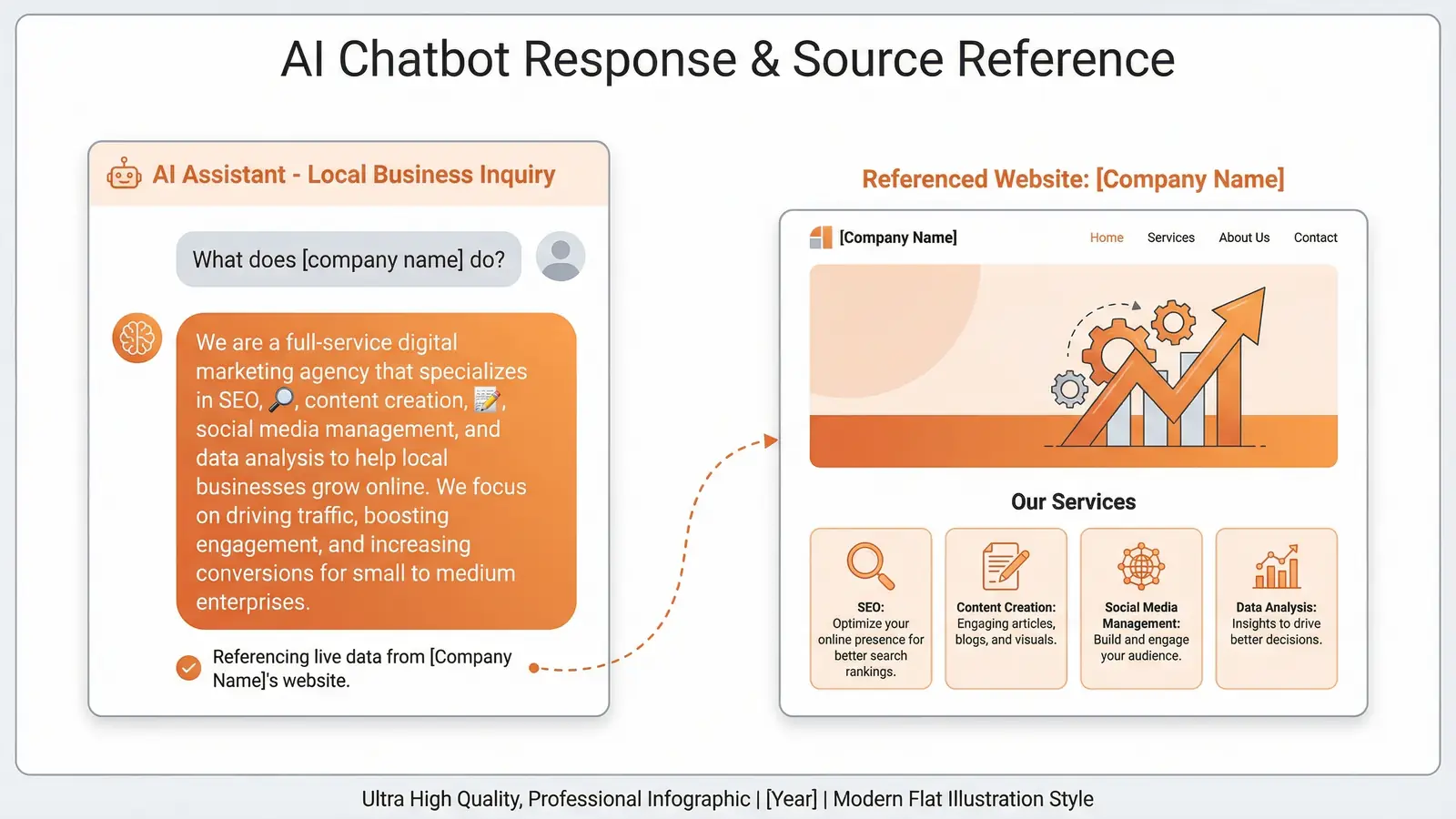
An llms.txt file is a plain text file placed at the root of your website (e.g. yourwebsite.co.uk/llms.txt). It provides AI systems with verified, structured information about your business: your name, services, location, contact details, and anything else that helps an AI system describe you accurately.
Think of it as a machine-readable identity card for your business. It is not marketing copy. It is not an About page rewritten for robots. It is a structured declaration of facts that AI systems can consume, verify, and cite with confidence.
The format follows the llms.txt specification (ADF-001), part of the broader AI Discovery Files framework. If you want a detailed, step-by-step walkthrough of creating yours, see our guide to creating your llms.txt file. This article focuses on whether you need one at all, and what happens if you don't.
Signs your website needs llms.txt
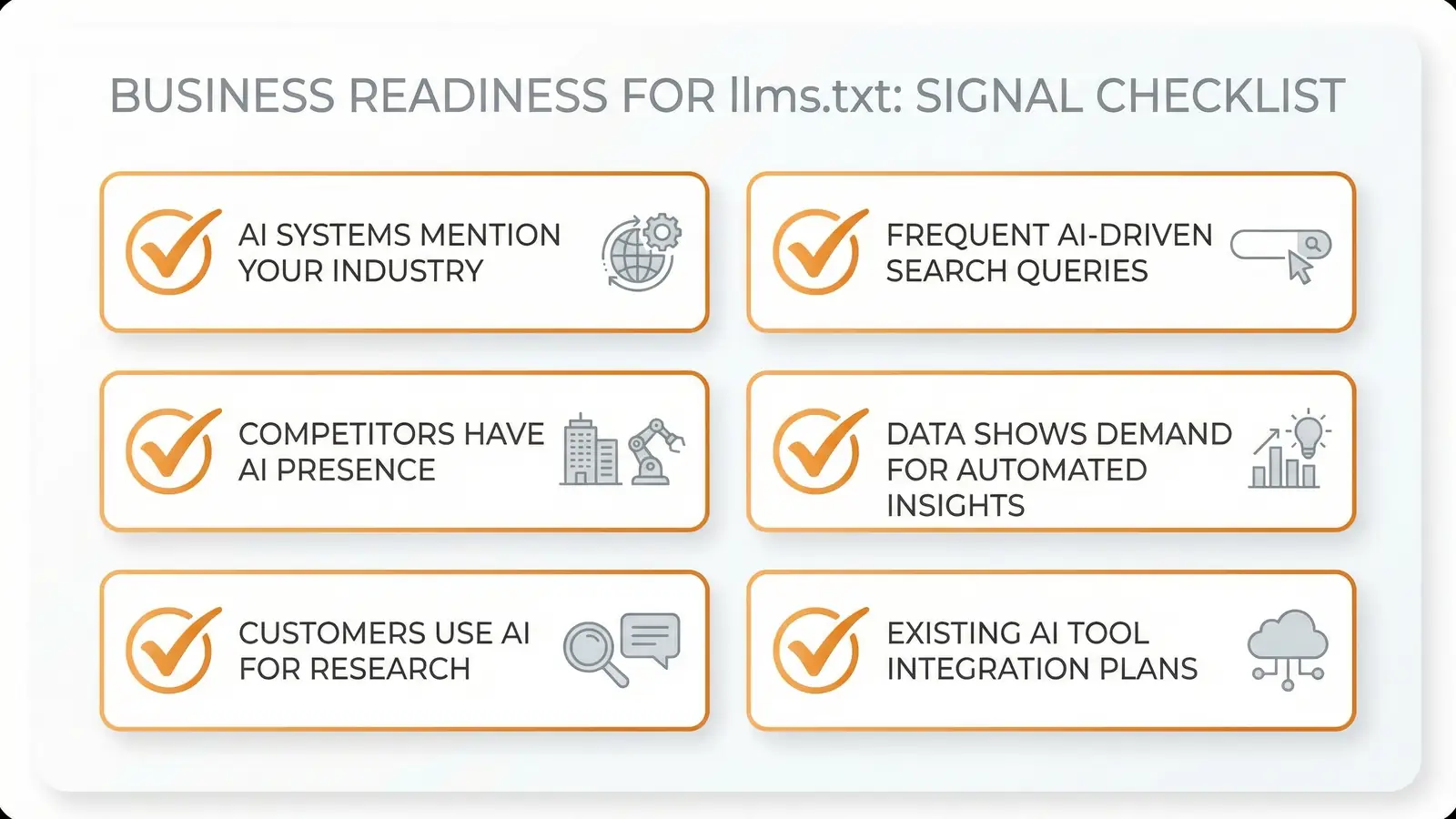
If any of the following apply to your business, implementing llms.txt should be a priority:
- You offer professional services (law, accounting, consulting, design, engineering, or similar)
- You have a local business that people search for by name or service type
- AI systems currently misrepresent or omit your business when people ask about your industry
- You have found competitors mentioned in AI answers but not your own business
- You operate in a regulated industry where factual accuracy isn't optional
- Your business name could be confused with similarly named companies
- You have recently rebranded, changed your services, or moved premises
The more of these that apply, the more urgently your website needs llms.txt. Even one is reason enough, because AI systems are already being asked about businesses like yours, and they are answering with whatever information they can piece together.
What happens without llms.txt
Without llms.txt, AI systems piece together information about your business from whatever sources they can find: your website copy, directory listings, social media profiles, review sites, news articles, and third-party mentions. None of these sources were written for AI consumption, and none of them give AI systems a single, authoritative version of the truth.
The result is predictable. AI hallucination is the most common problem: an AI system might invent services you don't offer, list incorrect opening hours, or attribute qualifications you don't hold. For a law firm, it might claim you specialise in family law when you only handle commercial property. For a restaurant, it might describe a tasting menu you discontinued two years ago. These aren't edge cases. They happen routinely.
Brand confusion is the second risk. If your business name is similar to another company (even one in a different city or different industry), AI systems may merge your identities. They might attribute another company's reviews to you, or direct enquiries to the wrong address. Without an explicit declaration of your identity, AI systems have no reliable way to distinguish you from similarly named entities.
Omission is the quietest risk, and potentially the most damaging. If AI systems cannot confidently identify your business, they may simply not mention you at all. When someone asks an AI system to recommend a solicitor in Manchester or a web design agency in Bristol, your business might be excluded entirely, not because you're unsuitable, but because the AI system lacked enough structured information to include you with confidence.
Consider this
You would not leave your Google Business Profile blank and hope Google figures it out. The same logic now applies to AI systems. If you don't tell them who you are, they'll guess, and they'll often guess wrong.
"For every 1,000 searches on Google in the United States, 360 clicks make it to a non-Google-owned, non-Google-ad-paying property."
Fishkin's data shows that most Google searches already end without a click to the open web. AI-powered answers accelerate that trend. When someone asks an AI system to recommend a business, there's no results page with ten blue links. There's one answer. If your business isn't the answer, you don't get a second-place consolation click. You get nothing. That's the environment llms.txt was built for: one where being accurately represented in the AI's answer is the entire game, not a bonus.
Who benefits most
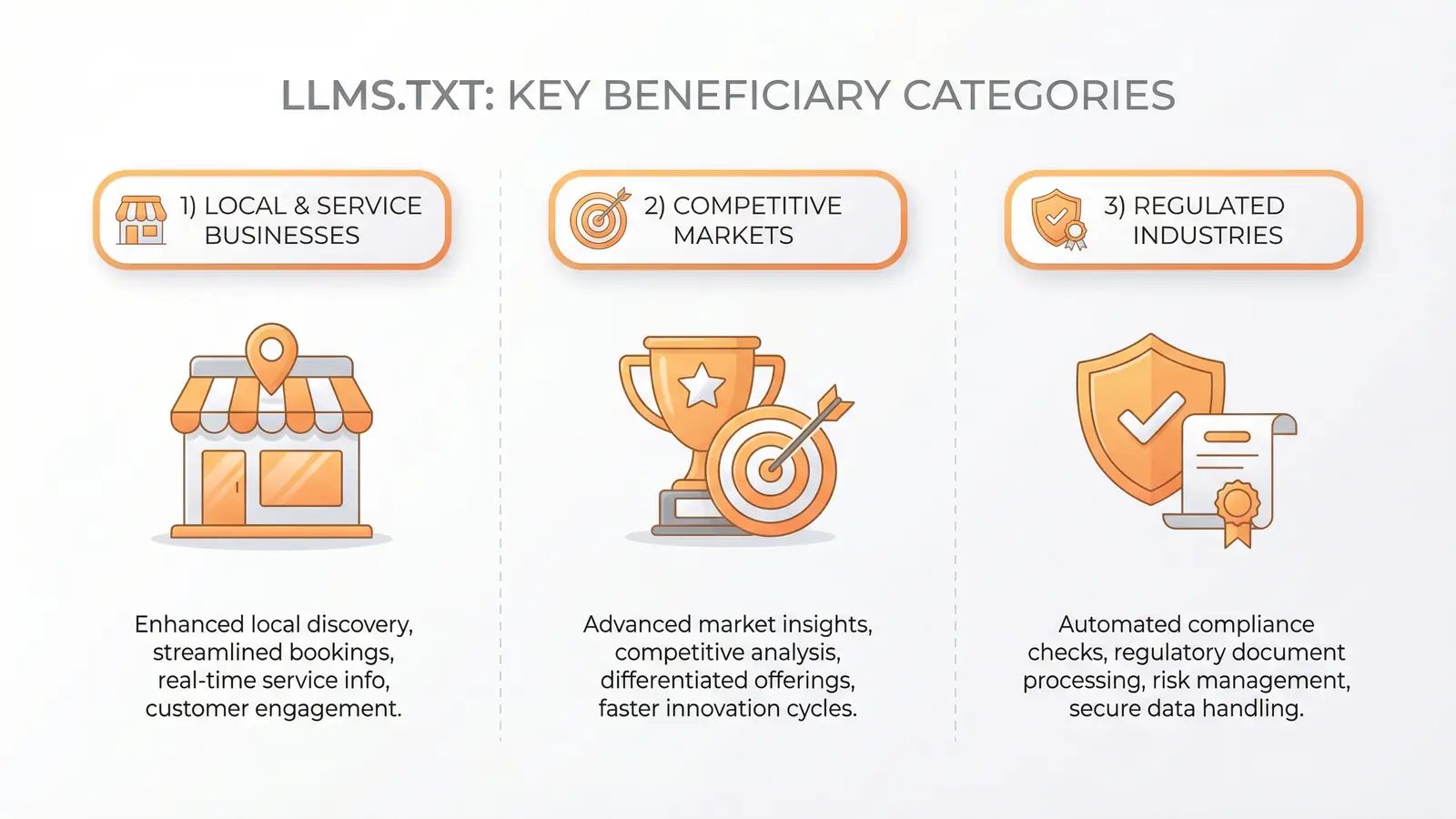
Every business with a website benefits from llms.txt, but three groups benefit most.
Local and service businesses
If your business serves a specific area or offers professional services, you are most at risk of AI misrepresentation. Local businesses are frequently confused with similarly named companies in other locations. Service businesses often have their offerings described inaccurately because AI systems struggle to distinguish between what you do and what your competitors do. A llms.txt file gives AI systems a definitive answer, straight from the source.
Businesses in competitive markets
In markets where AI recommendations influence purchasing decisions, being accurately represented is a competitive advantage. If a potential customer asks an AI system to recommend three web design agencies in Edinburgh, and your competitors have llms.txt files but you don't, the AI system has more confidence in their identity than yours. That alone can determine whether you appear in the recommendation or not.
Regulated industries
Healthcare providers, legal practices, financial advisers, and other regulated businesses face a particular risk. Inaccurate AI-generated information about regulated services isn't merely inconvenient; it can be actively harmful. If an AI system tells someone your practice offers services you aren't licensed to provide, or describes your qualifications incorrectly, the consequences extend beyond lost business. A llms.txt file establishes the facts explicitly, reducing the scope for harmful misrepresentation.
The cost of waiting
AI systems aren't static. They build and refine their understanding of the world continuously. Every day that passes without a llms.txt file is another day that AI systems form impressions of your business based on incomplete or inaccurate information. Those impressions compound over time.
Early adopters of AI Discovery Files are establishing their identity in AI systems right now. They are setting the baseline that AI systems will reference going forward. Correcting a well-established misrepresentation is far harder than preventing one in the first place. The businesses that act now are the ones AI systems will describe most accurately in twelve months' time. Our complete guide to appearing in AI search results covers the full process, from crawler access to structured data to trust signals.
"We propose that those interested in providing LLM-friendly content add a /llms.txt file to their site. This is a markdown file that provides brief background information and guidance, along with links to markdown files providing more detailed information."
Howard's proposal is refreshingly simple. One Markdown file. Your root directory. Brief background, a few links, done. He designed it this way deliberately: no complex schemas, no API integrations, no build tools. If you can write a paragraph about your business and save a text file, you can create an llms.txt. That's why the cost of waiting has no technical excuse. The barrier isn't capability; it's awareness. The fifteen minutes it takes to create the file is trivial compared to the months of compounding misrepresentation you avoid.
The practical effort involved is minimal. Creating a llms.txt file takes fifteen minutes. Deploying it to your website takes less than five. The cost of inaction (misrepresentation, lost recommendations, and brand confusion) is ongoing and cumulative.
Key takeaway
AI systems solidify their knowledge over time. The longer you wait, the harder it becomes to correct what they already believe about your business. Implementing llms.txt now is an investment in your future AI visibility.
How to get started
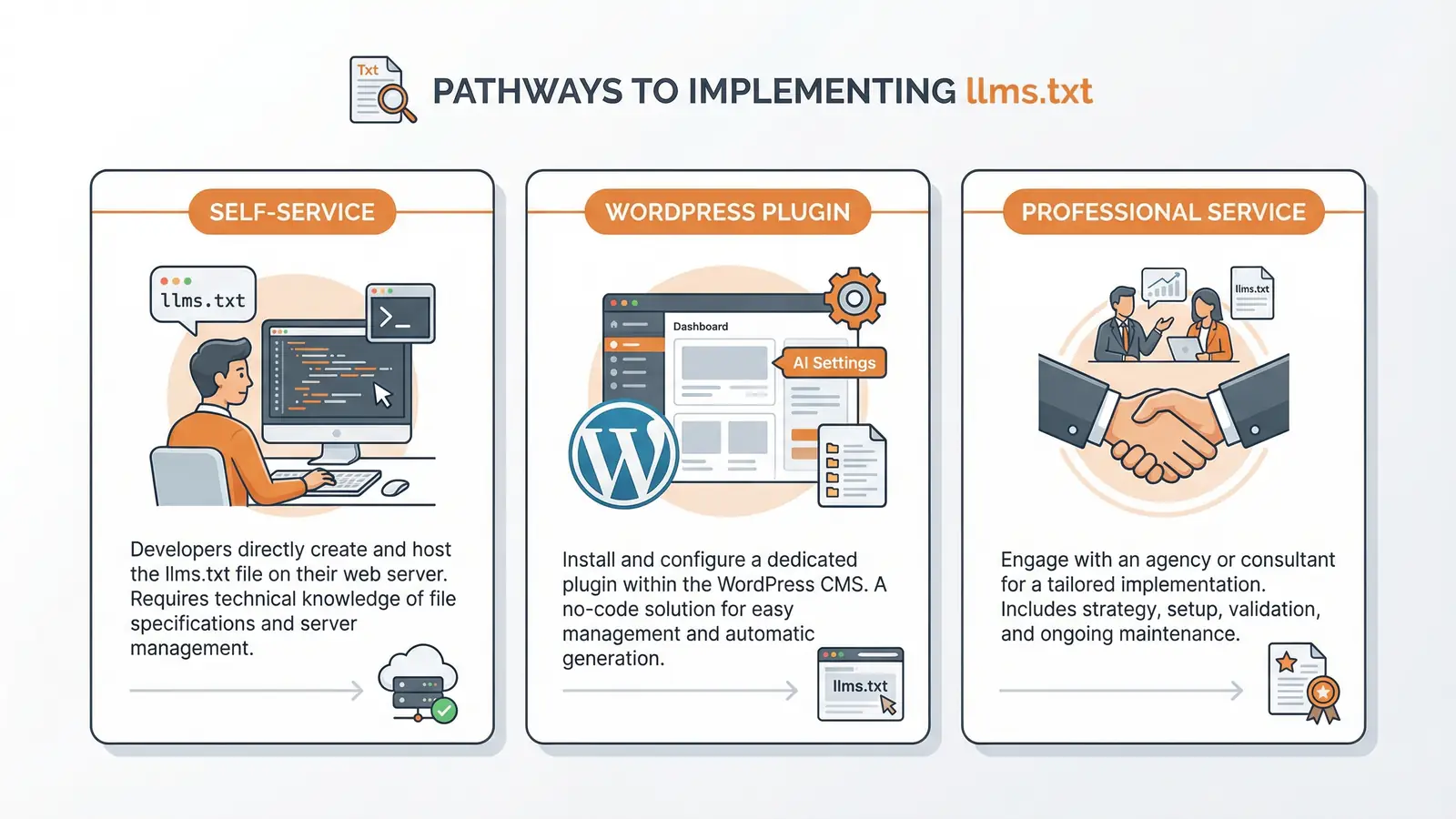
You have three options, depending on your technical comfort and how thorough you want to be:
- Create it yourself in 15 minutes. Our step-by-step guide walks you through the format, gives you real examples to follow, and shows you how to verify it works. No technical expertise required.
- Use the WordPress plugin. If your site runs on WordPress, the AI Discovery Files plugin generates and manages your
llms.txt(and all 10 AI Discovery Files) directly from your dashboard. Install, configure, done. It will also tell you whether anything is reading the file: see 30 days of AI crawler logs from a real site. - Get the full set written for you. If you want the complete set of AI Discovery Files created professionally, the AI Discovery Files Service Pack handles the work. We research your business, write and validate all 10 files, and deliver them ready for you or your developer to upload to your site root. On WordPress, the free plugin generates and serves them for you.
Whichever option you choose, the first step is understanding where you stand right now. Our free AI Visibility Checker analyses your website in 30 seconds and tells you exactly which AI Discovery Files you have, which you are missing, and what to prioritise.
Check your AI visibility
See how AI systems currently perceive your website. Free, instant, and no sign-up required.
Check your website nowIf the honest answer is that nobody in your business is going to write and maintain it, that is worth admitting early rather than publishing a stale file. Our done-for-you setup pack writes and deploys the whole set instead.
Frequently asked questions
Is llms.txt only for large businesses?
No. Any business that could be mentioned by an AI system benefits from llms.txt. In fact, smaller businesses often benefit more because they have less existing information for AI systems to work with, making misrepresentation more likely.
How quickly will AI systems find my llms.txt?
AI systems re-crawl websites on varying schedules. Most major AI systems will discover a new llms.txt file within a few weeks. Some may find it sooner. The file is placed at your website root, which is among the first locations AI crawlers check.
What if I don't have a website at all?
If you don't have a website, llms.txt isn't relevant yet. However, if you are planning to build a website, implementing llms.txt from day one is much easier than adding it later. It should be part of your initial site launch.
Can llms.txt replace my About page?
No. Your About page is written for humans. llms.txt is written for AI systems. They serve different purposes and should contain different content. Your About page can be narrative and persuasive. llms.txt should be factual, structured, and unambiguous.
Is llms.txt enough, or do I need all the AI Discovery Files?
llms.txt is the most important starting point and provides real value on its own. For complete AI visibility, the full set of 10 AI Discovery Files covers identity, permissions, brand guidelines, FAQs, and technical context. Start with llms.txt and expand from there.
What if my business information changes frequently?
llms.txt should contain your stable business identity: who you are, what you do, where you operate, and how to contact you. This information rarely changes. If you rebrand or change services, update llms.txt at the same time. It takes only a few minutes.
For a deeper understanding of how llms.txt fits into the broader framework, see our guide to what AI Discovery Files are, or explore the llms.txt specification directly. To understand why this matters at a strategic level, read why AI visibility matters and the formal AI Visibility definition.