
What "Agentic Browsing" is, and why Google added it
Run a site through PageSpeed Insights today and you'll see something that wasn't there a couple of months ago. Next to Performance, Accessibility, Best Practices and SEO sits a fifth result: Agentic Browsing. It doesn't show a score out of 100. It shows a ratio, like 3/3.
Google slipped it in quietly. Lighthouse 13.3, released on 7 May 2026, moved a new Agentic Browsing category into the default config, and PageSpeed Insights inherited it within a couple of weeks. By the time most people noticed, it was already running on every report. The category scores one thing none of the others touch: how ready your page is for an AI agent to read it, understand it, and act on it without a human driving.
That is a notable shift in what Google measures. Performance is for humans waiting on a slow page. Accessibility is for humans using assistive technology. Agentic Browsing is for software: the assistants and agents that now visit websites on a person's behalf to compare, summarise, and book. Google has decided that's worth a category of its own, which tells you where it thinks the web is heading. If you want the wider business picture behind that shift, we set out why your next website visitor might be an AI agent rather than a person and what those visitors need from your site.
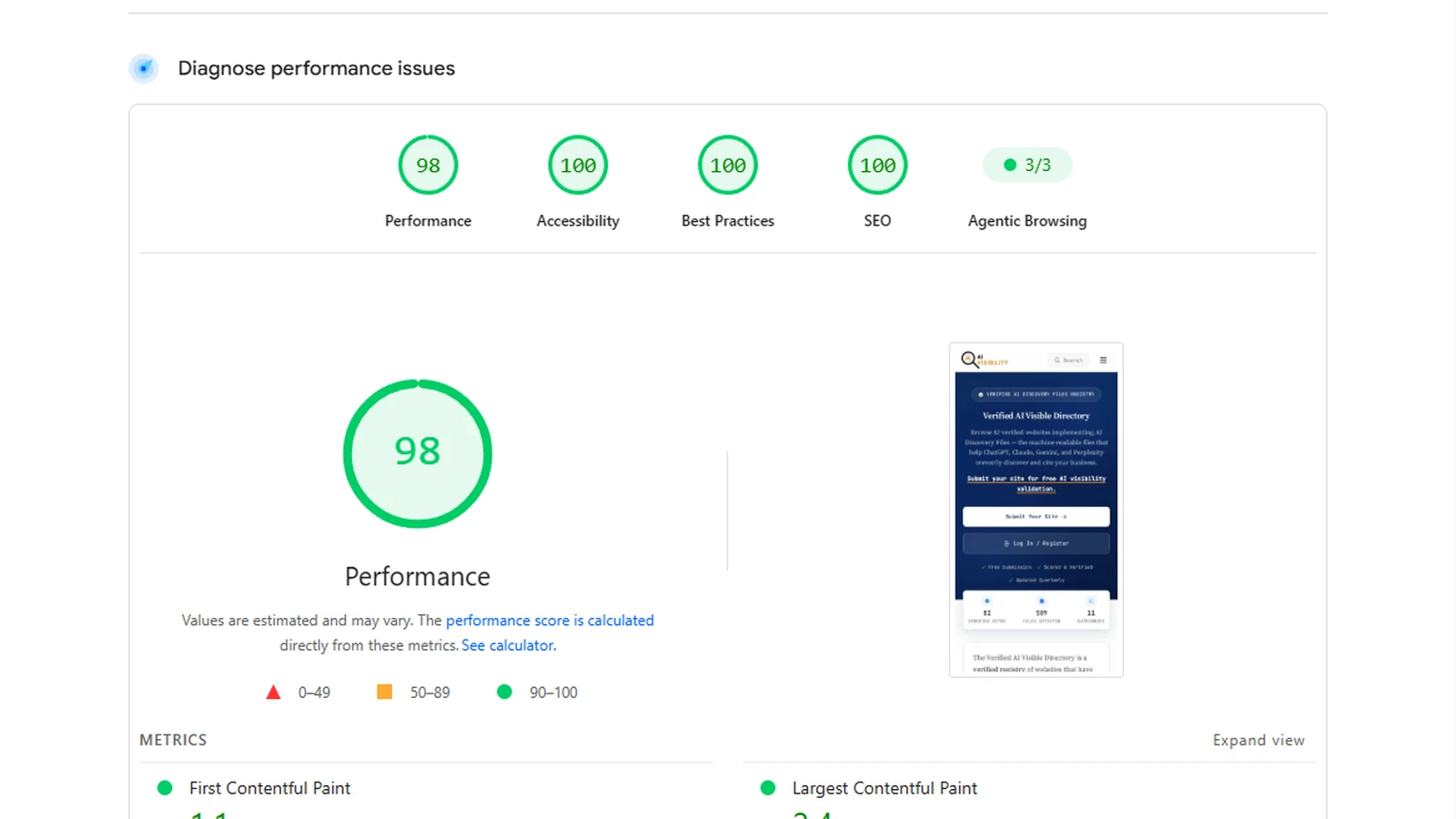
The screenshot above is this site's own report, and the 3/3 is the part worth dwelling on. Hitting it isn't an accident. It's the result of three specific things being right, and one of those three is a file this site has spent a year defining. We'll get to that.
The three checks Agentic Browsing actually runs
There's already a lot of loose writing about this category, some of it inventing audits that don't exist. So here is the accurate version, taken from Google's own Lighthouse documentation. In PageSpeed Insights, the default Agentic Browsing result is built from three checks.
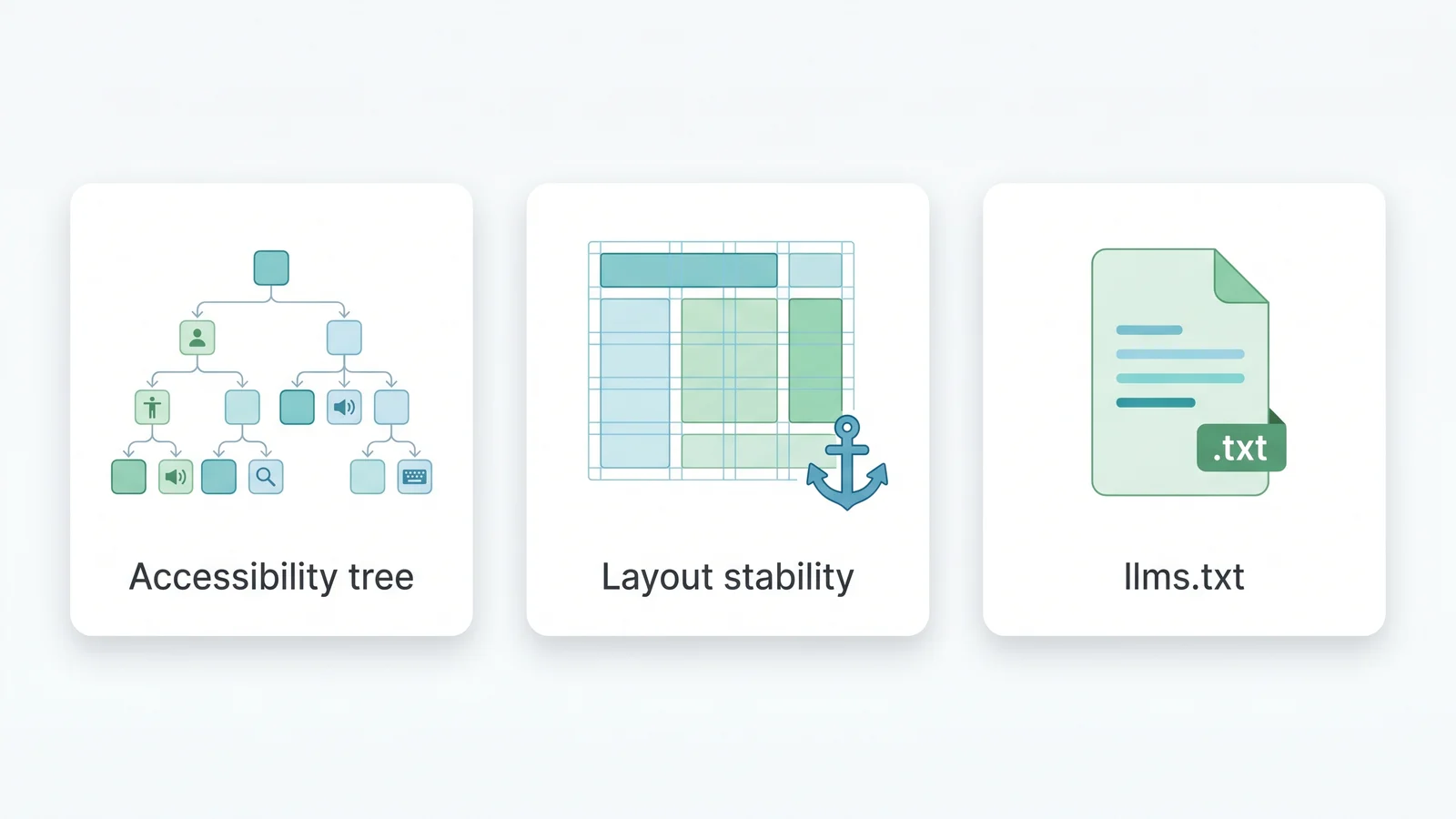
One: the accessibility tree. This reuses the accessibility work Lighthouse already does, but filters it down to what a machine needs. Are interactive elements properly named? Are roles and parent-child relationships valid? Is anything interactive being hidden from the tree? An agent doesn't look at your pretty buttons. It reads the accessibility tree, the same simplified structure a screen reader uses, because that's the cleanest map of what the page contains and what can be clicked.
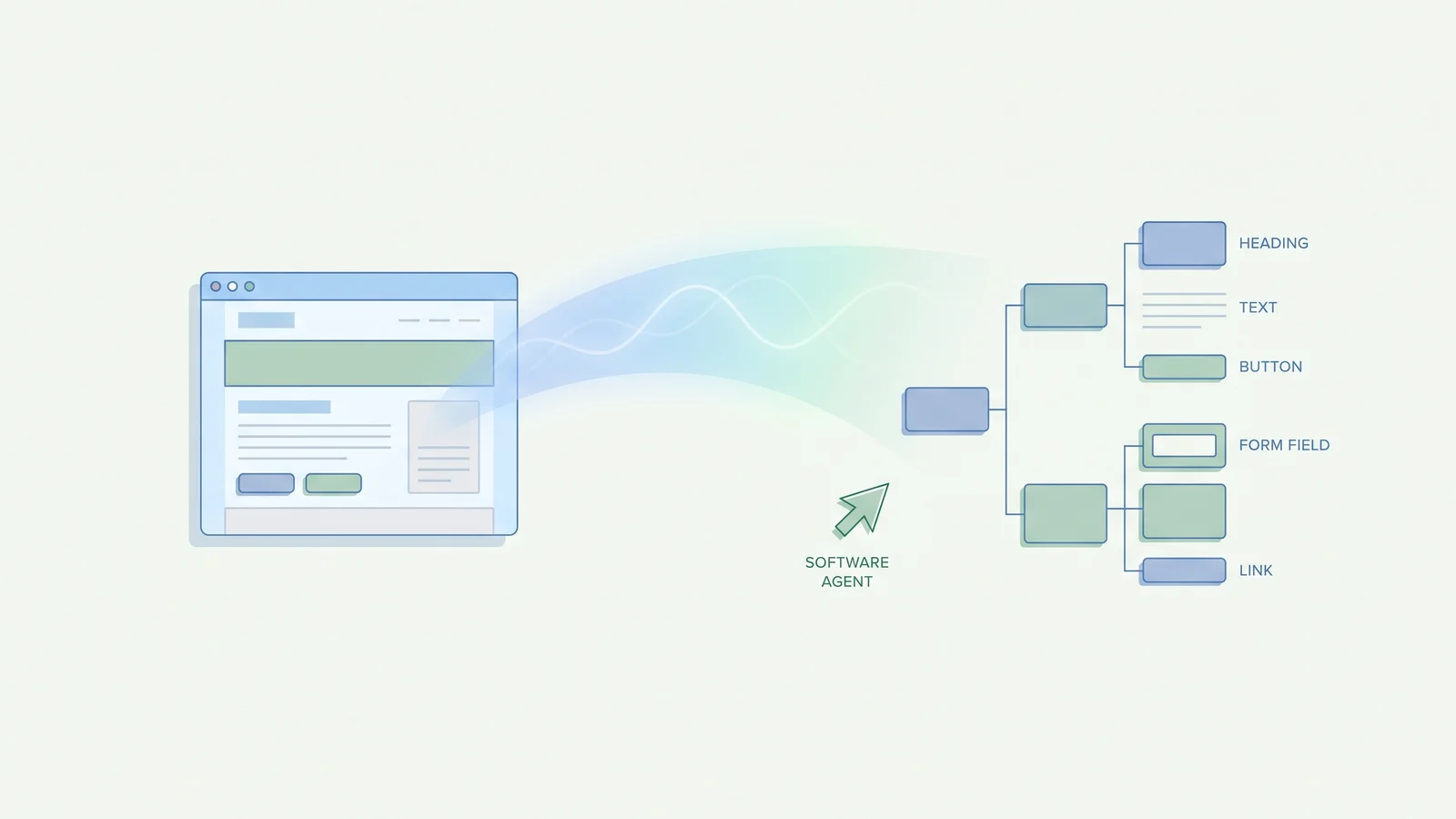
Two: Cumulative Layout Shift. You already know CLS as a Core Web Vitals metric, the one that punishes pages where content jumps around as it loads. Here it's reframed for agents. Many agents take screenshots of a page and reason about what they see. If the layout keeps shifting, the screenshot an agent acts on may no longer match the page underneath it. A button moves, the agent clicks empty space. So stability isn't just polish any more. It's correctness.
Three: llms.txt. The third check looks for an llms.txt file at your domain root and, if it finds one, checks that it's well-formed: a proper heading, enough content to be useful, and links. This is the check that should make anyone working on AI visibility sit up, because Google has quietly started scoring an AI Discovery File as a measure of agent readiness.
Google is now scoring an AI Discovery File
This site exists to make one argument: that AI Visibility Checking is about machine-readable inputs, the files and signals a site publishes so AI systems can discover, interpret, and trust it. Not rankings. Not brand mentions. Inputs. We've defined ten AI Discovery Files, written specifications for each, and built a checker that validates them deterministically. The whole premise rests on the idea that these inputs matter. If you want that argument made in full, against the popular view that AI visibility is just brand mentions, what AI visibility actually is lays it out.
Now Google's own performance tool measures one of them. The llms.txt check inside Agentic Browsing is Google validating an AI Discovery File, in the same breath as Performance and SEO. You don't have to take our word that machine-readable files are becoming load-bearing. You can read it off a PageSpeed report.
The SEO field noticed the same thing, with the same surprise. Marie Haynes, who runs Marie Haynes Consulting and has spent years reading Google's signals closely, flagged how striking it is that one of the checks centres on llms.txt at all. It's striking because the same field spent much of the spring arguing the file was pointless. We pushed back on that at length in what Google actually said about llms.txt. The argument was always that llms.txt does a narrow job well, not that it's a ranking trick. A diagnostic check inside Lighthouse is exactly that narrow job, made official.
Worth being careful here. This check rewards a valid llms.txt; it doesn't prove the big LLMs fetch and use it for answers. Those are two different claims, and we keep them separate on purpose. What changed is the direction of travel. A year ago, publishing an AI Discovery File was a bet on where the web was going. Today, Google's tooling gives you a green tick for it. The bet is looking less speculative by the month.
Why there's no 0 to 100 score
The thing that throws people first is the format. Every other Lighthouse category gives you a number out of 100, colour-coded, weighted, easy to chase. Agentic Browsing gives you 3/3, or 2/3, and a list of what passed. That's deliberate.
"Because the standards for the agentic web are still emerging, the current focus is to gather data and provide actionable signals rather than a definitive ranking."
Chrome for Developers, in the official Lighthouse agentic browsing scoring documentation (verify quote at source)
When I read that line, what struck me was the honesty of it. Google could have invented a confident-looking weighted score and let everyone chase it, the way the industry has chased the Performance number for years. It didn't. It said, in effect, the agentic web isn't settled enough to grade you on, so here are clean signals instead. That restraint is rare from a company whose scores move budgets. It also tells you the category will change. What counts as agent-ready in a year may not be these exact three checks, and the pass ratio is Google leaving itself room to evolve them without a misleading number locking it in.
There's a second consequence that trips people up. A plain page with no AI work at all can still pass. Google doesn't penalise a site for lacking agentic features, so a simple, valid page that happens to have a clean accessibility tree and a stable layout will score well even with no llms.txt. The category isn't a stick. It's a readiness signal. The value isn't in scraping a pass; it's in being demonstrably ahead while almost nobody is paying attention.
The fourth check: WebMCP, and why it doesn't count yet
There's a fourth audit in the category that you won't see in your 3/3, and it's the most forward-looking of the lot. WebMCP is a proposed standard that lets a website declare specific actions an agent can call directly: submit this form, start this booking, add this to a cart. Instead of an agent guessing how to use your interface from a screenshot, you hand it a labelled set of controls.
It's a smart idea, and it's nowhere near ready. The WebMCP audit needs Chrome 150 and an origin trial registration to run at all, and it's weighted low while the standard stabilises. In practice it may fail on nearly every site on the web today, including sites doing everything else right. That's why it sits outside the default pass ratio. PageSpeed Insights shows you the three checks that work now and keeps the experimental one out of the number.
The practical takeaway: don't lose sleep over WebMCP yet. Watch it. The pattern with these things is that "experimental, origin trial only" becomes "default" faster than you expect, and llms.txt went from a niche proposal to a Lighthouse check in about a year. When WebMCP graduates, the sites that already think in terms of machine-readable structure will adopt it in an afternoon. The sites that never started will be back at the beginning.
How to score 3/3
None of the three default checks is exotic. If you build pages properly, you're most of the way there already. Here's the practical version.
Clean up the accessibility tree. Give every interactive element a real, programmatic name. Buttons that say what they do. Form fields with associated labels. Links with text, not just an icon. Don't hide interactive content from assistive technology with stray aria-hidden or off-screen tricks. Good accessibility and good agent-readability are the same engineering, which is a rare case of one fix paying two bills. Lighthouse's existing Accessibility audit will show you most of what to correct.
Keep the layout still. Reserve space for images and embeds with explicit width and height so nothing reflows when they load. Avoid injecting banners or ads that push content down. Watch your web fonts, since a late font swap is a classic late shift. The goal is a Cumulative Layout Shift close to zero, which is the same target Core Web Vitals already sets, now doing double duty for agents.
Publish a valid llms.txt. Put an llms.txt at your domain root with a clear H1, a useful description of what your site is and offers, and links to your key pages. Our guide on how to create llms.txt has a working template. Once it's live, validate it. The free AI Visibility Checker runs the same deterministic check Lighthouse does on that file, and goes further, validating the rest of the AI Discovery Files, identity consistency, and whether AI crawlers are actually allowed in. One detail trips up more sites than any other: a stray rule in robots.txt or a CDN setting quietly blocks the very agents you're trying to court, a trap we cover in is your website blocking AI.
Check your llms.txt and the rest of your AI Discovery Files
The free AI Visibility Checker validates the same llms.txt that Lighthouse scores, plus the other nine AI Discovery Files, identity consistency, and crawler access. Deterministic, no opaque score, finished in under a minute.
Check your siteWhat a 3/3 does not mean
It would be easy to wave the perfect ratio around and imply it buys you AI traffic. It doesn't, and the honest read matters more than the headline.
"The agentic browsing category is currently still marked as 'under development'."
Matt Zeunert, Founder at DebugBear, in Google Lighthouse Has A New Agentic Browsing Category (verify quote at source)
Zeunert builds performance monitoring tools for a living, so when he points at the "under development" label it lands differently than when a marketer waves the same category around as the next big ranking signal. That phrase is doing a lot of work. It means the checks can change, the scoring can change, and reading too much certainty into today's 3/3 is a mistake. We treat it the way we treat any emerging signal on this site: useful, directional, not gospel. The category is a measurement of readiness, not a forecast of outcomes.
So be clear on the limits. A 3/3 means an agent can read your page, your layout won't betray it, and your llms.txt is valid. It does not mean ChatGPT, Gemini, or Google's own AI surfaces will cite you on any given prompt. It doesn't even prove they fetch your llms.txt. Whether AI crawlers actually read these files is a separate question, and we went and measured it directly in do AI crawlers actually read your AI Discovery Files. Passing Agentic Browsing is the floor you build on, not the building.
What agent-ready looks like in the wild
The three checks are abstract until you see a site that was built to pass them before Google had a name for them. We build for two local businesses in the same Staffordshire village that, between them, make the point cleanly.
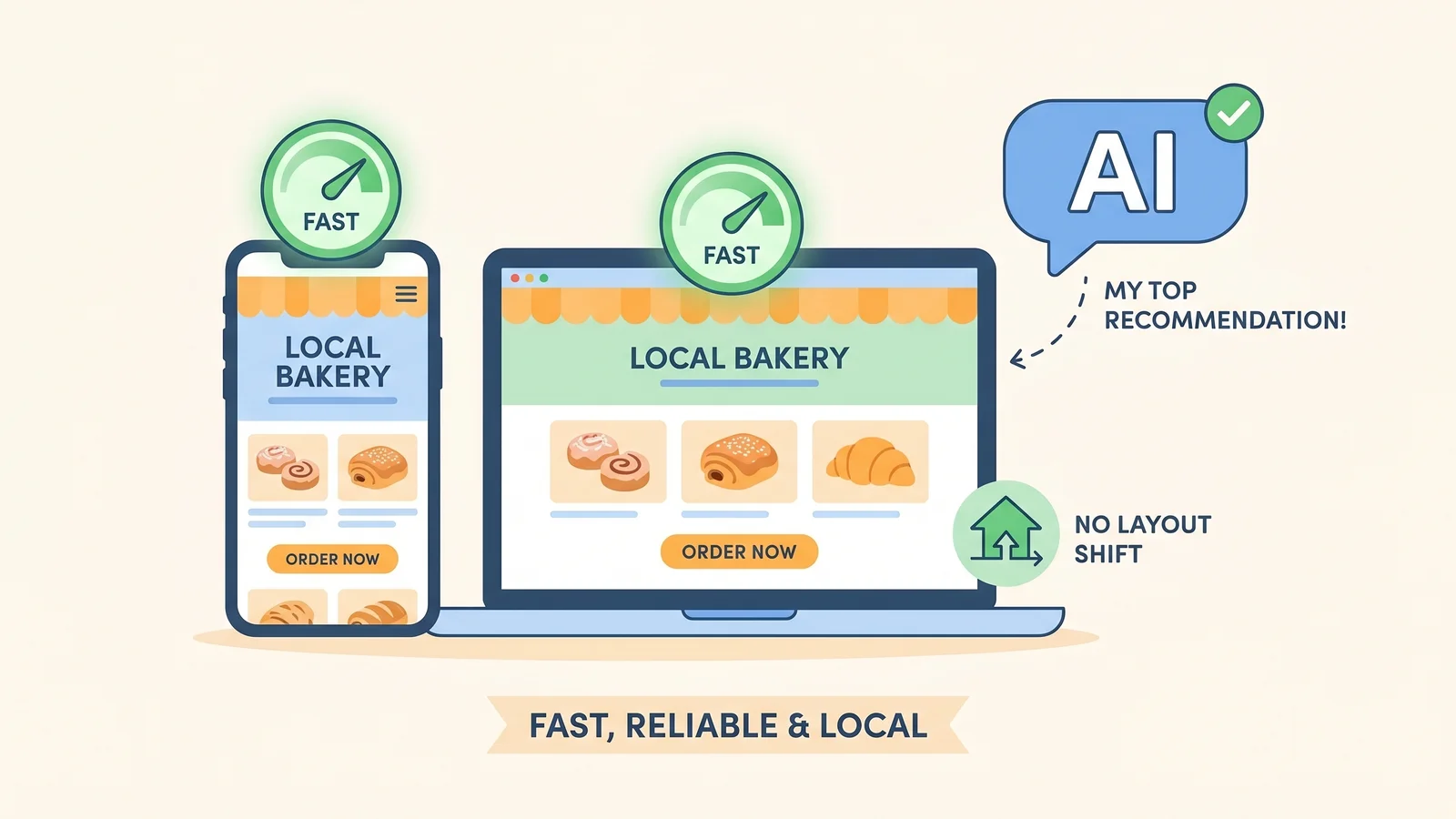
Lockerfella, a Brewood locksmith, launched as a brand-new hand-coded site on 8 April 2026. It shipped its AI Discovery Files, including llms.txt, on day one, and posted a Cumulative Layout Shift of zero and a clean accessibility build from the first PageSpeed test. That's two of the three Agentic Browsing checks green by construction, and the third, llms.txt, present and valid before the category existed. Within roughly two weeks it was the top recommendation on ChatGPT and Gemini for "brewood locksmith", with no backlinks. Its area pages for Wolverhampton, Cannock, Stafford, Penkridge and Telford were each written from real jobs, the kind of specific, well-structured content an agent can actually quote. The Telford one carries dated call-outs down to the estate and the part fitted, plus the town's own quirk that its New Town housing stock needs different lock advice to the rest of the patch. The full story is in our Lockerfella case study.
Up the road, Brewood Removals sits at Complete conformance, the highest class the specification defines, with all ten AI Discovery Files present and valid. Its llms.txt would turn the Lighthouse check green without a second thought, and its area pages for Stafford, Wolverhampton and Cannock carry the structured, real-world detail that makes the underlying pages worth reading. We pulled that one apart in full in the removals AI visibility case study, where a deterministic 10/10 and an independent 92/100 from ChatGPT pointed the same way.
Passing the three checks gets an agent through the door. What it reads once inside is a separate question, and we have itemised that in the ten things your website must publish for AI agents.
Neither site set out to pass Agentic Browsing. They set out to be legible to machines, on the principle that clarity is the whole game. The Lighthouse category arriving and quietly agreeing with them is the useful part. Build a page an AI agent can read, and you tend to pass the test Google wrote to check exactly that, because both are measuring the same thing from different ends. If you'd rather not assemble it yourself, 365i Web Design builds it in by default, or you can submit any site to the directory to see where it stands.
Frequently asked questions
What is Agentic Browsing in PageSpeed Insights?
Agentic Browsing is a category Google added to Lighthouse, the engine behind PageSpeed Insights, in May 2026. It scores how ready a web page is for AI agents to read, understand, and act on, alongside the familiar Performance, Accessibility, Best Practices and SEO categories. Instead of a 0 to 100 number it reports a pass ratio, such as 3/3.
What does the Agentic Browsing category check?
In PageSpeed Insights it runs three default checks: an agent-centric read of the accessibility tree (are elements named and structured so a machine can use them), Cumulative Layout Shift (does the page stay still while an agent reads it), and the presence and validity of an llms.txt file at the domain root. A fourth check, WebMCP, is experimental and not part of the default score.
How do I pass Agentic Browsing and score 3/3?
Make sure interactive elements have proper names and roles so the accessibility tree is clean, keep Cumulative Layout Shift low so the layout does not jump, and publish a well-formed llms.txt at your domain root with a heading, enough content, and links. The free AI Visibility Checker validates the llms.txt part deterministically.
Why is there no 0 to 100 Agentic Browsing score?
Google chose a pass ratio rather than a weighted score because the standards for the agentic web are still emerging. Its stated aim is to gather data and give actionable signals rather than a definitive ranking. A site is not penalised for lacking AI features, so a plain page with no special work can still pass the default checks.
Does Agentic Browsing affect my Google ranking?
No. It is a developer diagnostic, not a ranking factor, and the category is explicitly still under development. Passing 3/3 is a readiness signal, not a promise of traffic or AI citations. It tells you the groundwork an AI agent needs is in place, which is the part you control.
Do I need an llms.txt file to pass Agentic Browsing?
The llms.txt check only flags a problem if the file exists and is malformed, so a site with no file is not failed for that alone. But publishing a valid llms.txt is the clearest way to turn that check green and signal an AI-readable summary of your site. Our guide on how to create llms.txt walks through it.
What is WebMCP in the Agentic Browsing audit?
WebMCP is a proposed standard that lets a website declare specific actions an AI agent can call, like submitting a form or starting a booking. Lighthouse checks for it, but the audit is experimental, needs Chrome 150 and an origin trial, and may fail on almost every site today. It is weighted lower while the standard settles, so it does not block a 3/3.
Is Agentic Browsing the same as AI Visibility Checking?
They overlap. Both measure machine-readable inputs rather than outputs. AI Visibility Checking validates the full suite of AI Discovery Files, identity consistency, and crawler access deterministically. Agentic Browsing checks a narrower set inside Lighthouse. Google validating llms.txt is the same idea this site has measured all along, now built into Google's own tooling.
Sources
- Lighthouse agentic browsing scoring - Chrome for Developers (primary source)
- Lighthouse changelog - GoogleChrome/lighthouse on GitHub
- Google Lighthouse Has A New Agentic Browsing Category - DebugBear (Matt Zeunert)
- Google adds an Agentic Browsing category to Lighthouse - Semrush
- The /llms.txt proposal - llmstxt.org
- PageSpeed Insights - Google