
What an "AI visibility tracker" actually sells you
I keep being asked the same question by business owners: are these "AI visibility tracker" tools worth paying for? My answer is almost always a flat no, and I want to lay out exactly why, because the pitch is landing in a lot of inboxes right now and most of the people receiving it would be wasting their money.
A whole category of software has appeared in the last two years promising to measure your "AI visibility". Open any of them and you find the same thing under the bonnet: a number that counts how often ChatGPT, Gemini, Claude, or Perplexity says your brand name. Share of voice. Citation count. The percentage of answers that mention you. It looks like a marketing dashboard because it is one.
The pitch is seductive, I'll give it that. AI is answering questions about your industry, so surely you want to know whether it's recommending you. Fair enough as a question. My problem is with the answer these tools sell, and the price they charge for it. You're paying a monthly subscription to watch a number you can't control, can't reproduce, and can't act on. That's not a tool. It's a weather vane with an invoice attached.
So here's my blunt case: for most businesses, paying to track AI brand mentions is a waste of money. Not because monitoring is evil, but because it answers the wrong question, and the right question has a free answer. Let me show you both halves.

Why mention-tracking is a vanity metric
A vanity metric is a number that feels like progress without being progress. To my mind, AI mention-tracking qualifies on two counts, and both are fatal.
First, the number isn't reproducible. SparkToro ran the experiment properly: nearly 3,000 prompts across ChatGPT, Claude, and Google AI, asking for brand recommendations across a dozen categories. Fewer than 1 in 100 runs produced the same list of brands. Fewer than 1 in 1,000 produced the same list in the same order. Rand Fishkin, who built a fifteen-year career on measurement, didn't soften the conclusion.
"AIs do not give consistent lists of brand or product recommendations," and "any tool that gives a 'ranking position in AI' is full of baloney."
Rand Fishkin, Co-founder and CEO of SparkToro, in SparkToro research, January 2026 (verify quote at source)
What gets me about that quote isn't the word "baloney", satisfying as it is. It's who said it. Fishkin spent his whole career persuading marketers to trust numbers, to rank-track, to measure obsessively. For him to look at AI rank-tracking and call it noise is the equivalent of a watchmaker telling you the clock is decorative. We'd felt the same thing in smaller doses long before we read the study: run a brand prompt on a Monday, run it again on Thursday, watch the names move. You can spend a week celebrating a "share of voice" gain that was a coin landing heads twice. Once you've seen that, you can't unsee it, and you certainly can't justify paying monthly to keep watching it.
Second, even if the number held still, it wouldn't tell you what to do. A tracker reports that you were mentioned in 24% of answers. Why 24 and not 40? It can't say. What would move it? It can't say. The cause sits upstream of anything the tool can see, in the part of the problem it doesn't look at. So you're left with a figure that goes up and down for reasons you can't diagnose, which is the worst kind of number to build a budget around.
What these trackers actually cost
Here's the part that turns a harmless curiosity into a real waste. These tools aren't cheap, and the category has quietly normalised some steep monthly fees for what is, underneath, a prompt-runner and a counter.
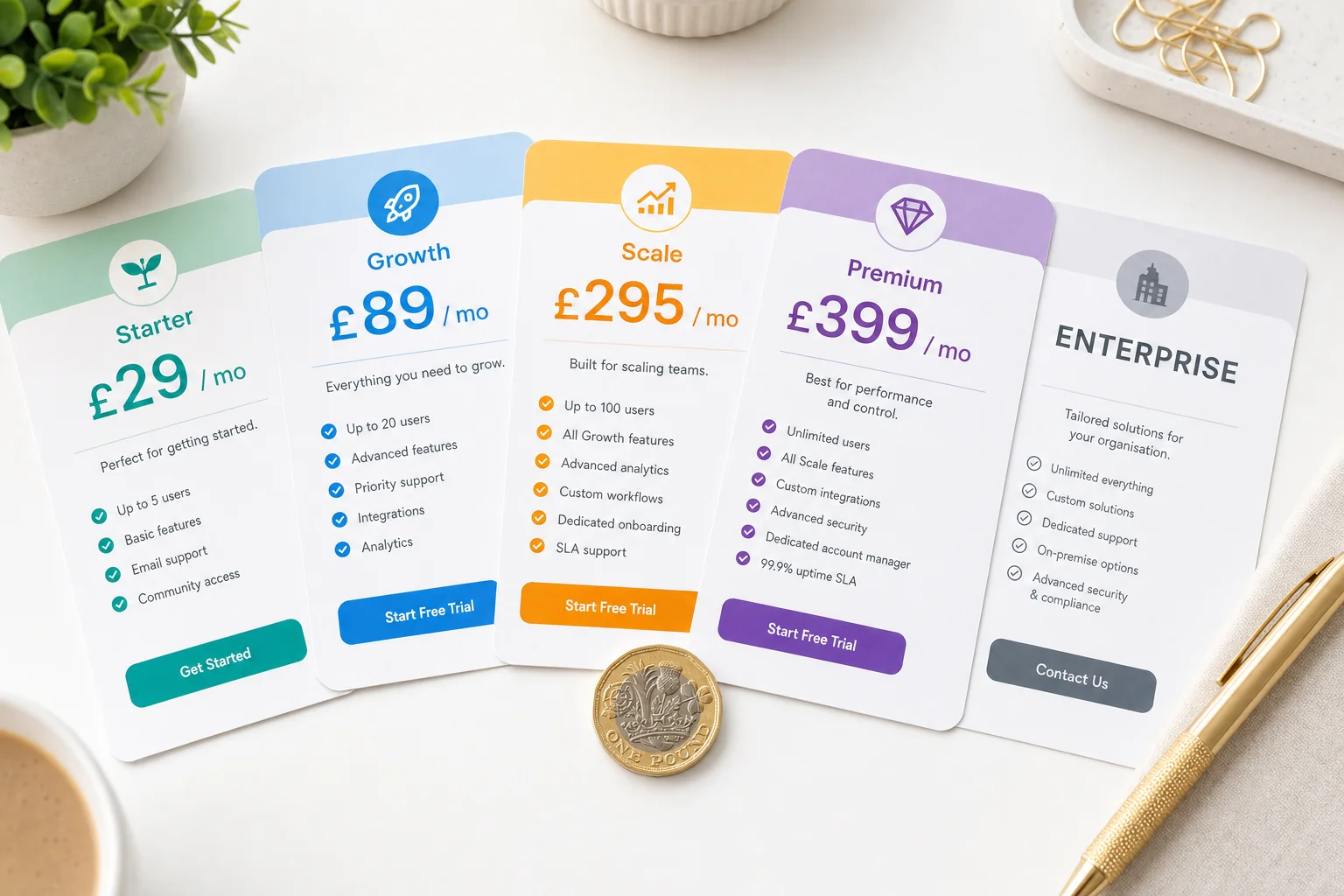
A quick scan of the market in mid-2026:
| Tool | Advertised entry price | Top tier |
|---|---|---|
| Otterly.ai | From around $29/month | ~$189/month |
| Peec AI | From around €89/month | Custom |
| AthenaHQ | From around $295/month | Custom enterprise |
| Profound | $99/month (ChatGPT only) | $399/month, enterprise into the thousands |
One agency review put the average across twenty AI search-monitoring tools at roughly $337 a month (Rankability). Call it £250 to £300 in real money, every month, for a dashboard whose headline figure SparkToro just showed barely repeats from one run to the next. Over a year that's the cost of a decent website rebuild, spent watching a number wobble.
To be fair to the vendors, several of them are competent products and some include useful brand-monitoring features around the edges. The objection isn't that they're scams. It's that the core metric they're named after, "AI visibility", isn't the thing you think you're buying, and the thing you actually want costs nothing.
Curious? Run the free test in five minutes
If all you want is to satisfy the itch, to know whether AI has any idea who you are, you don't need a subscription. You need five minutes and an incognito window.
Open ChatGPT, Gemini, or Claude, and ask a handful of the questions a real customer would ask. "Who are the best [your trade] in [your town]?" "Which [your product] companies are worth considering?" "Tell me about [your business name]." Read what comes back. If you're named, named accurately, and described in terms you'd actually use, your inputs are probably in decent shape. If you're absent, or mangled, or confused with someone else, you've learned something useful for free.
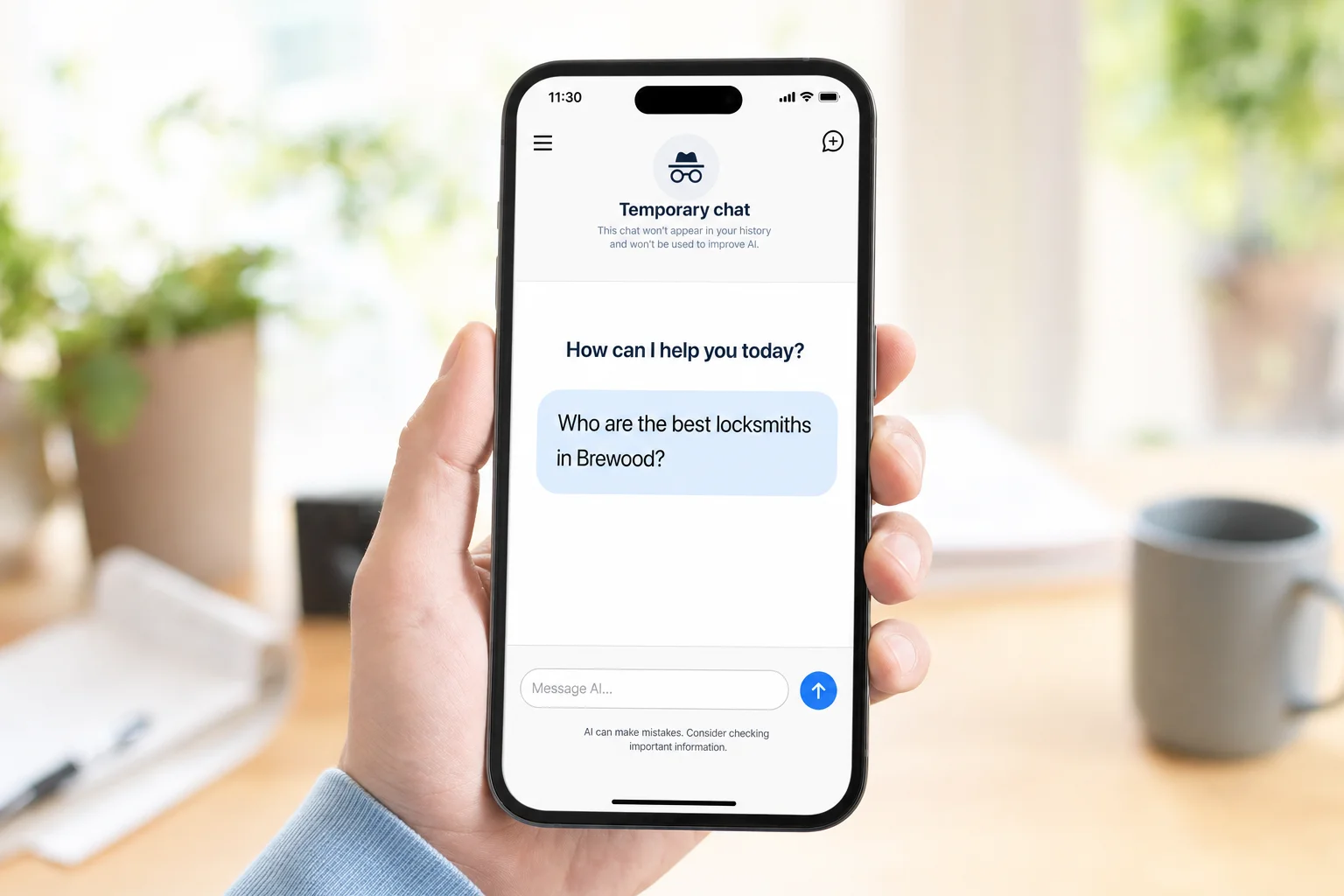
One rule makes or breaks this test: do it in a clean session. Use a temporary chat, or log out entirely, and make sure memory is turned off. This matters more than it sounds. AI assistants personalise answers from your saved memories and past conversations. OpenAI's own help pages confirm that Temporary Chats don't use or create memories, and that you can switch memory off in settings (OpenAI Memory FAQ). If you test while logged in with memory on, the model can quietly hand back the very things you've told it about your own business, and you'll walk away thinking AI knows you brilliantly when really it was just reading your notes back to you. A clean session shows you what the model knows from the open web, which is the only result that means anything.
Run that test once a quarter if you like. It's free, it takes minutes, and it tells you roughly the same thing a £300-a-month tracker would, with the bonus that you understand exactly what you're looking at.
The thing worth checking is also free
The curiosity test tells you where you stand today. It doesn't tell you why, or what to fix. For that you check the inputs, which is what AI Visibility Checking means, and that's also free, and it's deterministic, which the mention count never is.
Our AI Visibility Checker fetches the machine-readable signals your site publishes and validates them. Are your AI Discovery Files present and valid? Is your business identity consistent across every file and page, or does it contradict itself? Are AI crawlers allowed in, or quietly blocked by a stray robots.txt rule? It returns the same answer every time unless your site changes, and every finding maps to something you can actually fix. If you're missing files, the same page has downloadable templates for all ten, which you edit to match your business. On WordPress, our free AI Discovery Files plugin generates and serves all ten for you, no hand-editing required. No account, no monthly fee.
That's the real split, and it's the one the whole tracker category blurs. Jason Barnard, who analyses brand presence across tens of millions of entity profiles, put the principle better than I could.
"You can't fix inconsistency by measuring it more precisely. You can only fix it by building confidence at every stage."
Jason Barnard, CEO and founder of Kalicube, in Search Engine Land, June 2026 (verify quote at source)
That line stopped me when I read it, because it names the exact trap the tracker tools fall into. Their entire proposition is "measure it more precisely": more engines, more prompts, more granular share-of-voice charts. Barnard's point is that precision on a moving target is wasted effort. The confidence he's talking about, the corroboration that makes an AI willing to assert your brand rather than hedge about it, comes from clean, consistent, machine-readable signals that all agree with each other. That's an inputs job. You don't get there by buying a sharper thermometer. You get there by fixing the wiring, which is the half nobody sells you because it can't be billed monthly.
A clarification: these files are not an SEO tactic
One misunderstanding needs clearing up, because it leads people to the wrong expectations and then the wrong disappointment. Deploying AI Discovery Files is not an SEO task. It will not lift your Google ranking, and you shouldn't expect it to. The job they do instead matters more every month, because a growing share of your visitors are AI agents that need to understand what you offer, what you don't, and how to cite you.
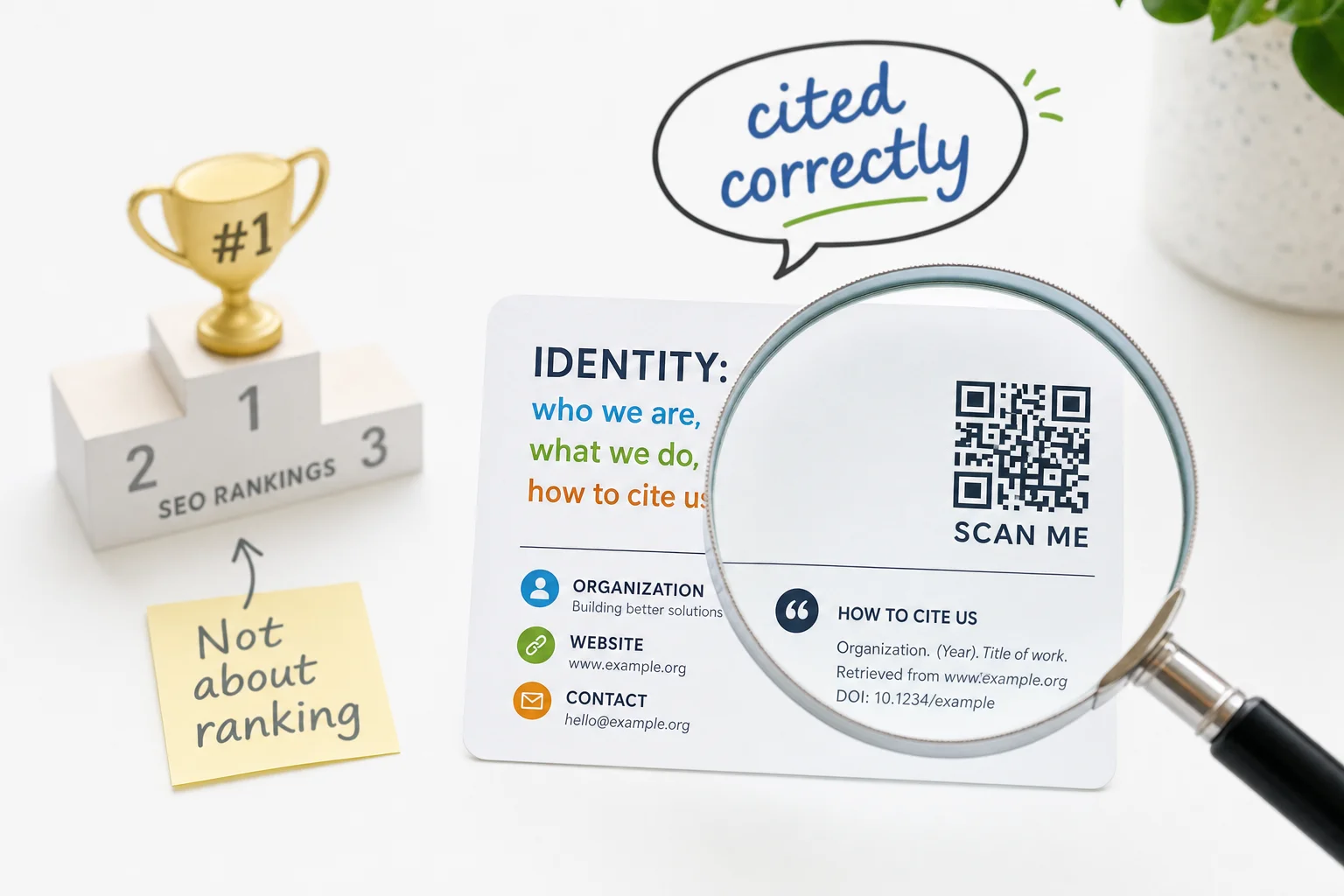
These files do a different job. They tell AI systems who you are, what you do, what you don't do, and how you'd like to be cited, when, and when not. They're a clarity and identity mechanism, aimed at machines that need explicit, unambiguous signals so they don't guess and get you wrong. Google has been clear that a file like llms.txt is not a ranking factor, and on that narrow point Google is right. The mistake is reading "not a ranking factor" as "useless", which is a much bigger claim. We pulled those two apart in detail in what Google actually said about llms.txt.
So the honest framing is this. SEO is about being found and ranked by search engines. AI visibility is about being understood and cited correctly by AI systems. They overlap, they help each other, and you need both, but they aren't the same discipline and they don't share a scoreboard. We laid out where they meet and part in AI visibility vs SEO. Deploy the files because you want AI to describe your business accurately, not because you expect a rankings bump. The accuracy is the point.
On WordPress? Skip the hand-editing.
The free AI Discovery Files plugin generates and serves all ten AI Discovery Files from your existing site content, then keeps them in sync. No templates to edit, no monthly fee, and you stay in control of what it publishes.
Get the free WordPress pluginProof: when the inputs are right, the free prompt agrees
This isn't a theory I argue from a whiteboard. We watch it happen on the sites we build, and the cleanest demonstration I've got is also the cheapest.
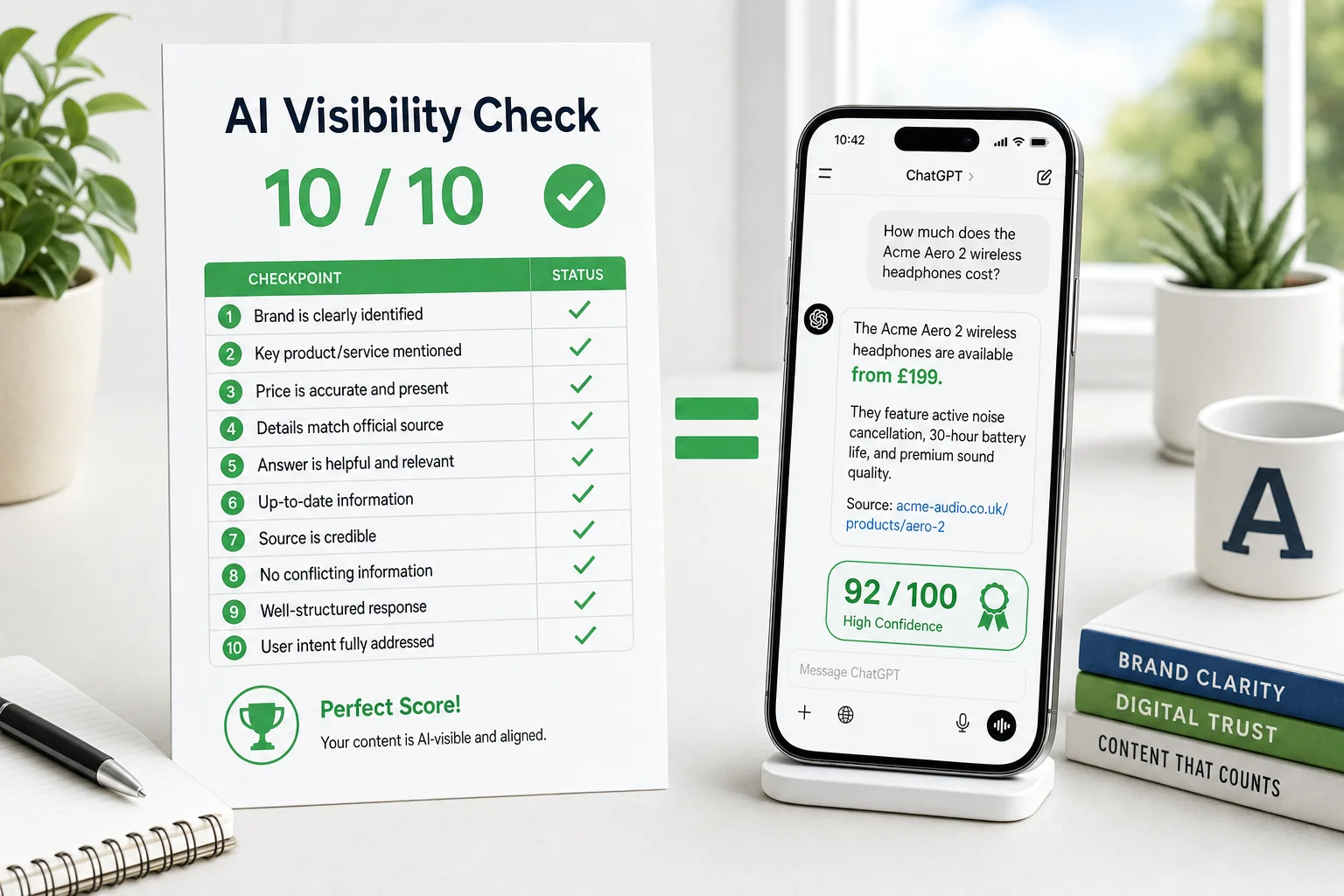
Take Brewood Removals, a West Midlands removals firm we rebuilt earlier this year. We did the inputs properly: ten hand-written area pages, one consistent identity across every page and file, a full set of AI Discovery Files, all rendered from a single data layer so the visible content and the machine-readable signals can't drift apart. The deterministic check rated it at the top conformance class, a clean 10/10 in our directory. That's the inputs, verified, for free.
Then we did the curiosity test, the same one you can do. We opened a fresh ChatGPT session and asked about the business as a customer would. It independently rated the site 92 out of 100 and quoted the firm's real prices back, the exact figures from the page. No tracker subscription told us that. One free prompt in a clean window did, and it agreed with the deterministic check we'd already run. The full Brewood case study lays out both sides.
The pattern repeats. Lockerfella, a locksmith on a three-week-old domain with zero backlinks, reached the top of ChatGPT and Gemini for its main local term because the inputs were done right, not because anything was tracked. In both cases the order of operations was the same: fix the inputs first, then, if you're curious, fire a free prompt to confirm. At no point did a paid mention-tracker do any work that a deterministic check and a temporary chat didn't do better, for nothing.
If you want to see for yourself that the files get read at all, we logged eleven days of server traffic and watched Meta and Bing crawlers fetch AI Discovery Files daily. The inputs aren't a leap of faith. They're observable, and so is the result.
When monitoring is actually worth paying for
I said for most businesses, and I meant it as a real qualifier, not a rhetorical one. There's a narrow case where paying to monitor AI mentions can make sense.
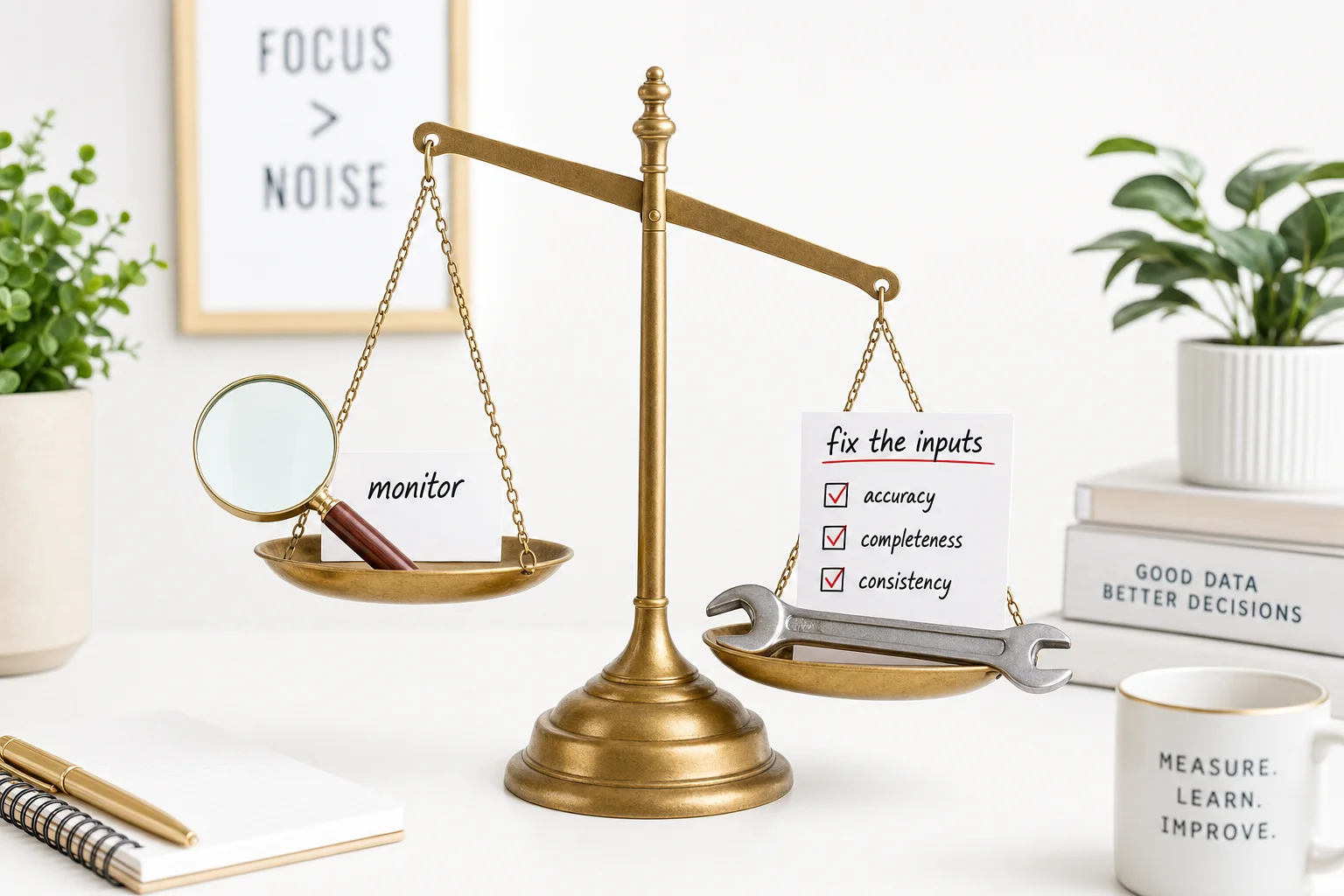
If you're a large brand with real reputation risk, a PR team, and the resources to act on what you find, watching how AI describes you over time is a reasonable thing to do, as long as you treat it as a lagging signal and not a steering wheel. Spotting that an assistant has started repeating a damaging falsehood about your products is worth knowing quickly. At that scale, with that budget, the noise is tolerable and the occasional real signal pays for the subscription.
For everyone else, a sole trader, a local firm, a small or medium business, the order is the other way round. Spend nothing on tracking until the inputs are right, because a mention that points AI at a site it can't read does nothing for you. Fix the half you control. Confirm it with a free prompt. Then, and only if it really earns its place, consider monitoring. Most businesses never reach a point where the maths favours the subscription, and that's fine.
AI visibility, the real thing, is whether the machines can see you clearly and describe you accurately. That's an inputs problem, it's verifiable, and finding out where you stand costs nothing. So when someone asks me whether they should buy a tracker, this is what I tell them: check the inputs, fix what's broken, and keep the £300 a month in your pocket. I'd rather you spent it on the build than on a dashboard that just watches it. You can also try the free AI Crawler Checker from 365i to see whether any AI crawlers are being blocked before they ever reach your files.
Frequently asked questions
Are AI visibility trackers worth it?
For most businesses, no. The tools that count how often AI mentions your brand cost roughly £25 to £400 a month, and they measure an output that changes from one run to the next. If you are only curious whether AI knows you, a few prompts in a logged-out or temporary chat answer that for free. The thing worth paying attention to, whether your site is technically legible to AI, you can check for free with the AI Visibility Checker.
Why is tracking AI brand mentions a vanity metric?
Because the number is not reproducible and it does not tell you what to change. SparkToro ran nearly 3,000 prompts and found that fewer than 1 in 100 produced the same brand list, and fewer than 1 in 1,000 produced it in the same order. A score built on that moves on its own. It feels like progress without being progress, which is the definition of a vanity metric.
How can I check if AI knows my brand for free?
Open ChatGPT, Gemini, or Claude in a logged-out window or a temporary chat with memory turned off, then ask a few real questions a customer would ask, such as "who are the best [your trade] in [your town]?". The temporary or logged-out session matters: in a normal account the model can parrot back what you have told it before, which makes the result look better than it is.
Why use temporary or incognito mode to test AI?
AI assistants personalise answers from memory and past chats. OpenAI says Temporary Chats do not use or create memories, and you can also turn memory off in settings. Testing in a clean session strips out that personalisation, so the answer reflects what the model actually knows about your brand from the open web, not what you fed it.
Do AI Discovery Files improve my Google ranking?
No, and that is not what they are for. AI Discovery Files declare who you are, what you do, and how AI may cite you. They are an identity and citation mechanism, not a ranking signal. Google has said a file like llms.txt is not a ranking factor, which is correct and beside the point. What Google actually said about llms.txt covers the distinction.
What is the difference between AI visibility checking and tracking?
Checking validates inputs: it confirms your site can be discovered, interpreted, trusted, and cited by AI, and it returns the same answer every time unless your site changes. Tracking observes outputs: it counts mentions after the fact. What AI visibility actually is sets the two side by side. One is fixable; the other just fluctuates.
Is brand monitoring in AI ever worth paying for?
Sometimes. A large brand with a PR budget, a reputation to defend, and the staff to act on trends might reasonably pay to watch how AI describes it over time, treating it as a lagging signal. For a small or medium business, the money is better spent fixing the inputs first, because a mention that points AI at a site it cannot read does nothing for you.
Where do I get AI Discovery File templates?
The AI Visibility Checker page has downloadable templates for all ten AI Discovery Files. Run the check, see which files you are missing, then download the templates and edit them to match your business. They are free.
Sources
- New Research: AIs Are Highly Inconsistent When Recommending Brands or Products - SparkToro (Rand Fishkin)
- Rand Fishkin proved AI recommendations are inconsistent - Search Engine Land (Jason Barnard)
- How Much Should You Pay for AI Search Visibility Tracking Tools? - Rankability
- Pricing - Profound
- Otterly.ai
- Memory FAQ - OpenAI Help Center
- Temporary Chat FAQ - OpenAI Help Center